Wednesday, January 28, 2009

Hawaii Island Snorkeling Tips, Part V: Best Snorkeling Baches of the Big Island

By Donnie MacGowan

Coming to my island for a vacation? There are three things I always recommend the first-time visitor do. First, go on an air tour. Secondly--go to a luau. Finally, I advise people of every age to get in the water and go snorkeling. The "one-one-one, experiencing the world through the fishes' eyes" magic of swimming in those bath-warm lagoons surrounded by clouds of tropical fish is an amazing, restful and restorative pursuit-you will find your mind going back to that experience over and over through the years much more so than many of your other travel experiences. Part I of this series discuses Snorkeling Gear; Part II of this series will discuss Snorkeling Technique and Part III will cover Snorkeling Etiquette; Part IV of the series covers Snorkeling Safety and Part V will cover Big Island Snorkel Spots.

Let’s Chat About Snorkeling, Part V: Hawaii’s Best Snorkeling Beaches

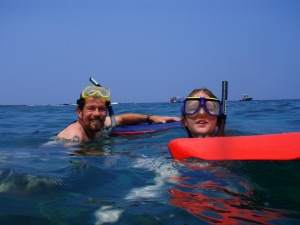
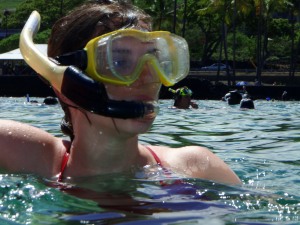
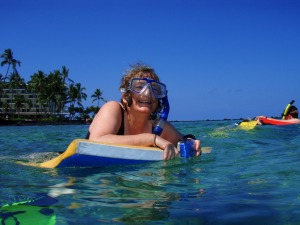
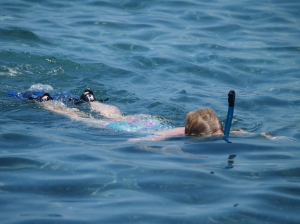
Liz Maus Snorkeling at Honaunau: Photo by Donnie MacGowanPhoto by Donnie MacGowan

Hawaii’s varied landscape and dynamic shoreline provides for an amazing array of snorkeling experiences, from broad, sandy beaches with placid and inviting turquoise water to broken glass-sharp cliffs where the swimmer leaps into surgey dark water. Everywhere I’ve snorkeled on Hawaii, from lazily paddling in calm waters at Kahalu'u to rappelling into the wild surf and open ocean currents at Pau'ekolu, the snorkeling is wonderful, beautiful, exhilarating. But many of the best places to snorkel are difficult or scary for the beginning snorkeler, some could be lethal. Here's a list of the crown jewel snorkeling spots that are easy for the beginner, tantalizingly fascinating for the experienced.

Westside Beaches:

Hapuna Beach (turn off Highway 19 at mile marker 69): Always rated in the Top 10 of American beaches, Hapuna Beach is long, wide and phenomenally sandy. The center of the beach is for wave play and boogey boarding, the north and south coves are quieter, for snorkeling or gentle floating. Although most of the shore is relatively free of currents, only experienced snorkelers who are strong swimmers will want to snorkel around the south end of Hapuna, past a sea arch and to the reef and cove of Beach 69—a long, but rewarding swim with some of the most incredible underwater vistas available to the snorkeler in the word.

Anaeho'omalu Beach (turn off Highway 19 at mile marker 76): The most photographed sunset view on the Island of Hawai’i, Anaeho’omalu Bay is the icon of what most visitors envision Hawai’i to be like before they get here. Although the water tends toward being cloudy, this is an excellent beach for beginning snorkelers.

Kekahakai State Park, Kua Bay (turn off Highway 19, between mile markers 88 and 89): Kua Bay has a lovely white sand beach and full facilities although there is no shade to speak of. Swimming and boogey boarding in the crystalline waters is primo, though strong currents and large waves call for respect, here; if the surf is up, don’t go in. Also, sometime in winter the surf removes the sand to offshore, leaving a rocky shelf that is less fun to frolic on than the sandy beach.

Bart Hunt Snorkeling at Kahalu'u Bay: Photo by Donnie MacGowanPhoto by Donnie MacGowan
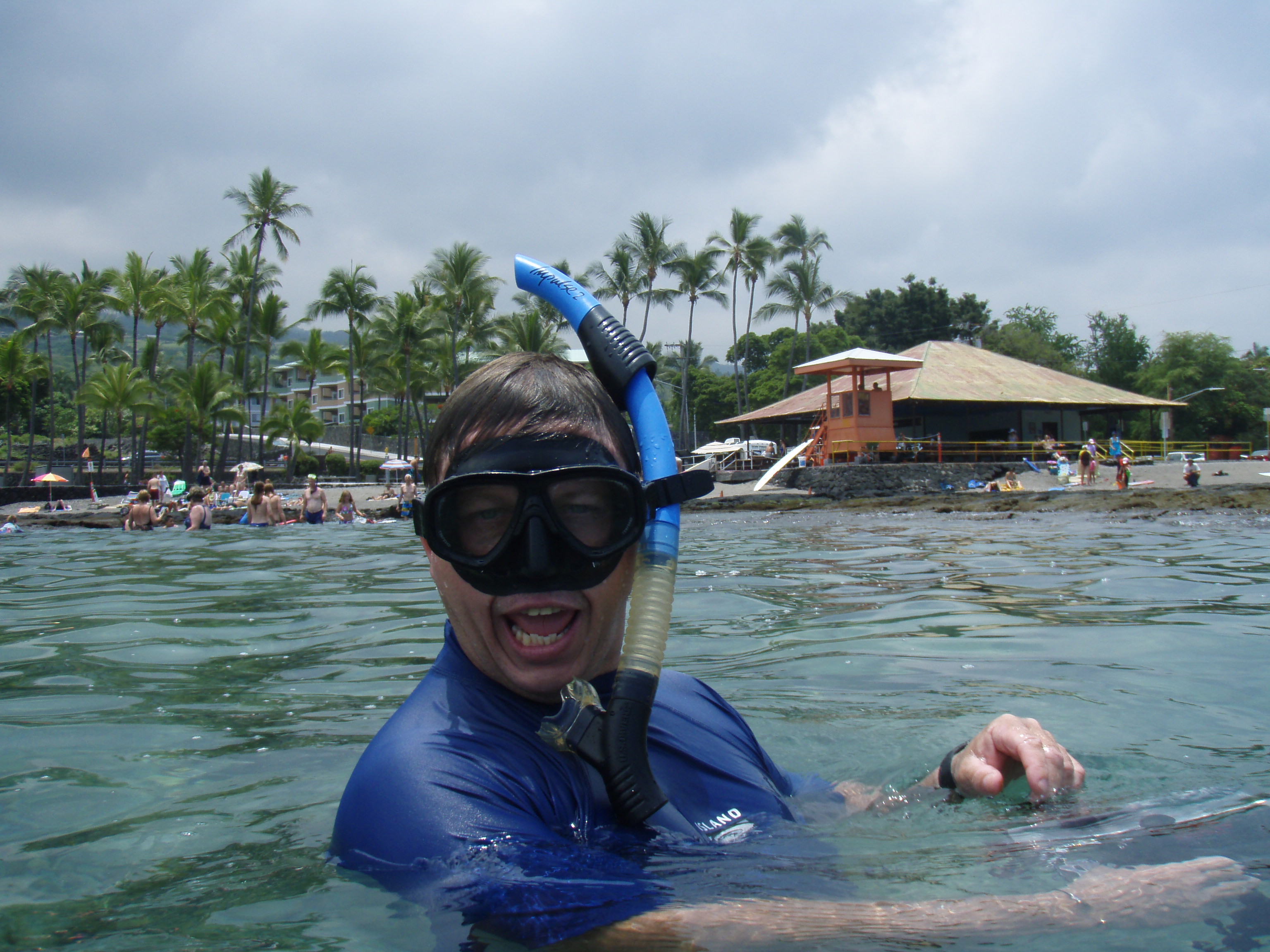
Kahalu'u Beach (in Kailua Kona, along Ali'i Drive, between mile markers 4.5 and 5): This is the premiere snorkeling beach of the Island of Hawai'i; protected from the open sea by a jetty, the reef is also protected against commercial aquarium fishing. Thus, the snorkeling is in calm, shallow water. Also, there is an abundance of fish of an enormous variety...perhaps the best display on the island. Numerous freshwater springs and shallow water bathers make the near-shore snorkeling unpleasantly cloudy, but about 50 feet offshore the water turns crystal clear and the display of coral is nothing short of amazing. There is a fair current north out of the bay and along the coast. Incredible archeological sites abound in this area and make a fine after-snorkel exploration on foot; ask for details at the concierge desk at the adjacent Keauhou Beach Resort.

Two-Step Beach (adjacent to Pu'u Honua O Hounaunau National Historic Park on Highway 160): Some of the finest, protected snorkeling on the Island is located at Two-Step Beach. A wonderland of turtles, coral and fish, with frequent morning visits by dolphins, this snorkeling experience shouldn’t be missed. No swimming is allowed within the Park out of respect for its sacredness; however, Two-Step Beach offers a convenient place to enter Honaunau bay. One can enter the bay either by the boat ramp, or by stepping off the short cliff into the water from near the center edge of the lava beach, where two ledges serve as steps down into the ocean. Getting in is a simple matter of stepping down these steps, "1-2-OCEAN!”--to get out, reverse the process.

Ho'okena Beach (turn off Highway 11 near mile marker 102): Brilliant snorkeling, decent boogie boarding, passable shell collecting and wonderful camping—it’s a wonder the large and warm stretch of sand at Ho’okena Beach is not more popular with visitors. Frequented by dolphin, stuffed full of pelagic and reef fish and turtles and boasting crystal clear, warm and calm waters, Ho’okena is a must-visit beach for avid snorkelers.

Southside Beaches:

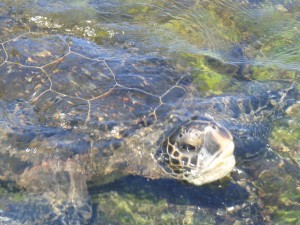
Punalu'u Beach (turn off Highway 11 between mile markers 55 and 56): A truly remarkable place of great peace, beauty and spiritual healing, Punalu’u’s black sand-lined coves and beaches are world-renowned. With dozens of endangered Hawai’ian Green Sea Turtles and superabundant abundant fish, this is a truly snorkeling experience--made unique because of the black sand bottom of the bay. Due to chilly waters, off-shore winds, strong currents and a fearsome rip, swimmers and snorkelers should use caution when swimming at Punalu’u, but it’s hard to resist getting in and swimming with all those turtles. There are abundant Hawaiian cultural sites in the park that are worth visiting.

Hawaiian Green Sea Turtle Basks in the Sun at Punalu'u Beach: Photo by Bradford T. MacGowan
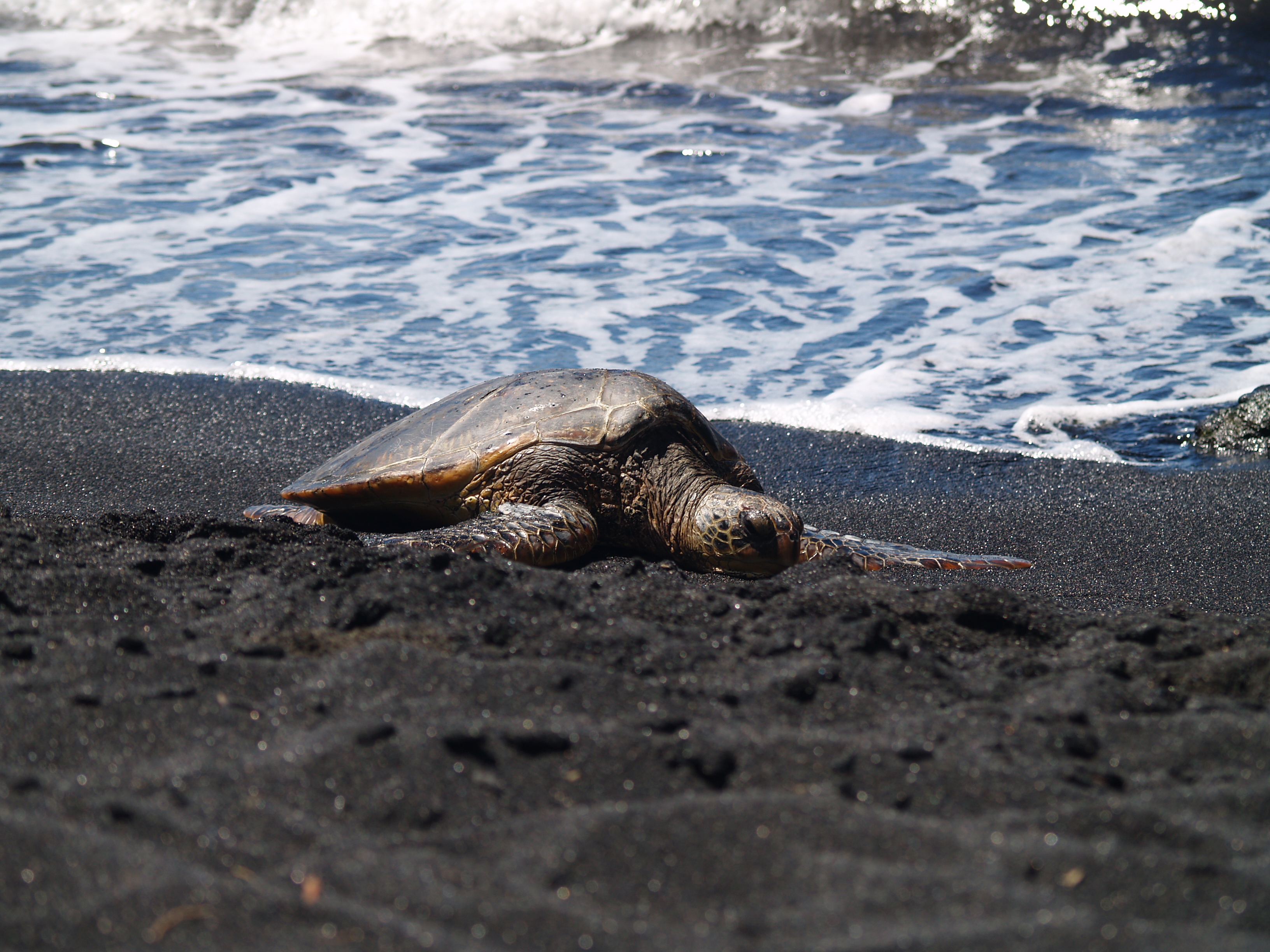
Photo by Bradford T. MacGowan

Kehena Beach (on Highway 137 near mile marker 19): A quick scramble down the bank on a dirt path quickly brings you to the Kehena Black Sand Beach. Once on the beach the first thing that may strike you is that many of the locals who frequent this park have forgotten to put on proper beach attire…or any other attire whatsoever, for that matter. In the shade of palms and ironwood this wonderful beach is generally sunny even when the rest of Puna is rainy. Swimming here is great near-shore, but ocean currents are strong and dangerous not far from shore. The locals are friendly but frisky, so don’t leave valuables in your car.

Pohoiki Bay at Isaac Hale Beach Park (on Highway 137 between mile markers 11 and 12): A lovely black sand beach with an expert surf break, Isaac Hale Beach Park is one of the very few real beaches and boat ramps in Puna District; as such this park sees a lot of traffic. It is also the site of the best surfing and some of the wildest snorkeling and scuba diving in Puna.

A short path along the shoreline leads from the parking lot, past a house with abundant “No Trespassing” signs, just a few minutes stroll then turns about 20 yards into the jungle to a secluded, perfectly lovely natural hot spring that is wonderful for soaking. Locals usually don’t bother with swimwear here; you shouldn’t feel required to, either.

Kapoho Tidepools (turn off Highway 137 and head east on Kapoho-Kai Road, left on Kaheka and right on Waiopae): Stuffed with abundant sea life, this sprawling basin of lava tidal pools is a remarkable treasure for snorkelers of all abilities from the starkly frightened to the seasoned veteran. Moorish idols, yellow tangs, various wrasses and eels, sea urchins and sea cucumbers abound and there are even some nice corals in the deeper pools. The largest pool is called “Wai Opae”, which means “fresh water shrimp”.

Keeping to the left of the main channel keeps one away from most of the ocean currents, which can be surprisingly strong, even in small channels, where ponds empty into the ocean. No real facilities exist here beyond the parking lot, so come prepared.

Eastside Beaches:

Richardson Beach Park (Take Kalaniana'ole Street 3.6 miles east from the intersection of Highways 19 and 11 in Hilo): The almost universal experience of visitors to Hawai’i is that, although it is certainly beautiful and unique, no matter what pre-conceptions a traveler may bring about Hawai'i, their experience is a bit different to what they expected. Richardson Beach Park, with its towering palms, fresh water pools, delightful surf, secluded and calm tidepools and general ambience of tropical paradise, is almost certainly very close to what most visitors expect from Hawai’i—hence it popularity. The snorkeling here along the small black sand beach is the best of the Hilo area.

Frequented by dolphins and sea turtles, the near-shore water is a little cold when getting in, due to fresh water springs, but soon warms-up a few dozen yards from shore. The currents and surf can occasionally be tricky here, so heads-up.

For more information about visiting and touring Hawaii in general, and exploring the fabulous snorkeling on the Big Island in particular, visit http://www.tourguidehawaii.com . For information about the author, go here.


Tuesday, January 27, 2009

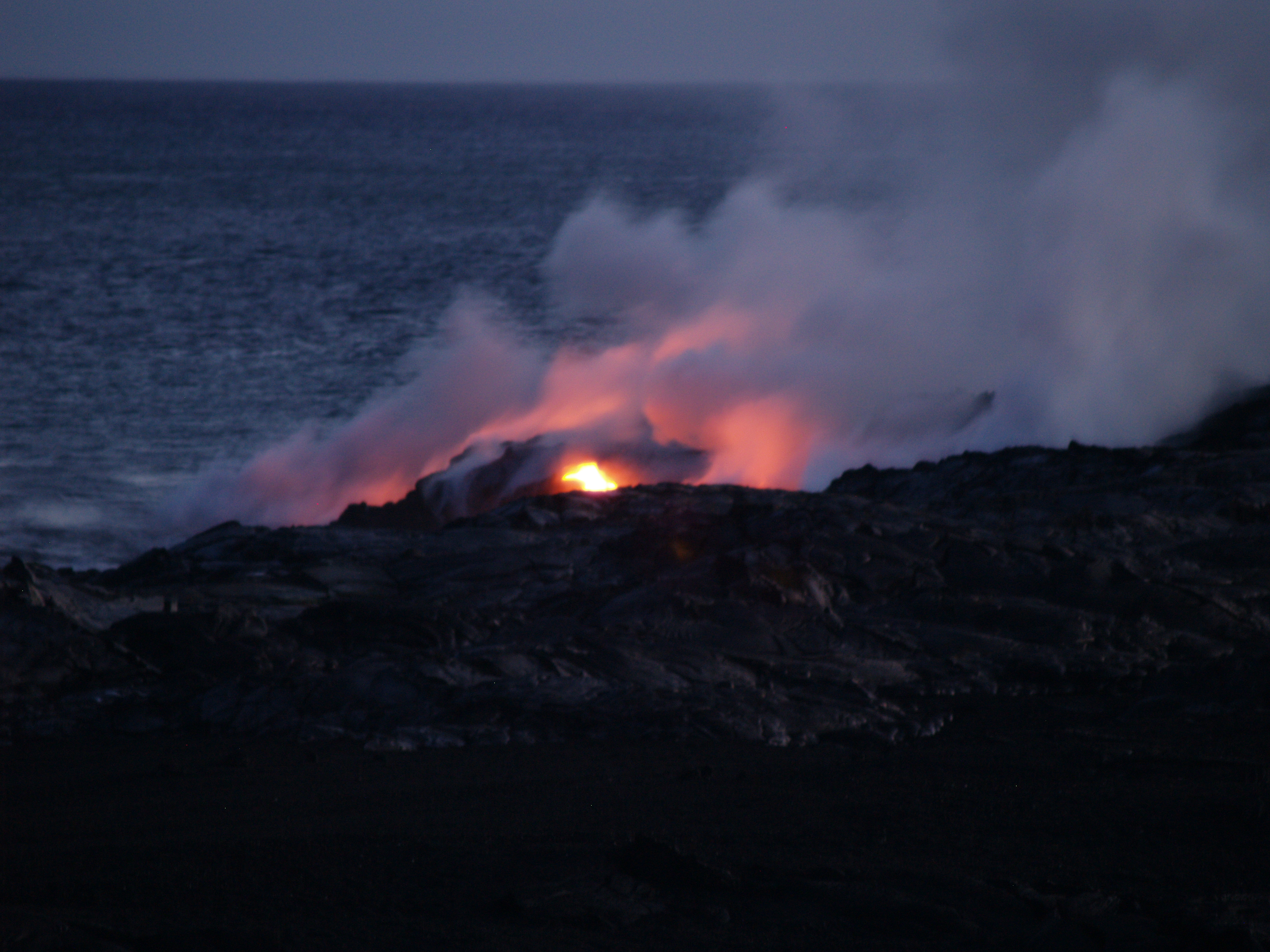
Eruption Update: Hawaii County Lava Viewing Area Hours change for Waikupanaha Area viewing of Kilauea Eruption

Glowing Lava from Kilauea Volcano Enters the Sea at Waikupanaha on the Big Island of Hawaii: Photograph by Donald B. MacGowanGlowing Lava from Kilauea Volcano Enters the Sea at Waikupanaha on the Big Island of Hawaii: Photograph by Donald B. MacGowan

Hours for the Hawaii County lava viewing area at Kalapana--to see the lava ocean entry at Waikupanaha--have been changed. Effective 1 February 2009, the area will be open from 5 p.m. to 10 p.m. (last car in at 8 p.m.).

Since dusk is the best, and most popular--time to see and photograph the lava ocean entry and littoral explosions, this will cause more of a traffic jam than there has been in the past. This will also mean that visitors who come without flashlights are effectively shut-out of seeing the volcano. Please exercise caution while visiting the volcano and extreme patience with our bone-headed Hawaii County bureaucrats who have never met a situation they couldn't make worse with a thoughtless decision or self-serving policy.

For more information, go here.

Monday, January 26, 2009

Hawaii Island Snorkeling Tips, Part IV: Snorkeling Safety

By Donnie MacGowan

Coming to my island for a vacation? There are three things I always recommend the first-time visitor do. First, go on an air tour. Secondly--go to a luau. Finally, I advise people of every age to get in the water and go snorkeling. The "one-one-one, experiencing the world through the fishes' eyes" magic of swimming in those bath-warm lagoons surrounded by clouds of tropical fish is an amazing, restful and restorative pursuit-you will find your mind going back to that experience over and over through the years much more so than many of your other travel experiences. Part I of this series discuses Snorkeling Gear; Part II of this series will discuss Snorkeling Technique and Part III will cover Snorkeling Etiquette; Part IV of the series covers Snorkeling Safety and Part V will cover Big Island Snorkel Spots.

Bradford MacGowan Snorkeling at Pu'u Honua O Hounaunau: Photo by Donald MacGowan

Finally, let's talk a minute about snorkeling safety.

First and foremost, as with all ocean sports, never turn your back on the ocean. Just as important, never snorkel alone; never get more than 20 feet from your partner. Memorize the color of your partner's mask and snorkel…this is how you will recognize him from a distance in the water. Listen to advice from the lifeguards, obey posted warnings, always pay attention to the currents, surf conditions and surges over rocks. Plan your entry and exit before you get wet; try to enter and exit from sandy areas. You and your partner should agree on a plan about where you are getting in and getting out of the water, what part of the bay you are going to explore and how long you plan to be out. Don't overestimate your abilities, plan conservatively, err on the side of safety. Don't change this plan, once you are in the water, except to make it shorter and more safe.

Don't confront incoming waves head-on, don't try to jump over them and don't turn your back on them; duck under incoming waves before they reach you.

Never snorkel on windy days. Offshore winds may take you unexpectedly our to sea or make it hard to swim back in and onshore breezes stack extra water, high on the beach making nasty rip-currents as it flows back into the ocean. Onshore breezes also bring in jelly fish and man-o-war.

If you are caught in a current, don't panic; don't swim against the current but rather swim diagonally across it toward shore. Keep going, you'll make it.

Poke your head out of the water frequently to check that your partner is within 20 feet of you and to keep yourself oriented relative to your entry and exit places. Stay alert--it's easy to loose track of time, get carried farther than you thought by a current you didn't even notice, wander out of your comfort zone, lazily paddle away from your partner, accidentally stray into a dangerous zone. It's easy to get overtired; get your partner and swim in BEFORE you feel fatigued, thirsty, sunburned; BEFORE the wind comes up or the surf builds. So stay focused, stay oriented, always know where you are, where your partner is.

Lee Ann MacGruder Snorkels the shallows at Ho'okena Beach: Photo by Donnie MacGowan

Lee Ann MacGruder Snorkels the shallows at Ho'okena Beach: Photo by Donnie MacGowan

Sunscreen washing off your body pollutes the water and is a major factor in coral death--wear a t-shirt and baseball cap to avoid sunburn while in the water, waiting until you are out of the ocean and rinsed off to apply sunscreen.

Many things in the ocean sting, most commonly sea urchins--avoid them, do not handle or step on them. White vinegar kills sea urchin stings from embedded spines and, regularly applied, helps to dissolve the spine. Other home remedies for sea urchin, jelly fish and other stings include the application of moistened tobacco, hydrogen peroxide or urine (this latter can be hard to self-administer and will quickly let you know who your real friends are). Like wasp stings, most stings from ocean creatures are not medically dangerous, merely a painful nuisance, but it's best to be prepared with whatever remedy you choose in your beach kit. Some jellyfish stings and all man-o-war stings are potentially life-threatening and need to be treated at the emergency department of the nearest hospital.

This shouldn't even need mentioning, but of course, if you've been drinking--even a little, you should not go snorkeling. Snorkeling is best done between about 9 a.m. and noon, anyway, so sobriety shouldn't even be an issue. Oh, right; you're on vacation--I forgot.

Don't forget to drink lots of water…immersion in salt water is very dehydrating and just swimming around you've worked harder--and sweated more--than you realize. Be kind to your skin and rinse yourself and your gear with fresh water immediately after you get out of the ocean and remember to apply sunscreen and wear your sunglasses. Don't overestimate your skin's tolerance for beach sun; a nasty sunburn is distressingly easy to acquire and will absolutely ruin your vacation. Now might be a good time to go inside and cool off, rest a bit--you are on vacation, you know?

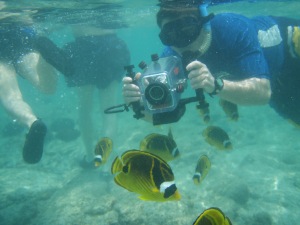
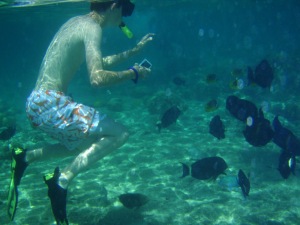
Bradford MacGowan Photographs a school of Humuhumuele'ele at Kahalu'u Beach: Photo by Donald MacGowan

That's a few of the technique, etiquette and safety tips you should bear in mind...remember to heed whatever advice the lifeguards give you--they are seasoned professionals who intimately know their beach; obey posted rules and be wary of riptides and currents. Most of all, spring for a cheap-o $10 disposable underwater camera, get in the water and enjoy...those fish won't photograph themselves, you know!

For more information about visiting and touring Hawaii in general, and exploring the fabulous snorkeling on the Big Island in particular, visit http://www.tourguidehawaii.com and www.lovingthebigisland.wordpress.com - a short video about snorkeling in Hawaii is available here. To see a funny video of my family learning to snorkel in Hawaii, go here. For information about the author, go here.
Friday, January 23, 2009

Hawaii Island Snorkeling Tips, Part III: Reef Etiquette

Coming to my island for a vacation? There are three things I always recommend the first-time visitor do. First, get in the air. Secondly--go to a luau. Finally, I advise people of every age to get in the water and go snorkeling. You will find your mind going back to that experience over and over through the years much more so than many of your other travel experiences. Part I of this series discuses Snorkeling Gear; Part II of this series will discuss Snorkeling Technique and Part III will cover Snorkeling Safety; Part V of the series will cover snorkel spots on the Big Island.

Photo by Donald MacGowan


Now, let's talk a moment about snorkeling etiquette and protecting the reef and the animals who live there.

Please do not feed the fish, it disrupts their natural feeding habits and you may be injured. Reef fish are territorial and do occasionally "nip" but you should not chase, harass or touch them (this includes octopi). The oils on your fingers will injure their skin and they may carry diseases which they can pass to you on your hands. For photographing reef fish, whether snorkeling or scuba diving, simply find a feeding spot (usually a boulder or dead coral head teeming with algae, and wait calmly and silently nearby. They will slowly begin to check you out and if you can remain still long enough, eventually surround you leading to excellent photos and a very memorable experience.

Snorkeling etiquette calls for protecting not only the reef animals, but also the fragile corals growing on the reef. Corals, actually colonies of very small animals, take hundreds of years to form the structures visible today; they feed, shelter and provide habitats for other reef animals. Coral reefs also protect the lagoons and shoreline from waves and sand erosion. Corals are at the very root of Hawai'ian history and culture; the Hawaiian creation chant places the origin of life in the sea, beginning with a coral polyp.

Simply touching corals to see what they feel like can cause the death of an entire colony. Oils from your skin can disturb the delicate mucous membranes which protect the animals from disease. Please don't walk upon or stand on coral, as this can kill the living coral polyps which, as the builders of the entire reef structure, are the very foundation of the reef ecosystem. Sunscreen washing off your body can kill coral; wear a t-shirt and a swim cap for UV protection and put your sunscreen on AFTER you come out of the water.

Called Honu by Hawaii's natives, the Hawaiian Green Sea turtle is beautiful, serene and seeming wise. Though they have swum the oceans for over 200 million years, peacefully feeding on algae and invertebrates, this highly successful product of amphibian evolution is in grave danger. Loss of habitat, hunting and molestation by humans has conspired to push the Hawaiian Green Sea Turtle to the very verge of extinction.
Photo by Donald MacGowan

Protected now by state and federal law, the population of once millions of individuals has been decimated to just a few hundred thousand; although they are making a comeback, Hawaii's honu are still very much endangered.

Do not approach basking turtles closely, never touch or pick them up. Harassing turtles carries a stiff fine and in any case, touching the turtle is a good way to get a raging salmonella infection. If honu are swimming near where you are, do not approach or chase them; always swim to the side of them, never above (as a predatory shark would) nor below them (so they won't feel that their soft belly is at risk).

Anyone who observes their beauty and grace underwater easily understands why the Hawai'ians base their word for "peace", "honua", on their name for the green sea turtle, "honu".

Although harder for the snorkeler to approach, but certainly no less in danger of molestation are the marine mammals: dolphin, seals and whales. In general, it is illegal, dangerous and generally a bad idea to approach marine mammals within 100 yards; 300 yards for females with calves. Dolphins and seals, in particular, may choose to approach you-just remember, this ain't "Flipper"-these are wild animals and they bite. Hard. If approached, remain calm (absolutely entranced, of course, but calm); do not approach any young animals and do not reach out to them as they may interpret this as aggression on your part and possibly bite. Male seals may exhibit dominant behavior and have been know to *ahem* mount swimmers. Avoid these unpleasantries by observing and enjoying these animals from a distance. About whales…uh, wait a minute…if there is anybody out there crazy enough to swim out into the open ocean and harass a 60,000 pound animal with a mouth twice the size of a king-size bed, nothing I say is going to stop them…just use some common sense, OK? Leave them alone—besides…it’s the law.

And now a word about sharks--two words, actually: "Don't Worry".

There's good news and bad news about sharks in Hawaii--first the bad news: if you are in water deeper than your knees, you are probably within 200 yards of a shark. The good news? You will never know it. The truth is that you are not likely to see or encounter a shark…period. Tens of millions of people swim Hawaii every year without seeing so much as a dorsal fin break the water. Don't worry--you are not what they eat (so you won’t attract them) and generally, they are more afraid of you than you are of them. To dispel visitor's apprehensions about sharks, the Hawaiian Tourism Bureau used to advertise that tourists were more likely to get hit on the head by a falling coconut than bitten by a shark…but they decided THAT was not a real cheery statistic to crow about, either. In reality, there are only about three shark bites a year in Hawaii—which is amazing considering there are hundreds of thousands of people in the water, all day, every day of the year.

Photograph by Donnie MacGowan

Having said that, bear in mind that all sharks demand respect and there are several things you can do to make yourself generally safer in any shark encounter. Number one safety tip is: avoid them. Sharks are stealth hunters and in any conditions where they are obscured in the water, they will hunt. Therefore--do not go into the water until at least an hour after dawn, be out of the water by about 4 pm; do not enter the water if it is murky; avoid stream mouths. Obey beach closures; obey warnings from the Lifeguards. Little sharks don't get to be big sharks unless they pay strict attention to avoiding whoever is bigger than they are--small sharks generally will glide silently away from you without you ever having known they were there. Big sharks are different. They may approach you.

The most common conventional wisdom you hear is: if you are being stalked or approached, swim purposefully, not panicked, away from the shark at an angle. Do not swim at high speed straight from him, it will trigger his predator-prey response and he’ll chase you. Do not splash excessively; this sounds like a dying fish (i.e., dinner) to sharks. Remember that the larger sharks eat sea turtles…to a shark hunting below you, your outline paddling on a surfboard or boogie board, looks remarkably like a sea turtle. When you approach the water, seeing three or four sea turtles sunning themselves on the beach is normal; seeing twenty or thirty indicates that something very large and hungry is hunting the water nearby. The presence of dolphin nearby is no guarantee there are not also sharks nearby.

There are hundreds of bits of advice for surviving shark attacks from hundreds of shark experts and attack survivors from all over the world—I will not pass these on to you for two reasons. First and foremost, I am a not a shark expert; secondly, I have never needed any of them because I have followed these sensible rules for years and have never, not once, seen a shark while snorkeling. I’m out there 4 or five days a week, year round. You won’t see one either. Relax and enjoy your snorkeling…as I said…don’t worry.

Finally--many people ask "What's the etiquette for, um--er--answering nature's call?" Easy--for wet stuff, just swim a bit away from people and let go, maybe maintaining forward momentum so as not to create a "cloud". No, this isn't why the ocean is salty. For solid stuff, get your partner and both of you swim in and get out, visit the rest room. No exceptions for that.

Part I of this series discuses Snorkeling Gear; Part II of this series will discuss Snorkeling Technique and Part III will cover Snorkeling Etiquette; Part IV of the series covers Snorkeling Safety and Part V will cover Big Island Snorkel Spots.

For more information on traveling to Hawaii in general, and beach activities on the Big Island in particular, visit http://.tourguidehawaii.com and http://www.lovingthebigisland.wordpress.com. For information about the author, go here.
Wednesday, January 21, 2009

Hawaii Island Snorkeling Tips, Part II: Technique

By Donald B. MacGowan

Photo by Donnie MacGowan

Coming to my island for a vacation? There are three things I always recommend the first-time visitor do. First, get in the air. Secondly--go to a luau. Finally, I advise people of every age to get in the water and go snorkeling. The "one-one-one, experiencing the world through the fishes' eyes" magic of swimming in those bath-warm lagoons surrounded by clouds of tropical fish is an amazing, restful and restorative pursuit-you will find your mind going back to that experience over and over through the years much more so than many of your other travel experiences.

Part I of this series discuses Snorkeling Gear; Part II of this series will discuss Snorkeling Technique and Part III will cover Snorkeling Etiquette; Part IV of the series covers Snorkeling Safety and Part V will cover Big Island Snorkel Spots.

Part II: Let's talk about technique: how are we going to do this?

Before getting into the water, where is your partner? Never snorkel alone; never get more than 20 feet from your partner. Memorize the color of your partner's mask and snorkel…this is how you will recognize him from a distance in the water.

Photo By Donnie MacGowan

Also before getting wet, you should make sure your mask is clean and that you have applied some form of defogger to it, either the commercially available solution (DO NOT get this stuff in your eyes!) or by simply rubbing some spit over the insides of the lenses. Pull the mask on your head, leaving it perched up on your hair as you enter the water. You should enter the water on a sandy patch of beach that does not drop off too steeply and is not in an area attacked by large waves.

Do not put your fins on before you are in the water. After wading out until the water is between knee and waist deep, face the incoming waves, sit down (this will also help you adjust to the temperature of the water--sometimes a bit of a shock but soon you get used to it) and pull your fins on. From this position, duck your head under and get your hair and face wet (to help the mask seal). Now stand up and pull the mask down, arranging hair, strap and snorkel mouthpiece to maximize the seal integrity and personal comfort. This may take some adjusting to get all the hair out from under the seal, to get the snorkel mouthpiece in the right position and get comfortable. Don't worry if there is a little fog on the mask at this point.

When the mask is sealed and you feel ready, bend at the knees, stretch arms forward and lean forward slowly until you are floating. Kick rhythmically, steadily, but at a pace you can keep up for some time. See? IT'S FUN! Oh, wait--don't forget to breath! Seriously, some people may feel a little claustrophobia at first with the mask and snorkel, and in chilly water it's natural to have short, gaspy breathing by instinct. Relax, concentrate on taking slow, even breaths. Snorkeling is relaxing, to be sure, but you have to be relaxed to snorkel. Breathe. Smoothly, rhythmically.

Many people find they breathe and move more efficiently with their hands clasped behind their backs. Use your hands in sweeping motions to turn, or back up or fend-off too-near snorkelers, then clasp them back behind you again for cruising. Again, breathe. Smoothly, rhythmically.

If at any point you feel uncomfortable, simply stop, tread water (or stand up in the shallows), and put your mask up on top of your head. Look around you. See? It's easy! But never, ever remove your mask all the way while in the water--you could drop it or it could be taken by a wave and then you'd be having significantly less fun, really quickly. If there is fog in your mask, pull your mask away from your face just a fraction of an inch and just for a moment while under water to allow just a little bit of water in. Pull your head out of the water, allow the water in the mask to rinse away the fog, then tilt the mask away from your face just a moment again to drain the water out. Practice this in a place you feel comfortable. When you get good, you can do this without even stopping--this technique also allows you to clear your mask of leakage (and all masks leak a little) while on the go.

What's that gurgling noise? Occasionally, especially if the surf is up or you are diving, water gets trapped in the snorkel. You can purge the snorkel simply by exhaling strongly through it and blowing the water out the top, or more easily by lifting your head above water, spitting out the mouth piece and allowing it to dangle in the air and drain clear. Cake.

Poke your head out of the water frequently to check that your partner is within 20 feet of you and to keep yourself oriented relative to your entry and exit places. Stay alert--it's easy to loose track of time, get carried farther than you thought by a current you didn't even notice, wander out of your comfort zone, lazily paddle away from your partner, accidentally stray into a dangerous zone. So stay focused, stay oriented, always know where you are, where your partner is.
Photo by Donald MacGowan
Gosh, what's that down there on the bottom? Diving is what snorkeling is all about. Do not expect to go deeply; do not expect to stay down long; err on the side of safety, be conservative in your actions. The ocean is composed of stacked layers, frequently of surprisingly different temperatures, sometimes distressingly moving in different directions. It is entirely possible to be swimming in quiet water, dive a half dozen feet under the surface and find yourself caught by a current you didn't even know existed…don't fight it, but turn and kick to the surface immediately so you can evaluate this new wrinkle while catching your breath.

To dive efficiently, start off by floating flat, face down, on the water. Fill your lungs and empty them completely a few times to charge your blood with oxygen. One more big breath in, then let half out (a lung-full of air will make you floaty and keep you from diving very deeply); with your arms forward, pointing at your target, bend at the waist, kick once then lift your feet in the air, allowing the weight of your legs to push you under. Keep kicking as you submerge. Do not over estimate the depth you can dive or the time you can spend down. Learn your limits slowly and safely. Uncomfortable? Turn quickly and kick to the surface, breathe, rest, try it again. Water pressure on the eardrums will make your ears ache in just a few feet of water; to alleviate the pain and adjust the pressure in your head, as you dive pinch your nose, close your mouth and "blow" to pop your ears. If pain, discomfort, dizziness or other distress continues, turn and kick to the top. Stay there for the duration of your swim.

Where are all the fish? The water near shore may be murky from fresh-water springs, lots of people wading or surf action; swim out a little until the water gets crystal clear…that's better. Although you will likely see large swarms of fish swimming about all over the bay, remember they live along the rocks and coral and not over sand, so that's where the most interesting stuff is. Check out cliffs, ledges, pockets and boulders. Look closer. You can get a cheap, disposable underwater camera for less than ten bucks at WalMart--it may be the best $10 you spend on your whole trip. Get two. Don't forget to take pictures of each other, too.

Before you get tired, before you feel your back getting sunburned, before you shoot the last picture, before the wind comes up or the surf builds, it's time to get out. Don't push it, the ocean plays for keeps. Remember your plan; where's your sandy exit point? Swim toward it; keep swimming until you are in about the same depth of water where you put your fins on--it's easier to stand up from a floating position in about navel-deep water. Keep your eye on the ocean as you walk out onto the beach. Wasn't snorkeling amazing? Wait'll you see those pictures!

After getting out, trust me, you are going to want to rinse yourself off--the ocean salt is really irritating to your skin as you dry off. You also need to thoroughly rinse your gear--the salt attacks and destroys the rubber and plastic. If there are not showers or any way to rinse off where you are snorkeling, you should bring a jug of water (about one gallon per person for body, hair and gear will do it) to do this. No, no, you really, really will want to rinse off after, I promise.

Photo by Donald MacGowan
Part III of this series will discuss snorkeling etiquette; Part IV will discuss snorkeling safety and art IV will discuss the best places on the Big Island to go snorkeling.

For more information on traveling to Hawaii in general, and beach activities on the Big Island in particular, visit www.tourguidehawaii.com and www.lovingthebigisland.wordpress.com. For information on the author, go here.

Monday, January 19, 2009

Hawaii Snorkeling Tips, Part I: Gear

By Donnie MacGowan

Photo by Donnie MacGowan

Coming to my island for a vacation? There are three things I always recommend the first-time visitor do. First, get in the air--seeing my island from the air is the only way to appreciate its vastness and diversity of landscapes-and it's the best way to see the erupting volcano.

Secondly-go to a luau--for people with limited time, you will not be able to discover much about the magic of the local lifestyle, and although canned and packaged for visitor consumption, a luau is a good place to get an introduction to it.

Finally, I advise people of every age to get in the water and go snorkeling. The "one-one-one, experiencing the world through the fishes' eyes" magic of swimming in those bath-warm lagoons surrounded by clouds of tropical fish is an amazing, restful and restorative pursuit-you will find your mind going back to that experience over and over through the years much more so than many of your other travel experiences. There are some things to bear in mind about snorkeling, however, so let's take a moment to talk about gear (covered here, in Part I), technique (covered in our next post, Part II), reef etiquette and the animals which inhabit the coral reefs (which will be in Part III) and safety (coming in Part IV).

First some advice about snorkeling gear:

Bringing vs. Renting vs. Buying: Bringing your personal snorkeling gear from home insures that you are familiar with the gear and you know that it fits…but it's a hassle in your luggage. In this day and age of paying for extra baggage, it may be better to simply rent. Renting gear once you get to your destination is cheaper than buying it there and you don't have to make room in your luggage to lug it home.

Fit: The mask should fit snugly over the face; you should be able to hold it onto your face with suction simply by taking in a quick breath through your nose. The strap should be snug enough to hold the mask in place against face but it should not be tight--if it is too tight, it'll make wrinkles in the seal, letting water in. Simple water pressure against the outside of the mask seals it. If you wear glasses, either use contacts while snorkeling or get a mask that has vision-corrected mask lenses (which is more expensive, but almost universally available); it's almost never possible to seal a mask around your glasses.

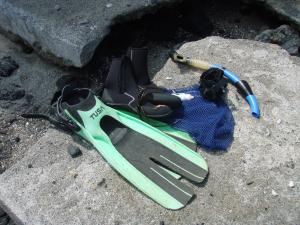
Fins should fit snugly like shoes, but you should able to pull them on and off without a struggle. If they are too loose, you'll either lose them or get blisters; if they are too tight, you'll get cramps AND blisters. With fins you need to make a choice. Shoe-style fins are easiest for the novice to use, but if you have to enter the water over rocks, your feet may get abused as you wade out barefoot. Strap-style fins allow you to wear reef-walkers with the fins, which makes rocky entries easier. If you choose this option, make sure the fins fit over your feet with the reef shoes on.

Snorkels come in a confusing array of styles and an astounding range of prices. Although some have space-age design features, a decent snorkel with a comfortable mouthpiece and a simple splash guard is all that's required.

Photo by Donnie MacGowan

Floaties: Many beginners, and even experienced ocean explorers in surgey or high surf conditions, appreciate having a floatation device. Standard life-jacket styles are not recommended because they are designed to keep your head above the water while the whole point of snorkeling is to keep your head under the water. There are specially designed snorkeling vests and belts which work quite well, but are waaay spendy. Boogie boards are a nice alternative; they have a wrist leash so you won't get separated from it and provide a floating platform to rest on, making your forays out over the reef longer and more enjoyable. Safer, too. Another, much less expensive, alternative is the foam "noodle" available in the toy department of all WallMarts and stores like that. I like to attach a boogie-board wrist leash to mine to keep it from floating away when I dive down. A large noodle will support even a full grown man upright in the water when ridden "horsey-style".

All the gear you drag with you needs to be carried in something and by far the best way is in a nylon mesh bag; rental gear will come in one and you can buy them inexpensively where you buy your mask and fins. Since you must rinse your gear off with fresh water immediately after you climb out of the ocean, this allows the gear to "breathe" as it dries, obviating the annoying growth of mildew.

For after your swim, a large, thirsty towel is also a nice beach accoutrement, but do not use it to lie on the sand with. Buy a cheap rice matt instead (again, at WalMart or such)--it won't collect sand, it's cooler on the skin, smells nice and it means your towel will be clean and sand-free when you use it to dry-off. Don't forget to bring drinking water…immersion in salt water is dehydrating and just swimming around you've worked harder--and sweated more--than you realize. Rinse yourself and your gear with fresh water immediately after you get out of the ocean and remember to apply sunscreen and wear your sunglasses. Don't overestimate your skin's tolerance for beach sun. Now might be a good time to go inside and cool off, you know?
Photo by Donnie MacGowan

Part II of this series will discuss snorkeling technique, Part III will cover snorkeling etiquette and Part IV will discuss snorkeling safety.

For more information on traveling to Hawaii in general, and beach activities on the Big Island in particular, visit www.tourguidehawaii.com and www.lovingthebigisland.wordpress.com. For information on the author, go here.

Saturday, January 17, 2009

Why I love Hawaii...

By Donald B. MacGowan


Photo by Donnie MacGowan

Like many people, my life on the Island of Hawaii involves, figuratively, my wearing many hats...today I am wearing my "Independent Filmmaker" hat and driving from my home in Kona south to Hawaii Volcanoes National Park to film the fire-fountaining eruption at Kilauea Volcano.

The drive is calming and scenic, much of the highway is posted thirty-five miles an hour, as the Hawaii Belt Highway runs from my sleepy little fishing village through the mountainous coffee-growing region of Kona, south through cattle and horse ranches and into the heart of the macadamia nut producing region. This is my favorite part of the Island; in my heart and mind it is the loveliest place on earth--rocky, rough open ocean shoreline with huge mountains and rolling, green volcanic slopes giving way to wide open spaces, uncrowded, even largely unknown to the outside world. I have a strong emotional bond to this part of the island. It was here, in the village of Pahala, that I first lived when I fled the frigid Rocky Mountain winters for a new life in tropical Hawaii a decade ago.

So when I reached the turn-off to Pahala I decided I had time for a break from driving to see what had become of my first home in Hawaii in the near-decade since I had lived there. For reasons and madness best left to the dust of the ages, I arose at 3:30 one morning at my home in Laramie, Wyoming. After living 20 years in the high plains, I was packed, ticketed, excited and ready for my move to Hawaii. The thermometer on my house read twenty degrees below zero and there was at least two feet of snow in my front yard--from the windows of Brees Field Airport I watched the rising sun light-up the east face of the Snowy Range, as frigid and alpine a view as I had ever had of it. Changing planes in Denver, San Francisco and Honolulu, I arrived on Hawaii in the brilliant sun and tropical warmth-- I will never forget smell of paradise as I got off the plane; flowery, ripe, heavy with promise, romance and adventure.

No matter where I am flying in from, where I have been or for how long I have been gone from Hawaii, when the door of that airplane first opens and Hawaii's gentle breath envelopes me, I know I am home. I have lived all over the US but I have never, ever felt that I was where I belonged, that I was at home, until I moved to Hawaii. When I come to Hawaii, I am coming home. I love Hawaii with a tender intensity that sometimes surprises me with its fierceness.

In Pahala today, I parked my car at Ka'u High School and walked across campus to the Teacher's Cottage I had inhabited my first months on Hawaii, just to see how things had changed. My mind went back to the first morning I had walked across campus, full of excitement at living in this strange land, eager and curious to learn about this island and her people. There are not words to explain my joy-filled love for Hawaii, nor for the utter heartbreak of unnecessary sorrows that lurk just below the surface here.

Photo by Donnie MacGowan

Some of the very first people I came across that first morning was circle of 5 girls, barely adolescent--ten, maybe twelve years old but certainly no older--playing with their Barbie dolls. All of them were smoking cigarettes, passing around a couple of 40-ounce beer bottles wrapped in brown paper bags; two of them were pregnant, another two were caring for their very real babies while they played dolls with their friends. One of the girls was my next-door neighbor's daughter, Lehua; the others were her cousins. The babies all had the same father.

Moving from Wyoming to Hawaii I had expected to experience eagerness to explore my new home, perhaps some home sicknesses, and certainly a bit of culture shock but I was absolutely unprepared for this, what would become one of my most enduring visions of Hawaii.

How I came to understand this aspect of Hawaii is an allegory for how I came to love my tropical home here…for it is in the warp and weft of the contradictions, of the beauty and sorrow, of the ancient traditions and modern hustle, of snow clad peaks and steaming jungle, spuming volcanoes and calm, clear lagoons and yes, the interplay between the embracing promises of paradise and the greed-fueled waste and grinding poverty here that Hawaii weaves her magic spell on me.

Friendly, clean, quiet, scenic; Pahala seems a perfect community. Thirty years ago Pahala was a prosperous, bustling center of activity for the Pahala Sugar Company, but with the demise of the sugar industry, Pahala residents have either moved on to other towns seeking employment, or hunkered down to await what future may come.

When the 102nd US Congress convened in 1994 with the first Republican-dominated legislature in a generation, they set out to politically reward states that went conservative and to punish states that elected liberals in very, very quiet, but ultimately devastating, ways.

In a bid ostensibly to reign in “federal pork-barrel spending”, the Congress cut the Farm Subsidies Bill a few paltry million dollars by slashing the federal price support for sugar that protected American sugar companies from cheaper Central American and African sugar. The support was cut to a level where it still made sugar a profitable crop in sugar states that went Republican, such as Wyoming, Utah, Colorado Kansas, Florida and California, but bankrupted the sugar industry in Hawai’i, the only liberal-voting sugar state. The amount saved was less than the cost of a single Tomahawk Cruise Missile, but the one-industry towns all over Hawai’i were completely devastated and no new industries moved in to take up the employment slack. There has been 70-80 percent unemployment ever since. The usual miseries of substance abuse and poly-generational sexual abuse, crime, hopelessness and degradation of the educational system moved in with the unemployment and small towns like Pahala have writhed in agony ever since. Everyone with ambition leaves town to live near work elsewhere, while those too old or unskilled languish, the human flotsam of a political system that rewards vindictiveness and cynicism. Such political finagling is as old as politics and rife in both political parties, but rarely does one get to see the painful cost of such partisan political gamesmanship writ so hugely, or tragically, upon the human landscape.

To be fair, shortsightedness among residents played a role in the misery of sugar-plantation towns in general and Pahala in particular. In mobilizing to fight against resorts moving in and to block a proposed private satellite launching facility, residents gambled on the sugar plantation economy lasting indefinitely. In seeking to preserve their generations-old way of life and their communities, they virtually guaranteed that life there would ultimately never be the same for anyone.

A re-birth, of a sort, is underway in Pahala and other small towns in Hawai’i; because of the extremely undervalued real estate, compared with the extremely over-valued real estate elsewhere in Hawai’i, mainlanders and retirees are buying up land as residents finally sell. This has caused a small renaissance in service-sector employment, but it will take a generation or two for these tiny towns regain their former energy and optimism.

Today, with nothing more pressing than nostalgia, I walked the small downtown of Pahala, stopping at the local market for a snack. The clerk was a young Hawaiian of exceptional beauty who eyed me a bit oddly--I thought because strangers are still a bit uncommon in this town--then, coming around from behind the till she embraced me, kissing my cheek.

"Welcome home, Donnie" she smiled to me, "Aloha".

Clean, sober and happily married for these past 6 years, a now 21-year old Lehua told me she had also had four more children. She and her husband had bought a house and a boat for tuna fishing, and he was general manager at a local macadamia nut farm. How had all this happened?

Laughing, she explained "Lucky we live Hawaii", in the local pidgin I had once found so impenetrable.

Lucky, indeed.

And this is why I love Hawaii so.


For information on traveling to Hawaii in general and exploring the wonders of the Big Island in particular, visit www.tourguidehawaii.com and www.lovingthebigisland.wordpress.com.
 

Casino Bonus no Deposit