Showing posts with label vog. Show all posts

Sunday, July 5, 2009

Give new life to your old photographs of Hawai`i's volcanoes!

Reprinted from here.
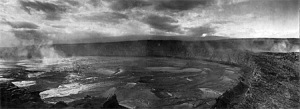
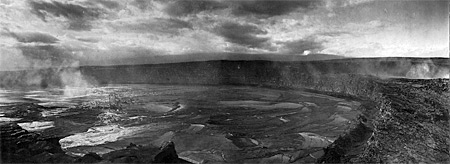
A view of the lava lake within Halema`uma`u Crater on December 27, 1911, with Uwekahuna bluff (where HVO and the Jaggar Museum now stand) and Mauna Loa in the background. The lake level had risen about 120 m (400 ft) since October 1911 and will drop 90 m (300 ft) in January, 1912, the month that HVO was founded by Thomas A. Jaggar's arrival for duty.
The adage "a picture is worth a thousand words" is certainly true, especially when it comes to photographs of Hawaiian eruptions and volcanic landscapes from earlier times.

Long-time readers of "Volcano Watch" might recall our January 20, 2005, article (http://hvo.wr.usgs.gov/volcanowatch/2005/05_01_20.html), which describes an HVO geologist's excitement at finding an 1860s photo of Kilauea's caldera. By comparing the photo to a present-day view of the caldera, he could see the location of volcanic features described in written records (with less than a thousand words) but no longer visible today—a valuable discovery when your job is to decipher a volcano's eruptive history.

Without realizing it, you or a family member may have captured a similarly important historical record of Hawai`i's volcanoes. How? By taking a photo and keeping it.

Your `ohana, like many families, probably has several albums—or shoe boxes—filled with old photographs. Perhaps your great-grandmother took a picture of a long-ago Kilauea summit eruption or your brother snapped a photo of `a`a lava as it flowed down the slopes of Mauna Loa. If you possess photographs that show volcanic landscapes or features, volcanic fume (vog), or any kind of eruptive activity, HVO geologists would like to hear from you and see the photos.

We learn the most from photographs that have some documentation about when and where they were taken. Date and location are essential pieces of information that help us interpret the geologic significance of a photo. If people are recognizable in a photograph, their names should also be included. Any other details you can provide about the image will add to its meaning.

Wide-angle shots are more helpful than close-ups. For example, if a photo is zoomed in on the leading edge of a lava flow and shows nothing else, we cannot determine the size of the flow-or much of anything else—from the image. With wide-angle views, we can see the geographic or geologic context of the eruptive activity or volcanic features shown in the photograph.

If you're interested in sharing your photos with HVO scientists, the first thing you should do is contact us by telephone (808-967-7328) or email us (askHVO@usgs.gov). Geologists are standing by to speak with you. The purpose of this initial conversation is to determine which of your photographs might be beneficial to our research and monitoring efforts on Hawai`i's volcanoes. We will then send you additional information on how we can receive and duplicate photos selected from your collection.

No need to worry about giving up your photographs—you retain ownership of them. We will return your photos to you after duplicating the images selected as most useful. In appreciation of your loaning us the photographs, we will be happy to give you digital copies of the images we scan.

To kick off our effort to expand HVO's photographic collection of Hawai`i's volcanoes, we are asking at this time to see photographs from 1924 and earlier. Those years included frequent lava lake activity in Halema`uma`u Crater and culminated in the explosive eruptions of May 1924.

Pre-1924 photos are of particular interest to us now because they could shed light on Kilauea's current summit eruption. Even if they show no eruptive activity, early photographs of Kilauea's caldera can contribute to a better understanding of the volcano's past and reveal features that are no longer visible. The same is true for early photos of Mauna Loa and Hualalai.

We will initially focus on early historical photographs, but you can contact us about any volcanic images you think might interest us. Although we may not be able to look at photos taken in recent decades right away, we would eventually like to see them. Our ultimate goal is to acquire images from the 1800s through the 20th century.

So, please lend us a hand while taking a trip down memory lane. Look through your family photos and contact HVO if you find images of Hawai`i's volcanoes. Your old photographs could give new life to eruptive events and volcanic landscapes rapidly fading from our visual memories.

Kīlauea Activity Update

Surface flows in the Royal Gardens subdivision remained active as of Thursday, June 18, burning through forested kipuka. Another area of breakouts active higher up on the pali was also reported. The Waikupanaha and Kupapa`u ocean entries remain active and continue to produce prominent plumes as lava spills into the ocean.

At Kīlauea's summit, the vent within Halema`uma`u Crater continues to emit elevated amounts of volcanic gas, resulting in high concentrations of sulfur dioxide downwind. Bright glow from the vent was visible at night through the past week. A collaborative effort last week between HVO and UH-Manoa scientists, using a sophisticated optical remote-sensing technology called LIDAR (Light Detection and Ranging), has measured the lava surface to be about 205 m (675 feet) below the floor of Halema`uma`u Crater.

No earthquakes beneath Hawai`i Island were reported felt this past week.

For more information on traveling to Hawaii in general and exploring the Big Island's volcanoes in particular, please also visit www.tourguidehawaii.com and www.lovingthebigisland.wordpress.com.

Thursday, June 26, 2008

Weekly Volcano Update: Kilauea's Puzzling Plume

Reprinted from here.

The Puzzling Plume


Geologist collecting ash at the Halema`uma`u overlook fence.  The collector is attached to the fence three feet above the ground to reduce sample contamination from windblown material.
Geologist collecting ash at the Halema`uma`u overlook fence. The collector is attached to the fence three feet above the ground to reduce sample contamination from windblown material.

The new Halema`uma`u Overlook vent is now only three months old, and the accompanying plume is relatively small in terms of previous explosive eruptions of Kilauea, but it has been front page news to Hawai`i's citizens and visitors. While watching the voluminous white plume rising thousands of feet into the air by day or admiring the strong glow at night, you're probably wondering what exactly is streaming out of the new vent besides gas. The short answer is ash-rock dust and bits of volcanic glass less than 2 mm (0.08 inches) in diameter. But how do we catch the ash coming out of the plume, and what are we doing with it?

Basically, we let it fall into our scientific laps. Each morning around daybreak, rain or shine, an HVO scientist goes to the Halema`uma`u overlook to collect the ash that has fallen from the plume since the previous morning. After experimenting with different types of ash collectors, 12-quart plastic buckets, weighed down with rocks, emerged as the best.

The contents of the ash collectors are brought back to HVO and weighed, and the average accumulation rate is calculated. The ash is then inspected under the microscope to note variations in its make-up. We're especially interested in the amount of juvenile material (fresh lava) versus the amount of lithic material (bits of older rock or debris from the conduit walls) in each day's collection.

The juvenile material, which comes from lava beneath the crater floor, is sent to our sister volcano observatory near Mount St. Helens for analysis. The results indicate that the chemical composition of the lava at the summit is almost identical to the lava currently erupting from the east rift zone and flowing into the ocean.

Because the ash that is already on the ground can also be blown into our collectors by strong winds, we had to devise ways to minimize collection of the windblown debris while maximizing the collection of ash falling from the plume. An ash collector was placed on the Halema`uma`u overlook fence, elevated about 1 m (3 feet) off the ground. Elevating this collector has proven enough to do the job.

The entire array of collectors are laid out within a few hundred meters (yards) of the vent, positioned to accumulate ash in both trade- and kona-wind conditions.

But that's not all that has been ejected from the new vent. Debris from the three explosions (on March 19, April 9, and April 16), including blocks of older lava as large as 3 feet in diameter and fresh spatter, litters the area around the overlook. Because of this pervasive debris, it would be difficult to tell whether new blocks are ejected from the vent. The solution was to clear a 2.2-m (7-foot) square area of all rock debris larger than 2-3 inches. This "explosion trap" should allow us to identify new material if it is ejected from the vent in this area. None has been seen since April 16.

So, what does all of this dirty, smelly work under the plume tell us? Since juvenile material first appeared in the ash on March 23, it has consistently been seen in the samples. Juvenile material is something geologists look for in volcanic ash, because it tells us that fresh lava is close to the surface. But the appearance of juvenile material, combined with the nature of our visual and thermal observations, still cannot tell us exactly how deep below the floor of Halema`uma`u Crater the lava resides. As we continue to collect the ash each day, we watch and listen for the possibility of seeing fresh lava in the crater again.

Activity update


Kilauea Volcano continues to be active. A vent in Halema`uma`u Crater is erupting elevated amounts of sulfur dioxide gas and very small amounts of ash. Resulting high concentrations of sulfur dioxide in downwind air have closed the south part of Kilauea caldera and produced occasional air quality alerts in more distant areas, such as Pahala and communities adjacent to Hawaii Volcanoes National Park during kona wind periods.

Pu`u `O`o continues to produce sulfur dioxide at even higher rates than the vent in Halema`uma`u Crater. Trade winds tend to pool these emissions along the West Hawai`i coast. Kona winds blow these emissions into communities to the north, such as Mountain View, Volcano, and Hilo.

The new gas vent observed on May 23 inside Pu`u `O`o has remained active, with no observed change. Lava from the 2007 Thanksgiving Eve Breakout (TEB) flow, erupting from fissure D of the July 21 eruption, continues to flow through what remains of Royal Gardens and across the coastal plain to the ocean in well-established lava tubes. Over the past week, the Waikupanaha ocean entry has remained active, with occasional small explosions and a variable plume.

Be aware that lava deltas could collapse at any time, potentially generating large explosions. This may be especially true during times of rapidly changing lava supply conditions, as have been seen lately. Do not venture onto the lava deltas. Even the intervening beaches are susceptible to large waves generated during delta collapse; avoid these beaches. In addition, steam plumes rising from ocean entries are highly acidic and laced with glass particles. Check Civil Defense Web site (http://www.lavainfo.us) or call 961-8093 for viewing hours.

Mauna Loa is not erupting. Three earthquakes were located beneath the summit. Continuing extension between locations spanning the summit indicates slow inflation of the volcano.

One earthquake beneath Hawai`i Island was reported felt within the past week. A magnitude-3.1 earthquake occurred at 9:26 p.m., H.s.t., on Monday, June 09, 2008, and was located 6 km (4 miles) southwest of Pahala at a depth of 33 km (20 miles).

Visit our Web site (http://hvo.wr.usgs.gov) for daily Kilauea eruption updates and nearly real-time Hawai`i earthquake information. Kilauea daily update summaries are also available by phone at (808)967-8862. Questions can be emailed to askHVO@usgs.gov. skip past bottom navigational bar

For more iformation on touring HAwaii in general and visiting the Big Island in particular, go here and here.
 

Casino Bonus no Deposit