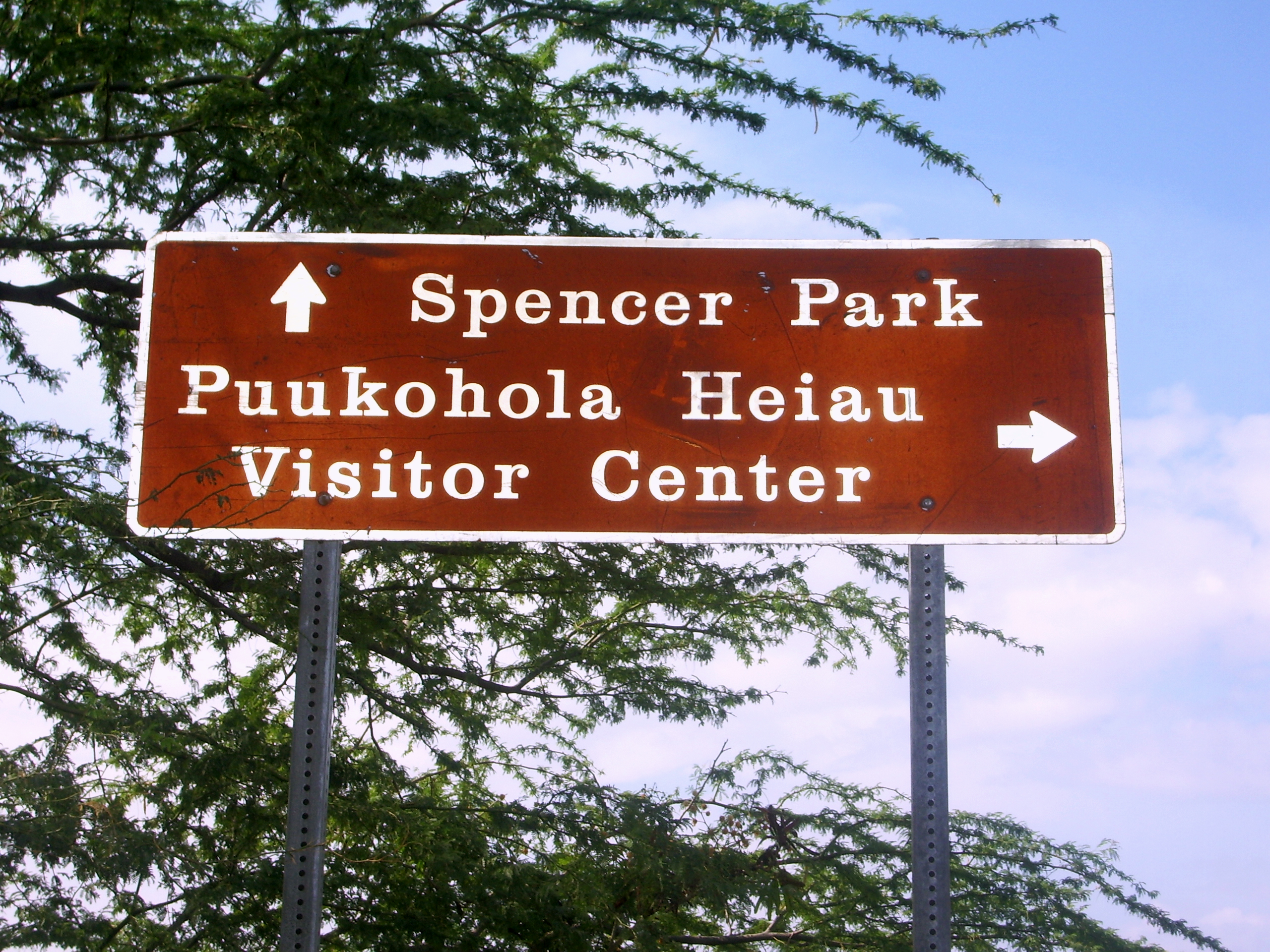
Showing posts with label travel. Show all posts

Sunday, September 27, 2009

Frank's Big Island Travel Hints #2: Kona Coast South of Honaunau to Ka'u

Frank's Big Island Travel Hints #2: Kona Coast South of Honaunau to Ka'u

By Frank Burgess and brought to you by Tour Guide Hawaii

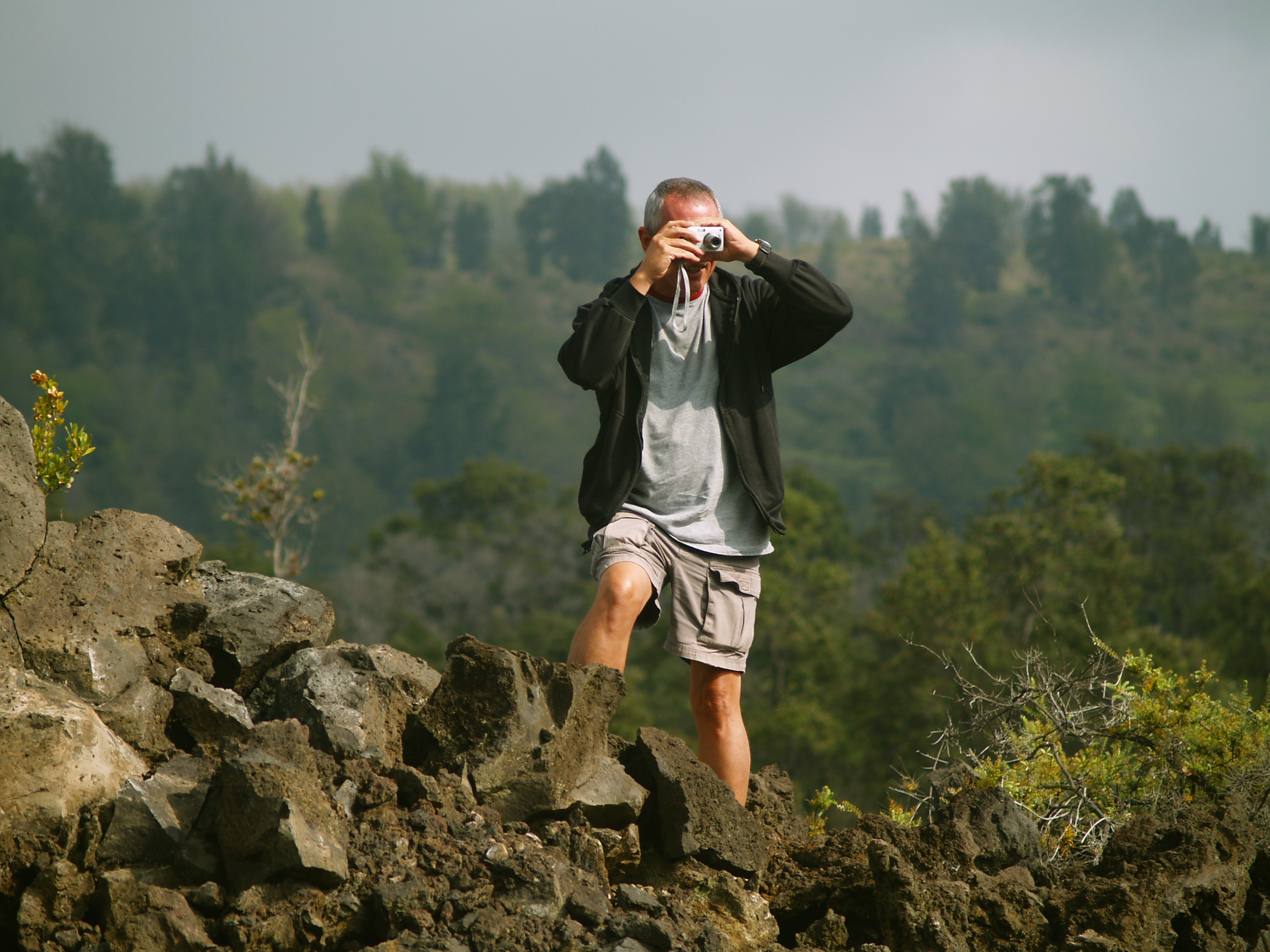
Frank Burgess stops to take a photo while hiking the Ka'u Desert Trail: Photo by Donald B. MacGowan

Tour Guide Hawaii is proud to announce the release of their new iPhone and iPod Touch App available at iTunes...this App will help you plan your trip to Hawaii, help you decide what you want to see, how you want to see it and help you get there with GPS, interactive maps and on-board driving instructions. The Tour Guide App presents hours of interesting videos and information about places of historical, cultural and recreational interest, giving you a sense of the people, the natural history and the unique specialness of each destination. The information is so comprehensive and complete they even tell you where all the public restrooms are!


What else will Tour Guide help you find? Let's look at a trip South from Kona along the Hawaii Belt Road to Hawaii Volcanoes National Park...Tour Guide will not only help you find many amazing sights along the way, it will tell you all about them, what to take and what to expect.

Today's hints cover the area from Pu'u Honua O Honaunau south to Punalu'u Black Sand Beach. Driving south on Hwy 11 there isn’t too much to stop and see for several miles, so enjoy the panoramic views. Your Tour Guide download from iTunes will give you more detailed information about this area.

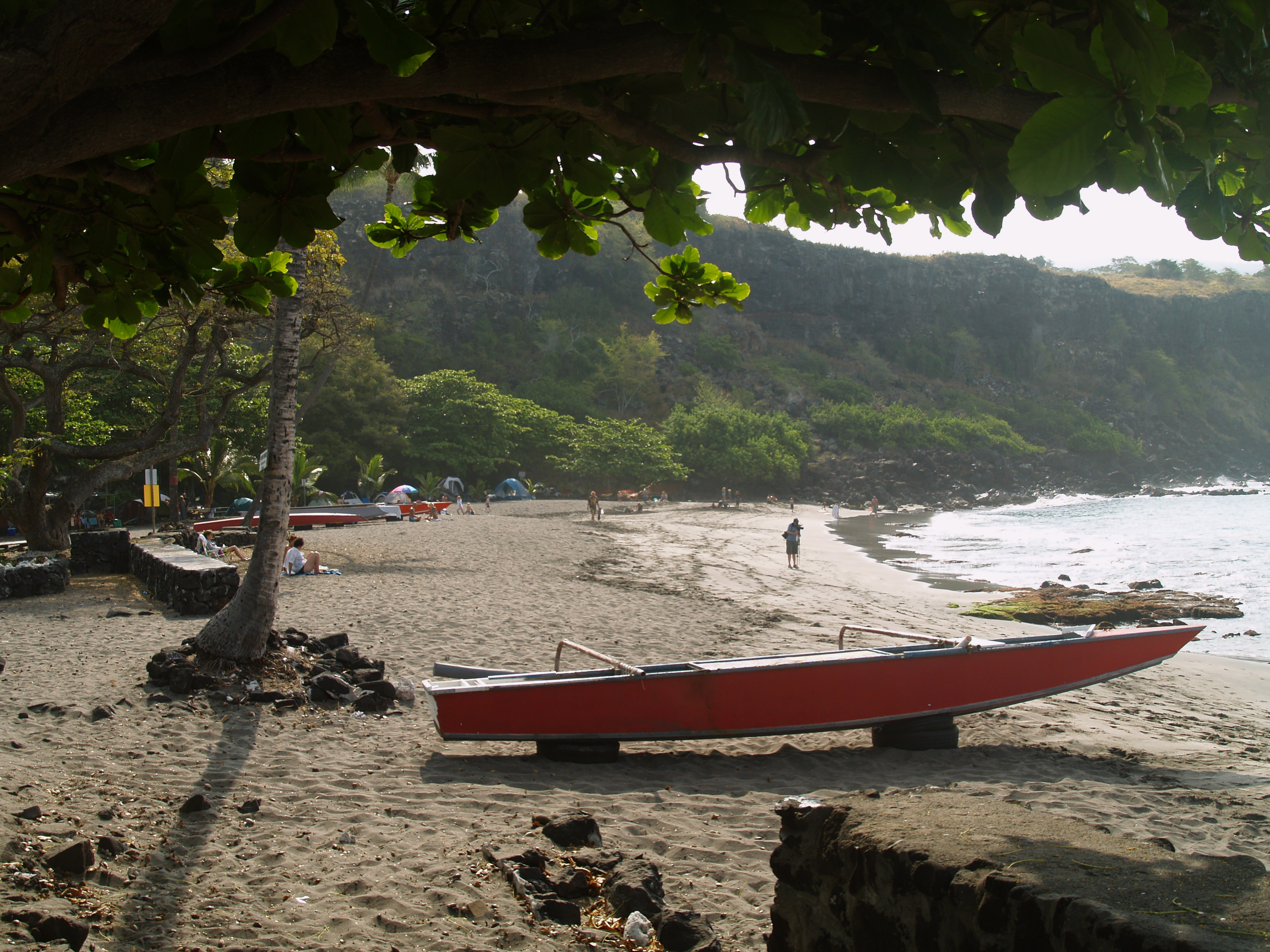
Ho’okena is a lovely gray sand beach about 5 miles off the main hwy. This is a nice beach for swimming, snorkeling and picnicking. There are some trails to hike and decent restrooms. Camping is also available by permit only. Tour Guide has more information about trails to hike, camping, and where to get snorkel gear and camping permits.

Driving a few miles further, headed toward the volcano park, is the turn off for Milolii. Again about 5 miles off the main highway, Milolii is one of the last fishing villages in Hawaii. On the way down the views are spectacular, so keep your camera handy. Tour Guide will give you lots of history about this area, so make sure you listen to it on the way. If you are up for a short hike, park at the Miloli'i County Beach Park and hike the shoreline trail to beautiful, secluded, empty Honomalino Bay.

As with anywhere you travel, make sure to lock your vehicle when you leave it and don’t leave valuables in plain sight.

Tour Guide will show many other great places to explore as you continue driving south. We’ll jump ahead at this point to the southernmost town in the United States, Na’alehu. This quaint plantation town is a throwback to when sugar cane was the main export. Na’alehu boasts being a favorite spot for Mark Twain to rest and enjoy the old Hawaii lifestyle. The Punalu’u Bakery has become famous throughout the state for their sumptuous sweet bread. These are just two great reasons to stop and take in some of the local flavor.

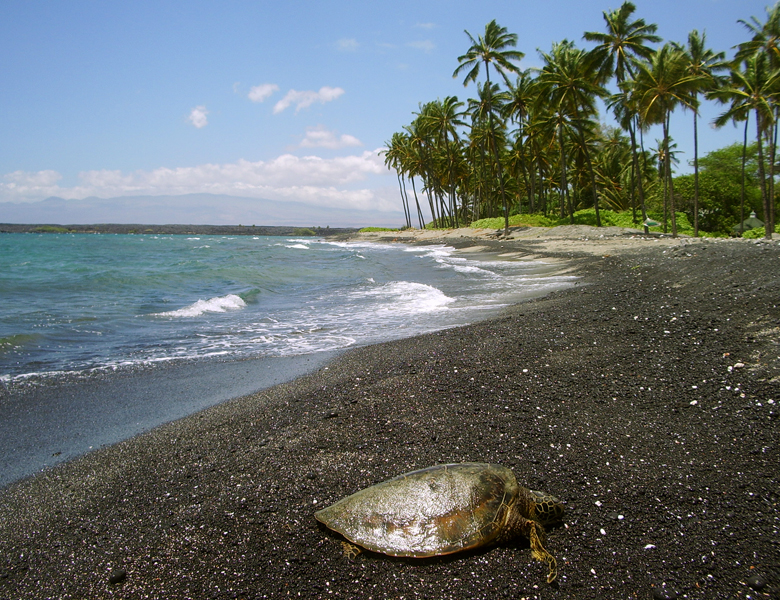
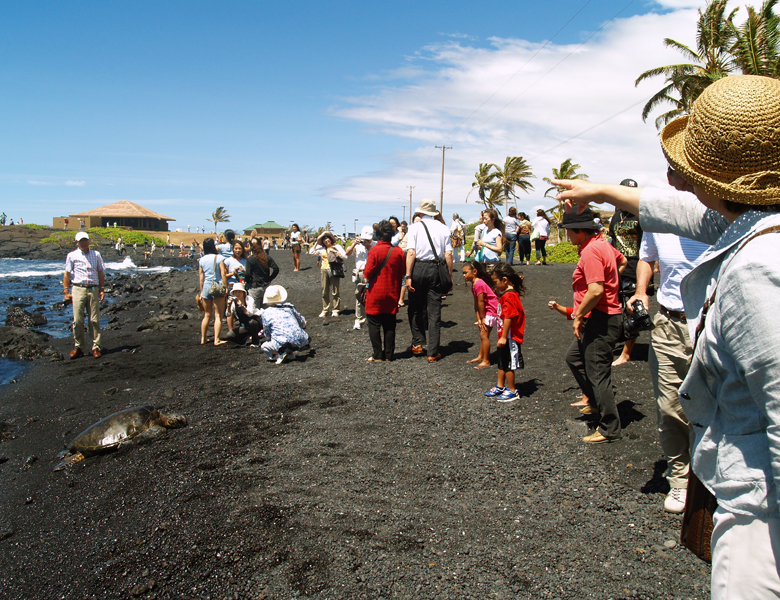
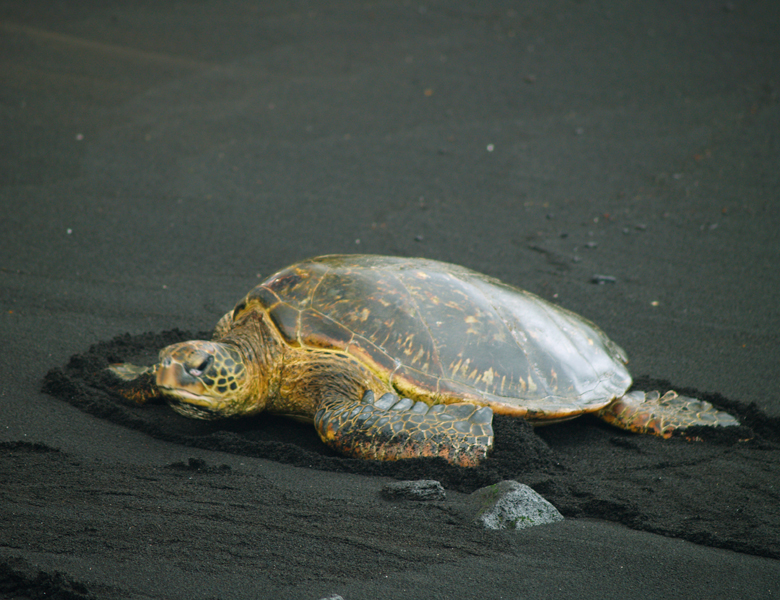
Driving about 10 miles further south, your Tour Guide will recommend the Punalu’u Black Sand Beach, one of the top 44 sites on the Big Island. This beach is not only famous for the jet black sand but also for the Hawaiian Green sea turtles and the Hawksbill sea turtles who reside nearby. Often you can see these magnificent creatures sunning on the black sand and, at certain times of the year, nesting and laying their eggs. All turtles in Hawaii are endangered species so touching them is forbidden and a $20,000 dollar fine is strictly enforced. Get up close for photos but please leave them alone. Tour Guide will give you some of the rich history of this area as well.

Driving south from Punalu’u Black Sand Beach, you will notice the highway begin to ascend toward the Hawaii Volcanoes National Park. Just after you see the Volcano Park sign, there will be a small parking lot, on the ocean side of the hwy, called the Ka'u Desert Trail Head. A one mile hike on this trail will bring you to the warrior footprints and a petroglyph field. Tour Guide gives the stories and history of this fascinating area.

To see the new iPhone/iPod Touch App, please visit http://www.tourguidehawaii.com/iphone.html. The best of Tour Guide Hawaii's free content about traveling to, and exploring, the Big island, can be found here. For more information on traveling to Hawaii in general and on touring the Big Island in particular, please also visit www.tourguidehawaii.com and www.lovingthebigisland.wordpress.com.

Copyright 2009
by Frank Burgess; photography copyright 2009 by Donald B. MacGowan. All rights reserved.

Saturday, September 19, 2009

Hawaii's Magnificent Honu, The Endangered Hawaiian Green Sea Turtle

Hawaii's Magnificent Honu, The Endangered Hawaiian Green Sea Turtle
by Donnie MacGowan

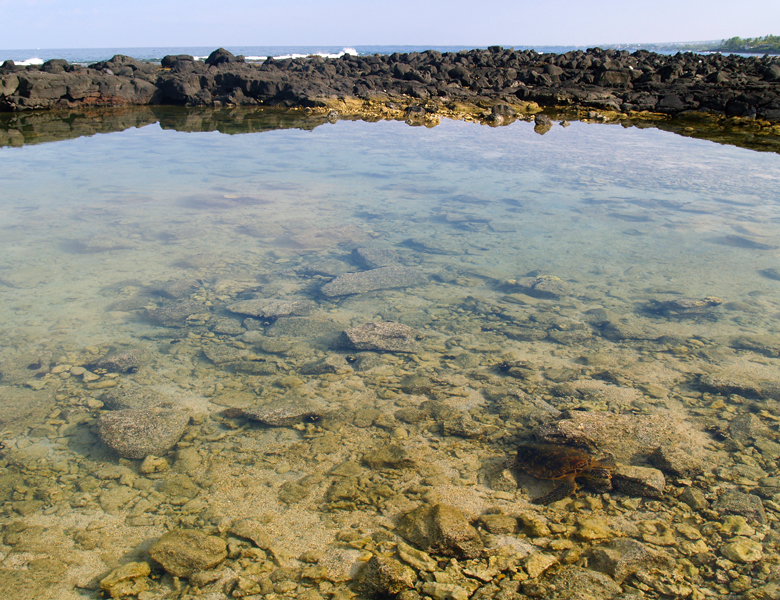
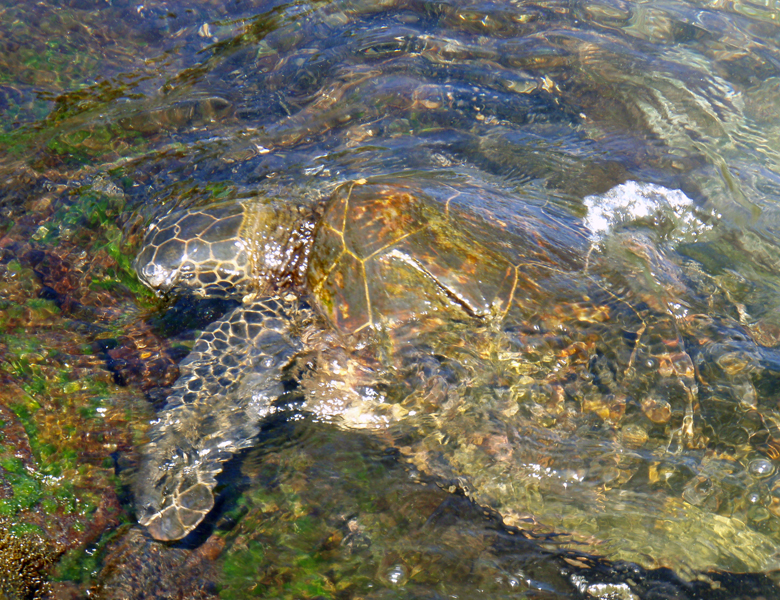
This perfectly camouflaged turtle basks quietly in a tidepool between Ke'eku Heiau and Hapaiali'i Heiau: Photo by Donnie MacGowan

Called Honu by Hawaii's natives, the endangered Hawaiian Green Sea turtle is beautiful, serene and seeming wise. Though they have swum the oceans for over 200 million years peacefully feeding on algae and invertebrates and living the turtle dream, this highly successful product of amphibian evolution is in grave danger. Loss of habitat, hunting and molestation by humans has conspired to push the Hawaiian Green Sea Turtle to the very verge of extinction. One of the great joys of visiting Hawaii is to see, and in many cases swim with, these gentle, fascinating, beautiful amphibians. But where?

Although the population is recovering, honu are still relatively scarce on most beaches in Hawaii--how is the casual visitor to know where to go, how to see them, how to treat them, how to swim with them?

A Hawaiian Green Sea Turtle Dozes Gently on the Beach at Kiholo on the Kohala Coast: Photo by Donald B. MacGowan

Clearly, the visitor to Hawaii can use some help finding special places in general and beaches where the honu hang out in particular. To help you find the more secluded, wild and exotic destinations and very special attractions such as beaches where honu live in particular, and to help you get more out of your Hawaii vacation, Tour Guide Hawaii has released a brand new iPhone/iPod Touch App. This "must have" travel app is packed with hours of informative video on the most interesting places on Hawaii; helps navigate you to all the most popular visitor destinations, the most interesting attractions, the most romantic and secluded beaches; helps you effortlessly find hikes, snorkel spots, historical and cultural landmarks, shopping and dining. And of course, our new App includes directions to, and rating of, all the public restrooms! Learn all about the App, here.

More about Hawaii's Honu

00Snorkeler and Turtle small
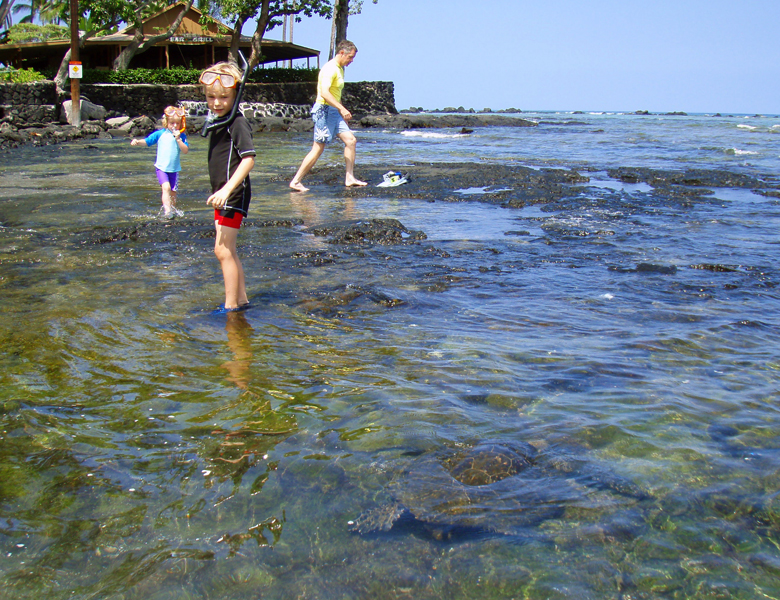
A young snorkeler at Kahalu'u is unsure what to make of his first encounter with a honu: Photo by Donnie MacGowan

Protected now by state and federal law, the population of once millions of individuals has been decimated to just a few hundred thousand; although they are making a comeback, Hawaii's honu are still very much endangered.

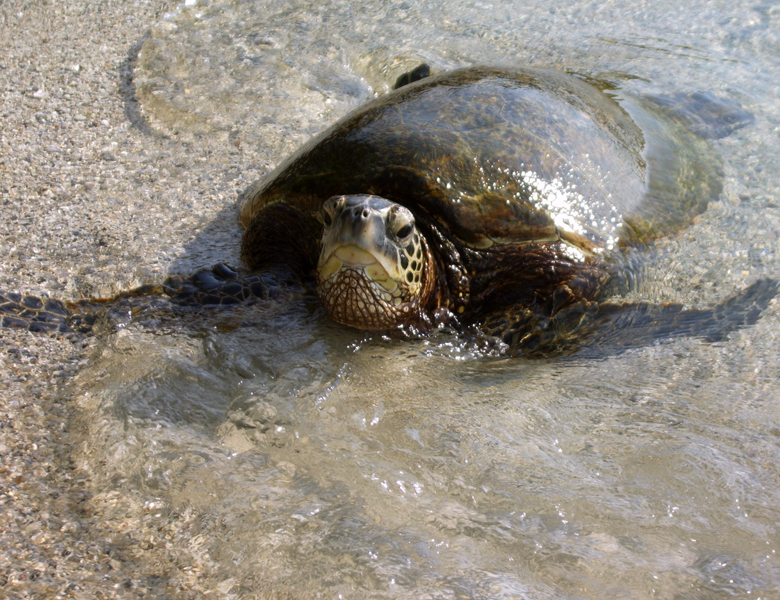
Honu may grow up to 45 inches and weigh as much as 400 pounds at maturity, reached at 25 years of age. Hawaiian Green sea turtles can easily be differentiated from the other near shore sea turtle in Hawaii, the much less common Hawksbill turtle, by counting the scales between the eyes. Hawksbills have four scales between the eyes and Hawaiian Green Sea turtles have two.

Honu Queen's Bath Honu small
Hawaiian Green Sea Turtles have 2 scales between their eyes; Hawksbill Sea Turtles have four: Photo by Donald B. MacGowan

Lady honu crawl on shore to lay their eggs, generally after migration to the quieter shores of the French Frigate Shoals, 800 miles northwest of Hawaii, or the black sand beaches on the south end of the Big Island of Hawaii. Adult turtles feed primarily on limu--sea weed--near shore and jellyfish and other invertebrates when out at sea. Hawaiian Green Sea Turtles have been known to make swimming voyages of a few thousand miles in a single year.

00Turtle Eating small
A Turtle Eating Seaweed at Kahalu'u Bay: Photo by Donald B. MacGowan

Danger to the turtles comes from a myriad of directions; toxic waste, floating balloons and plastic bags, Styrofoam, plastic six-pack rings, abandoned fish nets and line, not to mention getting caught in active fishing operations. As if this weren't bad enough, new and debilitating diseases are afflicting the Hawaiian green sea turtle. Near public beaches, resorts and other areas heavily impacted by human activity as many as 90% of the turtles are dying slow, painful deaths from tumors, infections and other diseases as well as parasites which attack the diseased flesh.

Punaluu Honu small
Turtle watchers at Punalu'u Black Sand Beach know they must stand at least 10 feet away from honu and not impede their progress: Photo by Donnie MacGowan
Pu'u Loa  Honu small
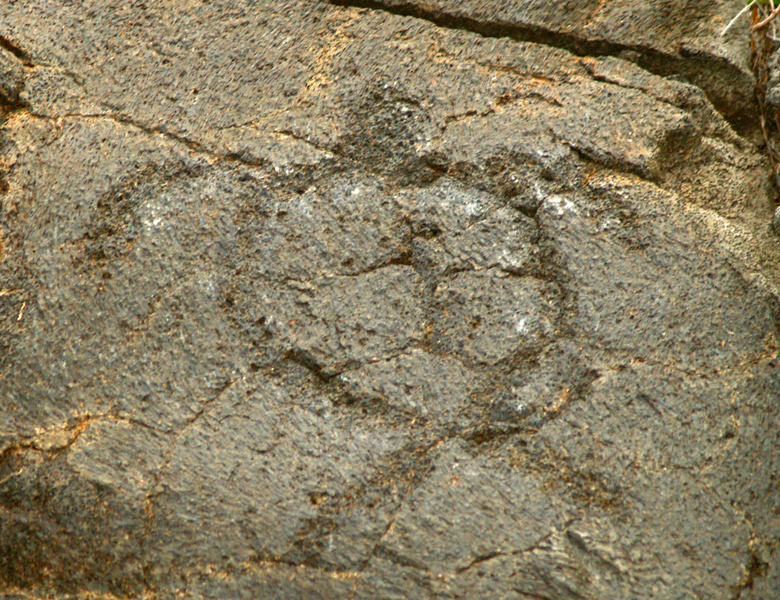
Hawaiians of old revered and respected the honu and left petroglyoph carvings of them liberally scattered across the archipelago: Photo by Donnie MacGowan

Humans have caused this misery and the decline in these magnificent creatures lives...visitors who wish to see the turtles must take care not to further stress them. Do not approach basking turtles closely, never touch or pick them up. While swimming or on the beach, give the turtles at least 10 feet of space...approach no closer; never block the path of turtle crawling out onto the beach or a turtle surfacing in the water.

Honu were honored and revered by Hawaiians of old and today, harassing turtles carries a stiff fine. In any case, touching the turtle is a good way to get a raging salmonella infection. If honu are swimming near where you are, do not approach or chase them; always swim to the side of them, never above (as a predatory shark would) nor below them (so they won't feel that their soft belly is at risk).

Anyone who observes their beauty and grace underwater easily understands how the Hawai'ians base their word for "peace", "honua" on their name for the green sea turtle, "honu".

A Hawaiian Green Sea Turtle Suns Herself on Punalu'u's Justly Famous Black Sand Beach: Photo by Donald B. MacGowan

It is within our grasp, this generation, to save or destroy forever these ancient animals; treat them gently and with respect. A video about Hawaii's honu can be found here.

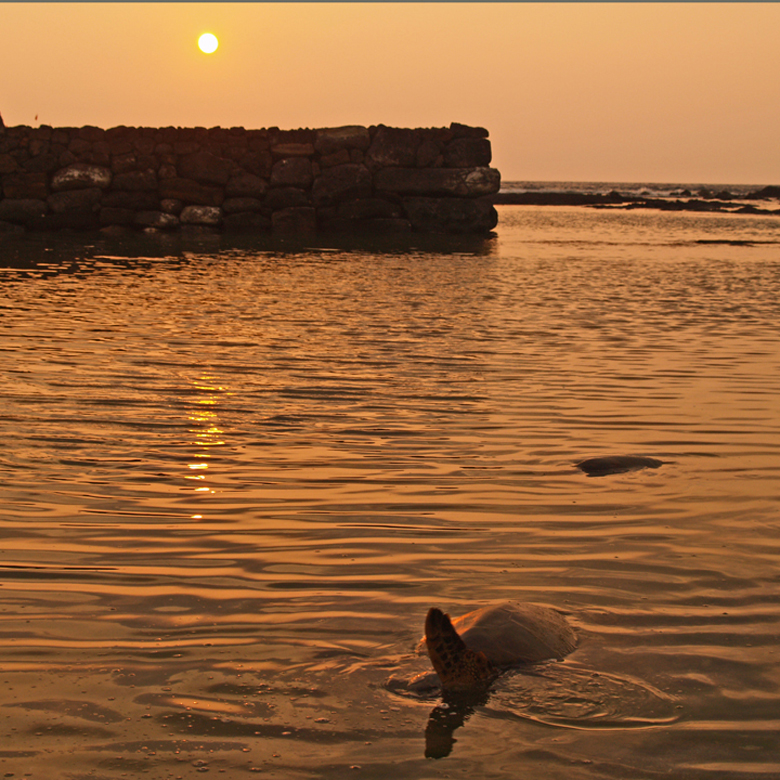
Honu at Sunset, Haapaiali'i Heiau: Photo by Donald B. MacGowan
Honu at Sunset, Hapaiali'i Heiau: Photo by Donald B. MacGowan

Don't forget to check out our exciting new iPhone/iPod Touch App at iTunes, here. More information is available by visiting www.tourguidehawaii.com or www.lovingthebigisland.wordpress.com. For information about the author, please go here.

All media copyright 2009 by Donald B. MacGowan

Tuesday, August 11, 2009

Best Beaches in Hawaii Part 5--Best Beaches for Snorkeling

by Donnie MacGowan

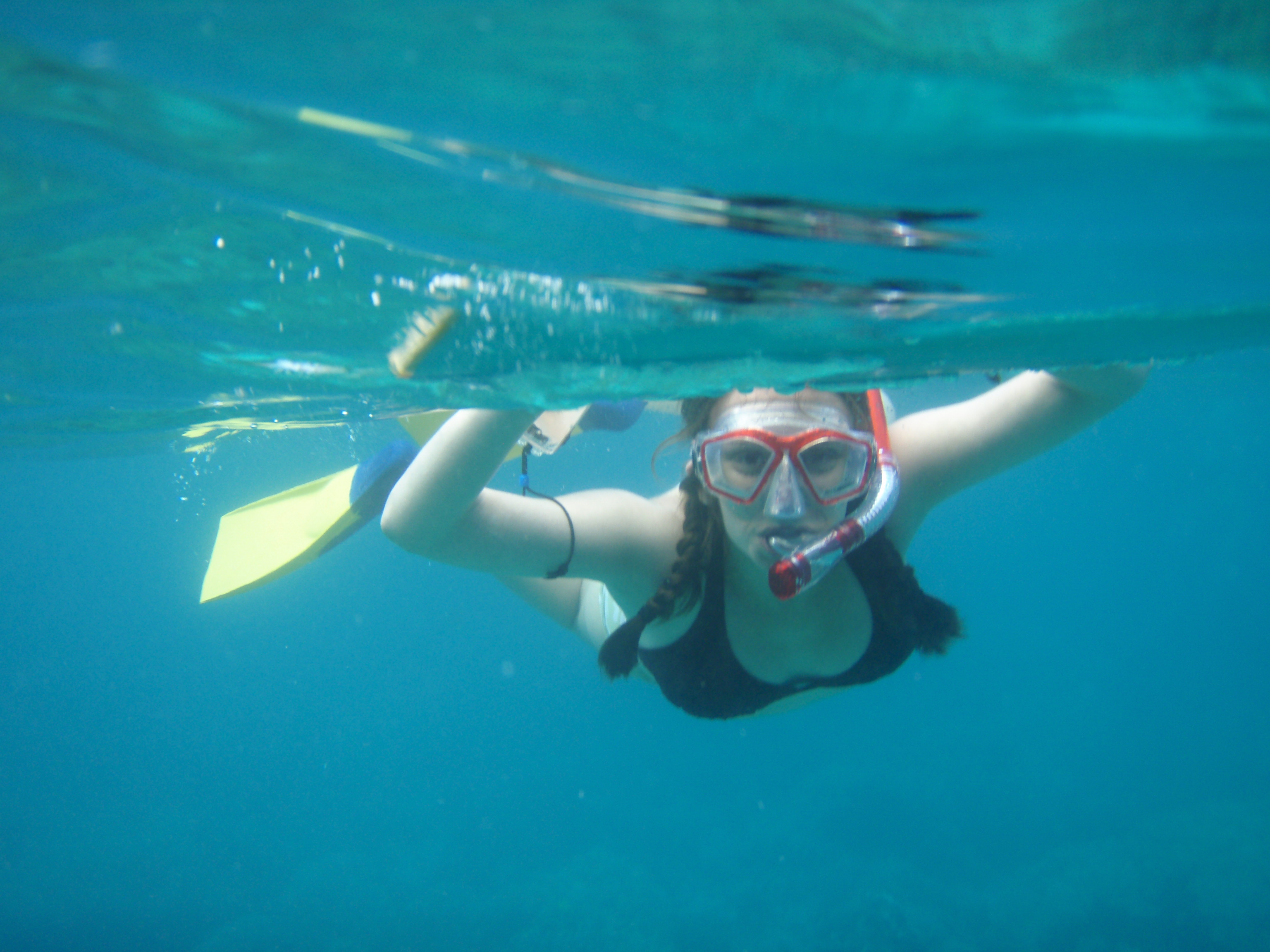
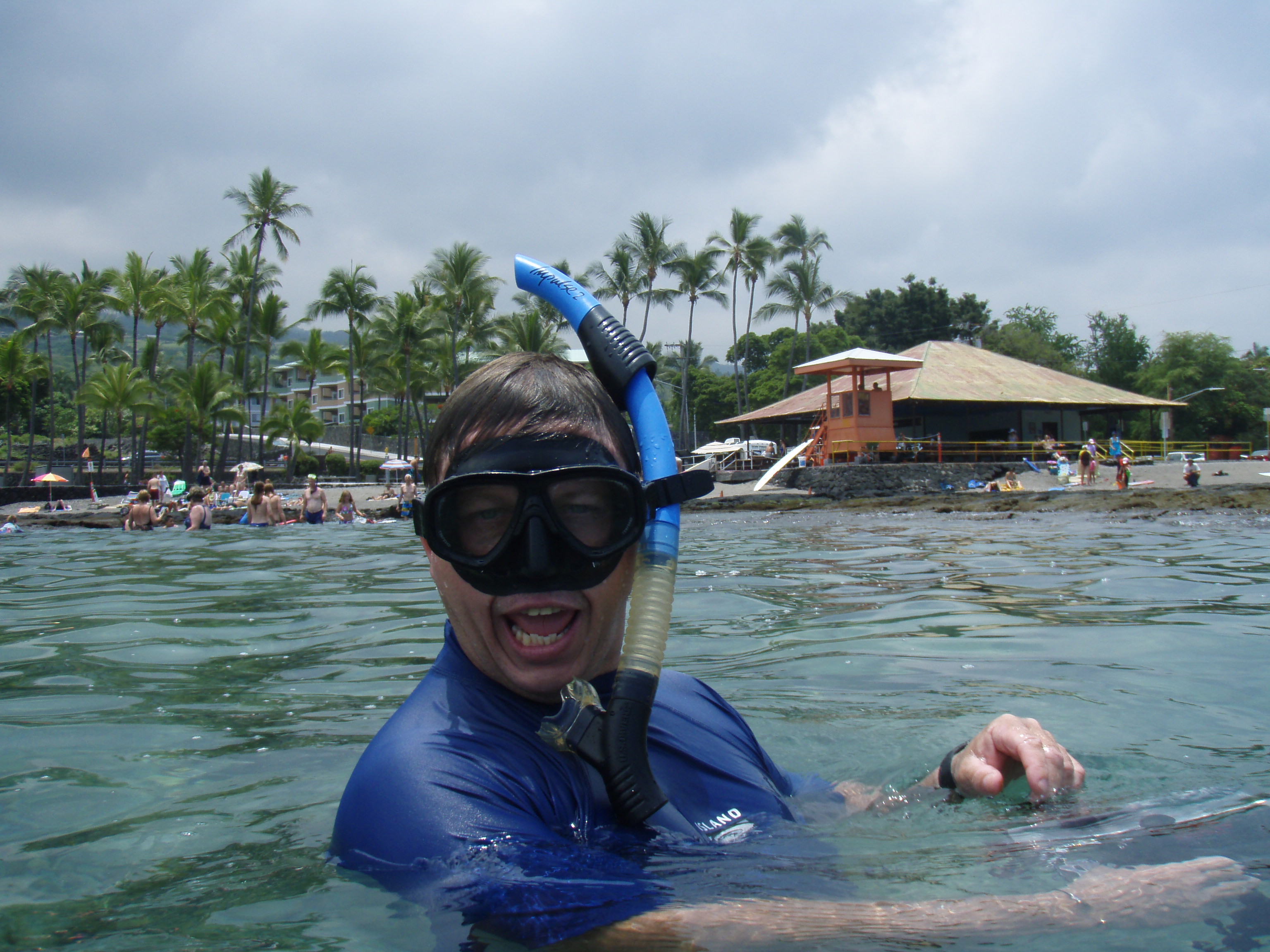
Donnie MacGowan Snorkeling at Kahalu'u Beach on the Big Island of Hawaii: Photo by Donnie MacGowan

Whether you visit the Big Island for a few days, a couple weeks or a few months, you want to make the most of your time in Paradise. With such a wide variety of natural and commercial attractions, it is natural for the visitor to get a little overwhelmed in the “Option Overload” and not be able to make a balanced and informed decision on what they want to do and how best to spend their time.

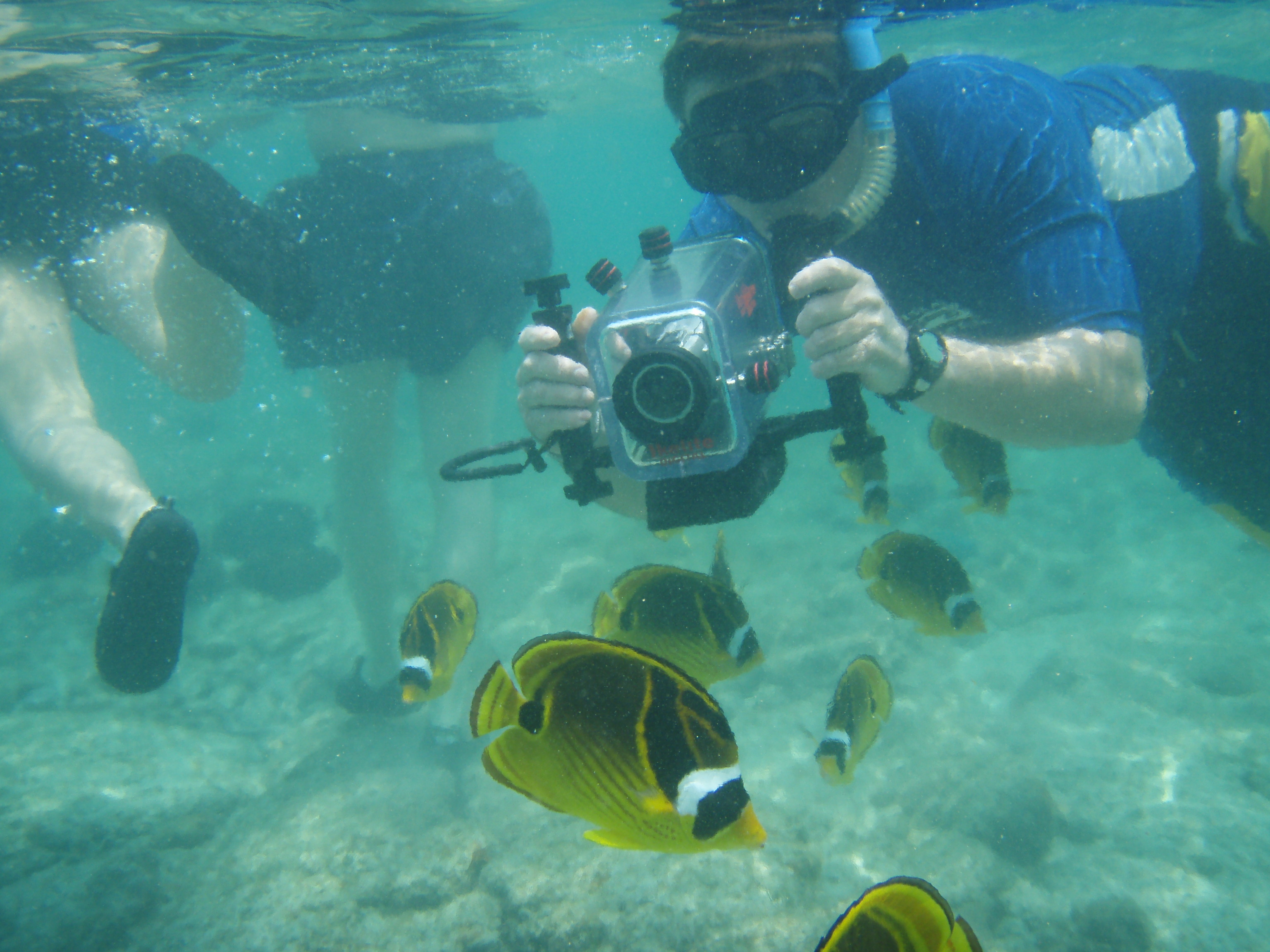
Bart Hunt Filming Fish at Kahalu'u Beach: Photo By Donnie MacGowan

Even choosing activities you want to participate in...do you want to snorkel, hike, go on a whale watching tour? We always recommend people do three basic things when they come to Hawaii: get in the air, go to a luau and get in the water. By getting in the air you get a glimpse of how magnificent our island home is, it is the best way to watch the volcano erupt and it allows you to sort of "scout" the island to see where you might want to spend more time. By going to a luau you get an introduction to Hawaiian culture and cuisine--you get a taste of what it means to live in Hawaii. And by getting in the water you experience the magic wonder of our reefs and colorful fish, the calm and renewal from floating in our warm, turquoise waters and the thrill of exploring something new, different and a little wild. We highly recommend you go snorkeling on your visit...but where do you go? Do you want a snorkel beach for beginners, or a place that's challenging to experience? Are you going simply to get in the water and see the fish or do you want a beach that's also alive with fun people? Are you looking for an experience that away from crowds, secluded and empty or one that's exciting, but perhaps a little more tame? Do you want to snorkel near your resort or one that's at the end of a day of delicious wandering?

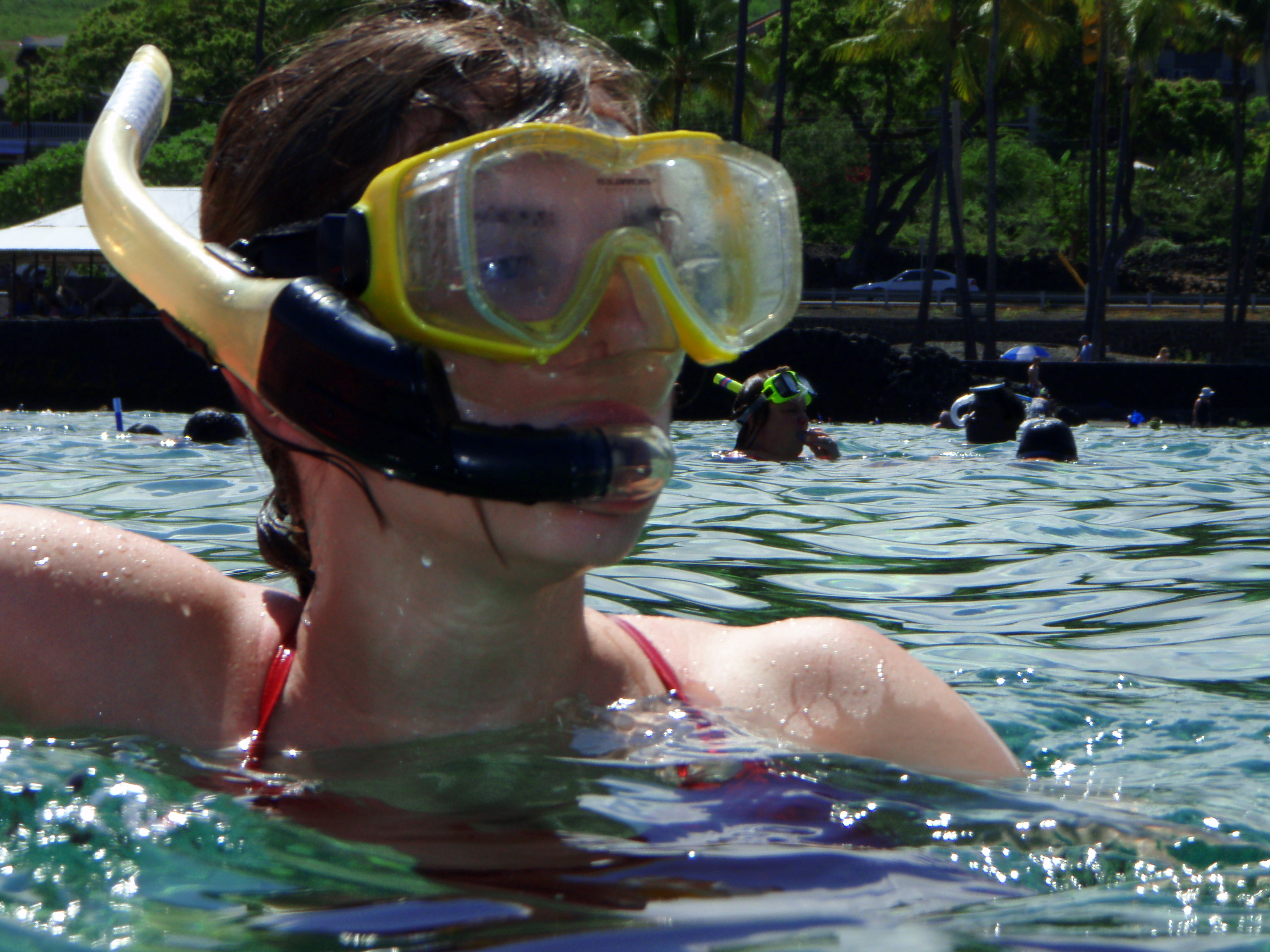
Liz Maus Snorkeling at Hounaunau Bay, Hawaii: Photo by Donnie MacGowan

Ranked in order, with the best on top, are our picks of the best snorkeling spots on the Island of Hawaii. We've tried to strike a balance in ranking these places since each is a gem in its own right, we've had to leave off many that are equally fine for their own reasons and of course, recommending some means that their popularity will increase and hence, they will become more crowded. This list at least provides an excellent starting point for deciding where you want to spend you beach time. When you arrive we ask that you treat these special places, and the people who live near them, with care, respect and aloha.

Two-Step Beach at Hounaunau Bay Has Some of the Finest Snorkeling in the World: Photo by Donald B. MacGowan

Two-Step Beach at Hounaunau Bay: Class Triple-A waters, stuffed with a wide variety of brilliant tropical fish, set in a calm and protected bay, and frequently visited by dolphins, this snorkeling area near the grounds of one of the most important Hawai'ian archeological sites is perhaps the most popular and one of the three top places to snorkel on the island. It earns the top spot because of it's easy accessibility.

Kealakekua Bay and Captain Cook Monument from Napo'opo'o: Photo by Donnie MacGowan

Kealakekua Bay: Whether you hike or boat to Captain Cook Monument, or enter the bay to snorkel at the end of the road in Napo'opo'o, there is no place on earth that has better snorkeling or more fish than Kealakekua Bay. Frequented by both dolphin and whale, protected, Class Triple A waters and a setting unmatched in beauty anywhere, this the premiere place for kayak-to-snorkel adventures on the island. Arguably, this bay and the Hawaiian settlements that surround it, experienced the most momentous and important historical events yet to unfold in the human history of the state of Hawaii.

Kahalu'u Beach, Kona Hawaii: Photo by Donnie MacGowan

Kahalu'u Beach: Referred to by many visitors as “Snorkel Beach” Kahalu'u is centrally located along Ali'i Drive in Kailua Kona. The welcoming waters are protected by a seawall and are amazingly warm, shallow and crystalline turquoise. The safety and ease of conditions here, many resident turtles and abundant colorful fish and the great facilities make this a perfect place to learn to snorkel, or for the tried and true veteran to “get wet and meet the fish”.

Hookena Beach in South Kona Is a Fabulous Beach Plunked Down in the Middle of Real Old Hawaii: Photo by Donald B. MacGowan
Ho'okena Beach in South Kona Is a Fabulous Beach Plunked Down in the Middle of Real Old Hawaii: Photo by Donald B. MacGowan

Ho'okena Beach: Ho'okena Beach is a fabulously beautiful beach park well off the beaten path, plunked down in the honest-to-gosh old Hawaiian village of Ho'okena. This beach has an amazing array of underwater topography populated by perhaps the greatest variety of reef fish n the island; recently rebuilt, this park has fine facilities including a refreshment stand as well as snorkel and kayak rentals. Ho'okena is a true snorkeler's mecca.

Long, Lonely and Wholly Wonderful Makalawena Beach in Kekahai State Park: Photo by Donald MacGowan

Makalawena Beach: Perhaps the loveliest wilderness beach in Polynesia, Makalawena is the perfect sand crescent, beach backed by palms and iron wood trees with morning-glory-draped sand dunes. A easy mile hike in from Kekaha Kai State Park keeps this beach uncrowded. Snorkeling here is better than perfect. Simply drive to Kekaha Kai State Park and walk the well-marked trail north to the beach.

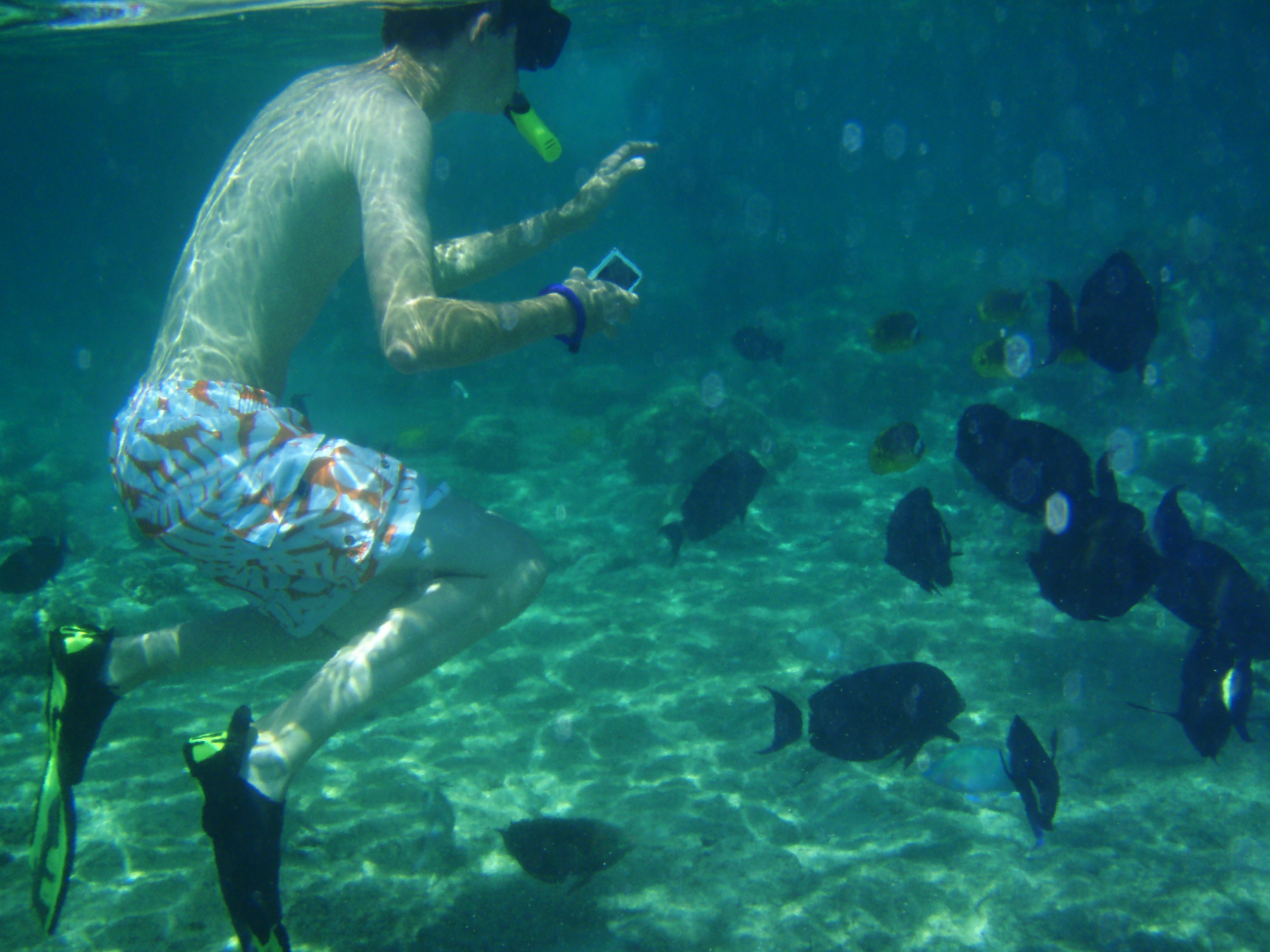
Bradford MacGowan Photographs a school of Humuhumuele'ele at Kahalu'u Beach: Photo by Donald MacGowan

Before we leave the topic of Best Snorkeling Beaches on the Island of Hawaii, we'd like to impress upon you the need to be proactive in keeping these places special and how to make your experience the best it can be. The open ocean is not your resort pool and deserves immense respect from you--the ocean is the strongest natural force on earth. Never snorkel alone, never turn you back on the ocean. Drink lots and lots of water; no, drink even more. Never snorkel after having consumed alcohol. Ask the lifeguard about conditions, chat with people coming out of the water about what they liked best and what conditions are like.

Bradford MacGowan Snorkeling at Pu'u Honua O Hounaunau: Photo by Donald MacGowan
.Gary Burton and his daughter snorkel at Hounaunau Bay: Photo by Donald MacGowan
Gary Burton and his daughter snorkel at Hounaunau Bay: Photo by Donald MacGowan

Please wear a hat and t-shirt to protect yourself from sunburn while in the water--never apply sunscreen just before entering the water,wait until you are done snorkeling and have rinsed off--sun-cream kills the coral and poisons the water. When in the water, do not stand directly upon the coral to rest, do not touch the coral or the fish; never feed the fish or other marine animals. Do not touch, approach, chase or harass the sea turtles, dolphins or whales--it's not only dangerous, it's illegal and will earn you a hefty fine. Always obey posted warnings and the lifeguard; do not swim in windy conditions (dangerous) or murky water (sharks); be aware of currents and rip tides. Jellies ride in with inshore breezes.

Amanda Maus Snorkeling at Kahalu'u Beach: Photo by Donald MacGowan

Get out before you feel tired, get out before you feel sunburned, get out before you get thirsty; get out before the wind comes up or the sun goes down; get out before you feel ready--you are more tired than you think. Rinse yourself and your gear off after snorkeling and remember to apply sun-cream liberally and often--you are getting more sun than you think. Always pack out everything you brought with you and dispose of your litter (and that stuff the ignorant slob over there left, as well) appropriately. These beaches get an enormous amount of pressure, try to leave Paradise a little nicer than you found it.

Laurie Maus Using a Boogie Board as a Floatie: Photo by Donnie MacGowan

And for heaven's sake, plunk-down ten bucks for a disposable underwater camera; in fact, buy two. I promise you will kick yourself from now until you return to Hawaii if you don't! You will want to show the folks back home your snorkel adventures, which seem to always be the most memorable of any trip to Paradise. Trust me, any money you spend on disposable underwater cameras will be the best return on investment of any part of your Hawaii vacation.

A video introducing the subject of snorkeling, technique, gear and safety can be found here.

Bart Hunt Snorkeling at Kahalu'u Bay: Photo by Donnie MacGowan

For more information of traveling to Hawaii in general or exploring the Big Island in particular, please also visit www.tourguidehawaii.com and www.lovingthebigisland.wordpress.com. Information about the author can be found here.

Monk seal at Honl's Beach near Kailua Kona: PHoto by Donald B. MacGowan
Monk seal at Honl's Beach near Kailua Kona: Photo by Donald B. MacGowan

All media copyright 2009 by Donald B. MacGowan.

Monday, July 13, 2009

What To Pack And Take To Hawaii: What You Need, What You Want, What You Can Leave Out Of Your Luggage

By Donald B. MacGowan

The MacGowan Family Deplanes in Sunny Hawaii; You Want To BE sure You Have Everything You Need to Enjoy Your Vacation, but Not So Much You Have To Haul a Pile of Luggage: Photo by Donnie MacGowan
The MacGowan Family Deplanes in Sunny Hawaii; You Want To Be sure You Have Everything You Need to Enjoy Your Vacation, but Not So Much You Have To Haul a Pile of Luggage: Photo by Donnie MacGowan

Packing Your Bags for Hawaii: With airlines charging for a second--or even for the first--piece of luggage, and strict "50 pounds each" weight limits being enforced, the thrifty traveler is wise to plan ahead carefully, to avoid racking-up expensive fees. I used to travel by the motto "Don't check baggage unless you can afford to lose it; if you can afford to loose it, why did you bring it?"; thus I never traveled with anything more than carry-on. While it is always good to travel lightly, with the advent of stringent new carry-on limits and my advancing age (and concomitant increasing desire to travel in comfort) I have learned to travel with only one piece of checked baggage plus carry-on. The key is packing intelligently so you can pack less.

MacGowan Family and Luggage for 3 for a Fourteen Day Trip to Hawaii: Photo by Donald B. MacGowan

Be Smart About Your Carry On Baggage: Most airlines allow you to bring one carry-on bag and a personal item such as a purse or a lap-top. I push this a little by bringing a carry-on bag plus my lap-top in a computer pack which also has room for one video camera, my SLR Camera and an emergency change of clothes (in case all my other luggage is lost). Usually they let me get away with this. Because I trust neither baggage handlers nor TSA inspectors and my luggage has been lost or ransacked and robbed more times than I remember, I pack my other cameras and the more of my clothes in my other carry on bag so they don't have to be checked. In this bag I also carry a quart of water and some snacks.

You'll want at least one book to read on the flight; your tickets, travelers checks, list of phone numbers, spare glasses (contacts and solution) and medications should be put in a water-proof bag in the carry-on bag you intend to hold most tightly to. It's a good idea to bring a copy of your eye-wear prescription, your health and car insurance cards, confirmations of hotel reservations, tours and activities and any printed itinerary you may have. Bring identification for your children. Put a swim suit and t-shirt in your carry-on--if your luggage is lost, you can wait for it by the pool! I always pack a small first aid kit, wet wipes and hand sanitizer. I always seem to use them. You'll want a sunhat, trust me.

Remember that more books, extra batteries, memory cards, video tape or film, masks-fins-snorkels, insect repellant, sun cream, beach towels--all the extra hoopla one might want on a Hawaii vacation--can be purchased at WalMart or Costco on-island as cheaply as the mainland. If you do pack film, and it is in your carry-on, be sure to protect it against x-rays.

Checked Luggage; First, Plan for Your Activities: Know your itinerary and pack only what you need; resist the temptation to toss in all those extra unnecessary items. You may be planning on some particular activities in Hawaii requiring specific gear or clothing--it is best to think this through thoroughly. Many people intend to save money by bringing their own snorkeling gear. This is false economy if it causes you to pay for additional luggage. Buying snorkel gear on island is fairly inexpensive and renting is faster, easier and even cheaper. The same can be said of renting diving gear and golf clubs. Activities such as hiking and horseback riding require a fairly specific wardrobe, but if you plan correctly, you only have to bring your hiking/riding boots and an extra pair of suitable pants and shirt. If you plan on visiting the mountain summits, remember that they can be quite cold--even snowy or rainy--so plan and pack accordingly. If you bring boots, I advise wearing them (and all your other bulky clothing) on the plane to save room and weight in your bags. As for photography gear or musical instruments--any expensive or delicate equipment for that matter--my philosophy is to never turn loose with it. Never check your cameras, your guitar, your laptop, etc--it's a recipe for theft, loss or destruction.

You Need More Suntan Lotion Than You Think...Put it on Before You Go Out in the Sun and Keep Putting It On Throughout The Day.  Likewise, Drink More Water Than You Think You Need...Drink Before You Get Thirsty, When You Get Thirsty and Drink Again After You've Just Had Some Water.  No, Drink Some More--I'm Serious: Photo By Donnie MacGowan
You Need More Suntan Lotion Than You Think...Put it on Before You Go Out in the Sun and Keep Putting It On Throughout The Day. Likewise, Drink More Water Than You Think You Need...Drink Before You Get Thirsty, When You Get Thirsty and Drink Again After You've Just Had Some Water. No, Drink Some More--I'm Serious: Photo By Donnie MacGowan

Next, Plan for the Weather: Being tropical, temperatures at sea level in Hawaii vary only by about 10 degrees between day and night and throughout the year. It's hot during the day, plan a cool wardrobe. The windward side is generally rainy and the "up-country" towns (mountains) frequently can experience afternoon showers. Evenings, particularly up-country, are delightfully cool as there is generally an evening or onshore breeze. With forethought, your wardrobe can cover all these situations without being bulky, heavy or ornate. Remember to pack layers of clothing for warmth, rather than one or two bulky coats and sweaters-this allows for maximum adaptability and a certain amount of built-in variability. This also means that if an emergency hotel-room laundry session is required, your laundry will dry much more quickly. Remember, chinos will dry in a day hanging in your room--jeans will stay wet all week. When deciding on wardrobe, bear in mind that Hilo is the rainiest city in the US; the Kona and Kohala Coast are mong the driest parts of the US, but rains do come here, as well.

Don't Forget Some Lightweight Raingear: Photo by Donnie MacGowan

Finally, Specifics: Be efficient--coordinate around a basic, neutral color so everything you bring matches everything else. Black or khaki are the traditional traveler's choices. Dark colors show dirt less than light colors, and this can be a saving grace where doing laundry is impractical. Choose clothes for lightness, packability and washability. Remember that suits in Hawaii are unnecessary; even Circuit Court judges wear Aloha Shirts under their robes here. A nice shirt, generally an Aloha Shirt, and a pair of khakis are the wardrobe of choice at the finer restaurants and nightclubs--everywhere else, it's shorts and sandals. I would advise a basic wardrobe consisting of a polo-style shirt and a couple Aloha Shirts, one pair of long khakis and three pair of shorts, a swimsuit, a couple tank tops or t-shirts, a sunhat and a light jacket for evenings; that's all you really need to cover most bases. Women may want to toss in a light sundress or skirt. Sandals are all you'll need or want in the way of footwear (your feet will be HOT)--you may want to toss in a pair of running shoes for exercise or hiking. Unless you are attending a formal event such as a wedding, don't worry about dressing up or you will not only find yourself carting far too much luggage, but awkwardly overdressed as well.

Jewelry is unneccessary, dress-code wise, it causes an extre security headache and it must be left in your hotel room when you are doing most activites. You are coming to Hawaii to get away from all the froofrah...leave the jewelry at home.

Be thoughtful about your wardrobe and activities: for instance, you may wish to think about bringing two swimsuits--you will be amazed how pleasant being in the water is in the hot tropics. Whether you are just cooling off in the pool or snorkeling with the turtles and fish, you'll probably want to swim everyday. Swimsuits rarely dry overnight and it's a lot more pleasant to get into a warm, dry suit than a wet, cold one. Also, if you plan on riding horseback or exploring the higher elevations such as Hawaii Volcanoes National Park or Mauna Kea, be sure to bring some chinos and appropriate footwear, a medium weight fleece sweater and light rain jacket/windbreaker. A compact traveler's umbrella is always a good idea--rains come at unexpected times and they make a nice shelter from the mid-day sun when walking around town or the resort.

Don't forget to pack your toiletries and personal items; I used to carry these on, in case of lost luggage, but restrictions on liquids and gels and razors make this impractical. Medications, of course, go in the carry-on. Sun block, sun hat, sunglasses, insect repellent and sun-burn cream (I use an aloe gel) will make your vacation smoother, but can be purchased cheaply locally if you don't quite have room for them.

Brad MacGowan on Kauai...A Tripod is Essential If You Intend To Photograph The Volcanic Eruptions Or Do Any Video Photography: Photo By Donnie MacGowan

Other Things to Bring: Just as an aside, two things you need to be head's up about when you are in Hawaii--if you begin to feel thirsty, you've waited too long to get a drink of water; if you begin to feel the sun, you've waited too long to put sun block on. Wear your sun hat. All the time. Drink more water than you think you need, apply sun block before you go out and re-apply more often that you think you need. Your body is used to more moderate climates and won't warn you in time of the danger. In fact, sometimes it's dry enough on the leeward side that you won't even feel yourself sweat—it evaporates before you get wet. So remember to keep drinking water—alcohol, coffee and ice tea (as well as caffeinated sodas) are both diuretic and vasodilatory, so are counterproductive to keeping hydrated and cool. Drink water. Lots and lots of water. Although bottled water is abundantly available, being a thrifty traveler, I always bring my own reusable water bottles. These may be carried on, but you need to take them through Security Screening empty, filling them at a water fountain before boarding—this also allows you to have water to drink during the flight, remembering that tap water on some airlines has proven to be unsafe.

Don't forget your sunglasses...if you are in the market to buy new ones, don't scrimp on price; Hawaii's tropical sun glaring off water and bright sand can permanently damage your eyes. If you can, get glasses that provide at least 90% darkening, screen 100% UVA and at least 80% UVB and IR. Cheap sunglasses, designer glasses with amber lenses or only slightly darkened lenses actually do more harm than good by causing the pupil of the eye to open up without screening enough of the damaging radiation out. Even if you wear regular glasses, bring prescription sunglasses or get good clip-ons--remember that cheap ones may be more damaging than none at all.

Lora Aller Hydrates on a Kona Coast Hike; Taking a Small Pack Helps Keep Water Bottles, Sunscreen, Sunglasses, Camera and Other Necessities Handy and Easy to Carry: Photo by Donald MacGowan

Many people plan ahead by leaving ample room in their luggage to bring back souvenirs and gifts; recent luggage restrictions are making this impractical. Rather than buying new outfits for my trip, I spend the week before my trip weeding through my wardrobe, packing one very nice set of clothes and the remainder are items I pack were already bound for the thrift store. Thus, I simply abandon them at the end of my stay and thereby have more than enough space in my luggage for anything I buy. Remember—Hawaii is part of the US and the U.S. Postal Service sells flat-rate, pre-paid, boxes for very inexpensive rates. Ask for "Flat Rate Shipping Boxes" and ship those gifts home safely, cheaply and with no fuss on your part.

You should toss in a small fanny pack or day-pack for day trips...it's amazing how many things you find you need to carry around during the day (sunscreen, water bottles, guidebook, camera, small purchases) and a pack helps to keep them organized and in hand. A small pack can also double as a laundry bag on the flight home.

I never travel anywhere without my laptop...you may not be so addicted, but I like being able to email photos and notes to friends left behind, as well as check-up on or change any reservations or activities at a moment's notice. Hawaii is so strange and wonderful anyway, you will wish you had access to Google to learn more about what you are seeing at least 5 times a day. They are a hassle at airport security and another thing to lug around, but I find it worthwhile. Free Wi-Fi is available all over the islands and your resort most likely will have it, as well. If you are traveling with children, a laptop with a few games in it can make long car rides or a rainy day more bearable.

A Small Pack Come In Very Handy For Keeping Your Stuff Together and Right At HAnd: Photo by Donald MacGowan
A Small Pack Come In Very Handy For Keeping Your Stuff Together and Right At Hand: Photo by Donald MacGowan

Although this is not the time for a discussion of vacation photography in general, let me say a few words about cameras. This is Hawaii for pete's sake, one of the most beautiful places on earth! You are going to want to take pictures while you are here, you are going to wish you had taken pictures all the long years down the road after you return if you do not. You do not have to be like me, packing two video cameras, a digital SLR and a digital underwater camera; even if you are not camera savvy at all, there are easy alternatives.

Simplest by far, and not terribly expensive, are pre-loaded, disposable film cameras. Available for $5-10 each, and costing about the same for film developing, these are the most basic point-shoot-enjoy photographic choice. There are even disposable underwater cameras if you plan on any swimming, kayaking or snorkeling. May I suggest that you have your film developed in Hawaii—WalMart, KMart and Costco all have 1-2 hour processing at reasonable prices. The color balance in Hawaii, because of its equatorial position (angle of sun and thickness of atmosphere) and the richness of the colors of flora, land and sea, is different to what most film-processing shops know and thus, if you wait until you return home to develop the film, the colors will turn our disappointingly. Getting your film processed on island also allows you to share prints with people you meet or are visiting.

Digital cameras may at first seem confusing, but are really much easier to deal with than film cameras, have such great storage capacity that they quickly pay for themselves in film and processing costs and produce images that, even for the rank beginner, are startling and gorgeous. You don't even need a computer to enjoy your digital pictures, just take them to any film processing shop and they'll make prints for you—much more cheaply than prints from film. If you plan to buy a digital camera for the trip, or are not quite used to the one you have, start practicing with it about a month before you leave...standing with your arm around your lover in the perfect sunset, with the palm trees swaying, the hula girls dancing on the beach and the humpback whales leaping in the ocean (oh, yes, these scenes DO happen!) is not the time to be fiddling with camera and instruction booklet trying to figure out how the damn thing works. Secondly, be sure to bring that instruction book, all accessory cords, chargers and adapters in a small plastic baggie when you come—they are expensive to buy on vacation and you never know what you'll need. Experience will teach what you can leave behind on successive trips. If buying a new digital camera to immortalize your trip to Paradise, think about getting a waterproof version. Most major camera manufacturers produce fine, submersible cameras, good to 40 feet or so, that are every bit as good as the regular cameras and are not very much more expensive. Many also have video features that allow you to take brief video clips, even underwater. One final note on your camera—never let go of it. Keep it in your carry-on bag during the flight, in your pocket or you day pack on the trip, do not leave it in your rental car or your hotel room or lunch table. Ever.

Amanda, Liz and Amy Maus Pose for the Underwater Camera: Photo by Donald MacGowan
Amanda, Amy and Laurie Maus Pose for the Underwater Camera: Photo by Donald MacGowan

Another useful item, many tourists bring their GPS from home to help navigate—be sure to download the maps for Hawaii before you come; some brands of GPS do not offer Hawaii coverage. A few of the rental car agencies have GPS units for rent at reasonable prices. The best solution, however, are the folks at Tour Guide Hawaii (808.557.0051; www.tourguidehawaii.com) who offer a hand-held computer with an onboard GPS at very reasonable rental rates (a video about the Tour Guide product is available here). They have stuffed into this device over six hundred points of interest (did you hear that? 600!) of recreational, cultural and historical importance. They have produced a short audio/video presentation for each site, telling you all about it, the history and culture, what to bring, what to do while there; they even have the public restrooms listed! These presentations play as you approach the points of interest, or can be searched for at any time or location. Thus, the device can be used to preview all the sites around the island in the comfort of your hotel room, pre-plan trips or to get information and turn by turn navigation on the road. Combining cutting-edge technology and old-fashioned story-telling, the unbelievably easy to use, fabulously informative and terrifically fun Tour Guide Self-Guided GPS Tours are an amazing bargain and a great way to see Hawaii. They are now offering a pared-down version (45 of the top sites—AND the restrooms!) that is downloadable to iPhone and iPod.

Finally, one of the most enduring visions I have of travel is standing exhausted, late night at the luggage carousel as hordes of weary travelers lift first one anonymous piece of black luggage, then the next, searching for their own amongst a sea of ubiquitous black nylon and leather travel bags. Not everyone is comfortable carrying the bright Hawaiian print luggage I have (although I always instantly recognize my bags...except when returning to Hawaii where EVERYBODY has this luggage), but there are ways to customize and personalize your bags. One of the more common, and therefore useless, is the nylon rainbow-colored strap...there are almost as many of these wrapped around the anonymous black luggage as there are plain black bags themselves. Airlines don't like straps and cords flopping around off the luggage, for obvious reasons, but you can buy colorful and unique baggage tags or tie a bit of uniquely colored ribbon or a small scarf to the handle of your luggage...just something that screams “Mine!” to you as it slides down onto the carousel so you do not have to search plaintively through the weary lot of black bags with rainbow belts on them.

The MacGowan Family Deplanes From Airforce 1--Even Traveling in Style Your Luggage Can Get Lost So Plan Ahead: Photo by Donald B. MacGowan

This is Hawaii, remember? You came to have fun!

For more information on traveling to Hawaii in general, or touring the Big Island in particular, please also visit www.tourguidehawaii.com and www.lovingthebigisland.wordpress.com. Information about the author can be found here.

All media copyright 2009 by Donald B. MacGowan

Wednesday, July 1, 2009

Frank's Guide to Pronouncing the Hawaiian Langauge

by Frank Burgess

When people come to Hawai'i, especially for the first time, they notice that most of the locations, towns and street names are in a language they are unfamiliar with. It looks strange and sounds even stranger. But Hawaiian isn't very difficult to pronounce once you know a few basic ideas and rules.

Hawaii Has Very Poor Signage for Towns, Beaches and Attractions; What Signs There Are Are n Hawaiian Words Which May Be Hard For The Visitor To Pronounce And Remember: Photo By Kilgore Trout

Alphabet: The Hawaiian alphabet has five vowels and seven consonants; a total of 12 letters altogether. Several vowels may be used in a row, but consonants are never placed together. Some words have no consonants at all and Hawaiian words always end with a vowel. There are many subtle nuances to the language as well, but for now let's just hit the basics.

Vowels: The vowel sounds in Hawaiian are always pronounced the same and are similar to Spanish or Latin. This chart might visually help as we progress through the sounds using “b” at the beginning and “t” at the end of each vowel sound:

A...pronounced as a soft “u” as in but. (not “aw”)
E...pronounced as a soft “e” as in bet. (not “ay”)
I...pronounced as a hard “e” as in beet.
O...pronounced as a hard “o” as in boat.
U...pronounced as a hard “u” as in boot.

Even at Highway Speeds, The English on This Sign IS Easy To Read, Whereas The Visitor May Have Trouble Decoding The Hawaiian Language Words Quickly Quickly Enough to Turn: Photo By Japhy Ryder
Even at Highway Speeds, The English on This Sign Is Easy To Read, Whereas The Visitor May Have Trouble Decoding The Hawaiian Language Words Quickly Quickly Enough to Turn: Photo By Japhy Ryder

These are the most common vowel sounds. There are some exceptions, such as words with a macron. The macron extends the vowel sound to twice the normal value. (Not all road signs and maps include the macron.)

Ä€ = Bought...pronounced as “aw” and extends the sound.
Ä’ = Bet...and extends the sound.
Ī = Beet...and extends the sound.
Ō = Boat...and extends the sound.
Ū = Boot...and extends the sound.

Hokina: The hokina looks like a comma and is added to Hawaiian words to change the meaning or to replace consonants that have been dropped over time. It creates a glottal stop (a slight hesitation with an “uh”, like starting a new word). The hokina will always occur between vowels, especially the same vowel repeated (a'a, i'i, etc). Because of it's significance, in 2004 the hokina was officially added as the 13th letter in the Hawaiian language.

As you explore Hawai'i, you can now begin to pronounce the words correctly. Have fun and aloha.

For more information on traveling to Hawaii in general and visiting the Big Island in particular, please also see www.tourguidehawaii.com and www.lovingthebigisland.wordpress.com.

Copyright 2009 by Frank Burgess.

Friday, June 12, 2009

Frank's Big Island Travel Hints #12: More fun in Hawaii Volcanoes National Park, Big Island, Hawaii

Deeper and Deeper into Hawaii Volcanoes National Park

As you continue driving around and exploring Hawaii Volcanoes National Park you will find many great hiking and bicycling opportunities. Tour Guide has some 50 sights to see in the park and has details such as, parking, food and water and restroom facilities along the way.


One of the best day hikes in the park is the Kilauea Iki Crater Trail. This four mile round trip hike, about three hours at a nominal pace, will descend into the crater itself. From the floor of the crater, you will see fern, Ohia, and tropical rainforest crowding right up to the rim. The floor itself is stark desert, by comparison, as the trail takes you across and then up the other side. Make sure to bring plenty of water and maybe even some snacks for this hike.


To see even more of the parks wonders, we at Tour Guide suggest a drive down the Chain of Craters Road. This drive unlocks dozens more sights, hikes and vistas from high mountain rainforest to the barren lava landscapes and scenic ocean views below. Along this road are a number of overlooks for some fabulous photography. It ends at the sea where waves crash and spew against cliffs with steam clouds in the distance where lava reaches the ocean. Let’s see what this stunning area has to offer.


Lua Manu is a pit crater formed before written records were kept of the eruptive activity in the park. You will notice no cinder around the rim. This indicates no eruption here but a lava lake that formed inside the pit. As it drained, the pit collapsed, the latest of which was in 1974.


There are several more pit craters to see along this route and then you will come to Hilina Pali Road. This nine mile road takes you to some of the most magical views of the National Park. From forest down to the coast, the breathtaking scenery with leave you with the awe and majesty of Mother Nature and Madam Pele. For the hearty campers, Tour Guide will lead you to Kulanaokuaiki Campground. There are restrooms here but no water is available. At the end of Hilina Pali Road is an overlook not to be missed.


Back on Chain of Craters Road, Tour Guide brings you to Pauahi Crater, a large hourglass shaped crater that has held lava from many different flows over the years. Most recently, the 1979 earthquakes opened the south rift of the crater and issued steam and lava fountains. Though this episode only lasted one day, it was precursor to the current flows from Pu’u O’o in 1983 that destroyed hundreds of homes and businesses miles away in the Puna District.


Tour Guide will guide you to Kipuka Kahali’i. A kipuka is a hole or space where the lava surrounded forest or grassland but did not burn it. This one was partially devastated by the 1969 hot ash eruption of Mauna Ulu. The tallest trees survived and some hearty species of plants have returned.

For more information on visiting Hawaii in general and touring the Big Island in particular, please also visit www.tourguidehawaii.com and www.lovingthebigisland.wordpress.com.


Tuesday, May 26, 2009

Hawaii Island Snorkeling Tips, Part IV: Snorkeling Safety

By Donnie MacGowan

Coming to my island for a vacation? There are three things I always recommend the first-time visitor do. First, go on an air tour. Secondly--go to a luau. Finally, I advise people of every age to get in the water and go snorkeling. The "one-one-one, experiencing the world through the fishes' eyes" magic of swimming in those bath-warm lagoons surrounded by clouds of tropical fish is an amazing, restful and restorative pursuit-you will find your mind going back to that experience over and over through the years much more so than many of your other travel experiences. Part I of this series discuses Snorkeling Gear; Part II of this series will discuss Snorkeling Technique and Part III will cover Snorkeling Etiquette; Part IV of the series covers Snorkeling Safety and Part V will cover Big Island Snorkel Spots.

Photo by Donald MacGowan
Bradford MacGowan Snorkeling at Pu'u Honua O Hounaunau: Photo by Donald MacGowan

We've covered snorkeling gear and technique...before we go any farther, let's talk a minute about snorkeling safety.

First and foremost, as with all ocean sports, never turn your back on the ocean. Just as important, never snorkel alone; never get more than 20 feet from your partner. Before getting in the ocean, memorize the color of your partner's mask and snorkel…this is how you will recognize him from a distance in the water. Listen to advice from the lifeguards, obey posted warnings, always pay attention to the currents, surf conditions and surges over rocks.

Plan your points of entry and exit before you get wet; try to enter and exit from sandy areas with little of no surf. You and your partner should agree on a plan about where you are getting in and getting out of the water, what part of the bay you are going to explore and how long you plan to be out. Don't overestimate your abilities, plan conservatively, err on the side of safety. Don't change this plan, once you are in the water, except to make it shorter and more safe.

Don't confront incoming waves head-on, don't try to jump over them and don't turn your back on them; duck under incoming waves before they reach you. Watch the local kids on boogie boards...see how they duck the waves? You do that, too.

Never snorkel on windy days. Offshore winds may take you unexpectedly out to sea or make it hard to swim back in and onshore breezes stack extra water, high on the beach, making nasty rip-currents as it flows back into the ocean. Onshore breezes also bring in jelly fish and man-o-war.

If you are caught in a current, don't panic; don't swim against the current but rather swim diagonally across it toward shore. Keep going, you'll make it.

Poke your head out of the water frequently to check that your partner is within 20 feet of you and to keep yourself oriented relative to your entry and exit places. Stay alert--it's easy to loose track of time, get carried farther than you thought by a current you didn't even notice, wander out of your comfort zone, lazily paddle away from your partner, accidentally stray into a dangerous zone. I cannot stress this enough--it's easy to get overtired; get your partner and swim in BEFORE you feel fatigued, thirsty, sunburned; BEFORE the wind comes up or the surf builds. So stay focused, stay oriented, always know where you are, where your partner is.

Photo by Donnie MacGowan

Lee Ann MacGruder Snorkels the shallows at Ho'okena Beach: Photo by Donnie MacGowan

Sunscreen washing off your body pollutes the water and is a major factor in coral death--wear a t-shirt and baseball cap to avoid sunburn while in the water, waiting until you are out of the ocean and rinsed off to apply sunscreen.

Many things in the ocean sting, most commonly sea urchins--avoid them, do not handle or step on them. White vinegar kills sea urchin stings from embedded spines and, regularly applied, helps to dissolve the spine. Other home remedies for sea urchin, jelly fish and other stings include the application of moistened tobacco, hydrogen peroxide or urine (this latter can be hard to self-administer and will quickly let you know who your real friends are). Like wasp stings, most stings from ocean creatures are not medically dangerous, merely a painful nuisance, but it's best to be prepared with whatever remedy you choose in your beach kit. Some jellyfish stings and all man-o-war stings are potentially life-threatening and need to be treated at the emergency department of the nearest hospital.

This shouldn't even need mentioning, but of course, if you've been drinking--even a little, you should not go snorkeling. Snorkeling is best done between about 9 a.m. and noon, anyway, so sobriety shouldn't even be an issue. Oh, right; you're on vacation--I forgot.

Don't forget to drink lots of water…immersion in salt water is very dehydrating and just swimming around you've worked harder--and sweated more--than you realize. Be kind to your skin and rinse yourself and your gear with fresh water immediately after you get out of the ocean and remember to apply sunscreen and wear your sunglasses. Don't overestimate your skin's tolerance for beach sun; a nasty sunburn is distressingly easy to acquire and will absolutely ruin your vacation. Now might be a good time to go inside and cool off, rest a bit--you are on vacation, you know?

Photo by Donald MacGowan
Bradford MacGowan Photographs a school of Humuhumuele'ele at Kahalu'u Beach: Photo by Donald MacGowan

That's a few of the gear technique and safety tips you should bear in mind...remember to heed whatever advice the lifeguards give you--they are seasoned professionals who intimately know their beach; obey posted rules and be wary of riptides and currents. Most of all, spring for a cheap-o $10 disposable underwater camera, get in the water and enjoy...those fish won't photograph themselves, you know!

A video covering many of these topics is available here.

For more information about visiting and touring Hawaii in general, and exploring the fabulous snorkeling on the Big Island in particular, visit http://www.tourguidehawaii.com and www.lovingthebigisland.wordpress.com - a short video about snorkeling in Hawaii is available here. To see a funny video of my family learning to snorkel in Hawaii, go here. For information about the author, go here.

All media copyright 2009 by Donald B. MacGowan.

Friday, May 22, 2009

Packing for a Trip To Hawaii: What to Bring, How To Pack, More Advice Than You Need

What Do I Take When I Go To Hawaii?

The MacGowan Family Deplanes in Sunny Hawaii; You Want To BE sure You Have Everything You Need to Enjoy Your Vacation, but Not So Much You Have To Haul a Pile of Luggage: Photo by Donnie MacGowan
The MacGowan Family Deplanes in Sunny Hawaii; You Want To Be sure You Have Everything You Need to Enjoy Your Vacation, but Not So Much You Have To Haul a Pile of Luggage: Photo by Donnie MacGowan

Packing Your Bags for Hawaii: With airlines charging for a second--or even for the first--piece of luggage, and strict "50 pounds each" weight limits being enforced, the thrifty traveler is wise to plan ahead carefully, to avoid racking-up expensive fees. I used to travel by the motto "Don't check baggage unless you can afford to lose it; if you can afford to loose it, why did you bring it?"; thus I never traveled with anything more than carry-on. While it is always good to travel lightly, with the advent of stringent new carry-on limits and my advancing age (and concomitant increasing desire to travel in comfort) I have learned to travel with only one piece of checked baggage plus carry-on. The key is packing intelligently so you can pack less.

MacGowan Family and Luggage for 3 for a Fourteen Day Trip to Hawaii: Photo by Donald B. MacGowan

Be Smart About Your Carry On Baggage: Most airlines allow you to bring one carry-on bag and a personal item such as a purse or a lap-top. I push this a little by bringing a carry-on bag plus my lap-top in a computer pack which also has room for one video camera, my SLR Camera and an emergency change of clothes (in case all my other luggage is lost). Usually they let me get away with this. Because I trust neither baggage handlers nor TSA inspectors and my luggage has been lost more times than I remember, I pack my other cameras and the majority of my clothes in my other carry on bag so they don't have to be checked. In this bag I also carry a quart of water and some snacks.

You'll want at least one book to read on the flight; your tickets, reservation confirmations, travelers checks, list of phone numbers, spare glasses (contacts and solution) and medications should be put in a water-proof bag in the carry-on bag you intend to hold most tightly to.

Remember that more books, extra batteries, memory cards, video tape or film, masks-fins-snorkels, insect repellant, sun cream, beach towels--all the extra hoopla one might want on a Hawaii vacation--can be purchased at WalMart or Costco on-island as cheaply as the mainland. If you do pack film, and it is in your carry-on, be sure to protect it against x-rays.

Checked Luggage; First, Plan for Your Activities: Know your itinerary and pack only what you need; resist the temptation to toss in all those extra unnecessary items. You may be planning on some particular activities in Hawaii requiring specific gear or clothing--it is best to think this through thoroughly. Many people intend to save money by bringing their own snorkeling gear. This is false economy if it causes you to pay for additional luggage. Buying snorkel gear on island is fairly inexpensive and renting is faster, easier and even cheaper. The same can be said of renting diving gear and golf clubs. Activities such as hiking and horseback riding require a fairly specific wardrobe, but if you plan correctly, you only have to bring your hiking/riding boots and an extra pair of suitable pants and shirt. If you plan on visiting the mountain summits, remember that they can be quite cold--even snowy or rainy--so plan and pack accordingly. If you bring boots, I advise wearing them (and all your other bulky clothing) on the plane to save room and weight in your bags. As for photography gear or musical instruments--any expensive or delicate equipment for that matter--my philosophy is to never turn loose with it. Never check your cameras, your guitar, your laptop, etc--it's a recipe for theft, loss or destruction.

You Need More Suntan Lotion Than You Think...Put it on Before You Go Out in the Sun and Keep Putting It On Throughout The Day.  Likewise, Drink More Water Than You Think You Need...Drink Before You Get Thirsty, When You Get Thirsty and Drink Again After You've Just Had Some Water.  No, Drink Some More--I'm Serious: Photo By Donnie MacGowan
You Need More Suntan Lotion Than You Think...Put it on Before You Go Out in the Sun and Keep Putting It On Throughout The Day. Likewise, Drink More Water Than You Think You Need...Drink Before You Get Thirsty, When You Get Thirsty and Drink Again After You've Just Had Some Water. No, Drink Some More--I'm Serious: Photo By Donnie MacGowan

Next, Plan for the Weather: Being tropical, temperatures at sea level in Hawaii vary only by about 10 degrees between day and night and throughout the year. It's hot during the day, plan a cool wardrobe. The windward side is generally rainy and the "up-country" towns (mountains) frequently can experience afternoon showers. Evenings, particularly up-country, are delightfully cool as there is generally an evening or onshore breeze. With forethought, your wardrobe can cover all these situations without being bulky, heavy or ornate. Remember to pack layers of clothing for warmth, rather than one or two bulky coats and sweaters-this allows for maximum adaptability and a certain amount of built-in variability. This also means that if an emergency hotel-room laundry session is required, your laundry will dry much more quickly.

Don't Forget Some Lightweight Raingear: Photo by Donnie MacGowan

Finally, Specifics: Be efficient--coordinate around a basic, neutral color so everything you bring matches everything else. Black or khaki are the traditional traveler's choices. Dark colors show dirt less than light colors, and this can be a saving grace where doing laundry is impractical. Choose clothes for lightness, packability and washability. Remember that suits in Hawaii are unnecessary; even Circuit Court judges wear Aloha Shirts under their robes here. A nice shirt, generally an Aloha Shirt, and a pair of khakis are the wardrobe of choice at the finer restaurants and nightclubs--everywhere else, it's shorts and sandals. I would advise a basic wardrobe consisting of a polo-style shirt and a couple Aloha Shirts, one pair of long khakis and three pair of shorts, a swimsuit, a couple tank tops or t-shirts, a sunhat and a light jacket for evenings; that's all you really need to cover most bases. Women may want to toss in a light sundress or skirt. Sandals are all you'll need or want in the way of footwear (your feet will be HOT)--you may want to toss in a pair of running shoes for exercise or hiking. Unless you are attending a formal event such as a wedding, don't worry about dressing up or you will not only find yourself carting far too much luggage, but awkwardly overdressed as well.

Be thoughtful about your wardrobe and activities: for instance, you may wish to think about bringing two swimsuits--you will be amazed how pleasant being in the water is in the hot tropics. Whether you are just cooling off in the pool or snorkeling with the turtles and fish, you'll probably want to swim everyday. Swimsuits rarely dry overnight and it's a lot more pleasant to get into a warm, dry suit than a wet, cold one. Also, if you plan on riding horseback or exploring the higher elevations such as Hawaii Volcanoes National Park or Mauna Kea, be sure to bring some jeans and appropriate footwear, a medium weight fleece sweater and light rain jacket/windbreaker. A compact traveler's umbrella is always a good idea.

Don't forget to pack your toiletries and personal items; I used to carry these on, in case of lost luggage, but restrictions on liquids and gels and razors make this impractical. Medications, of course, go in the carry-on. Sun block, sun hat, sunglasses and sun-burn cream (I use an aloe gel) will make your vacation smoother, but can be purchased cheaply locally if you don't quite have room for them.

Brad MacGowan on Kauai...A Tripod is Essential If You Intend To Photograph The Volcanic Eruptions Or Do Any Video Photography: Photo By Donnie MacGowan

Other Things to Bring: Just as an aside, two things you need to be head's up about when you are in Hawaii--if you begin to feel thirsty, you've waited too long to get a drink of water; if you begin to feel the sun, you've waited too long to put sun block on. Drink more water than you think you need, apply sun block before you go out and re-apply more often that you think you need. Your body is used to more moderate climates and won't warn you in time of the danger. In fact, sometimes it's dry enough on the leeward side that you won't even feel yourself sweat—it evaporates before you get wet. So remember to keep drinking water—alcohol, coffee and ice tea (as well as caffeinated sodas) are both diuretic and vasodilatory, so are counterproductive to keeping hydrated. Drink water. Lots and lots of water. Although bottled water is abundantly available, being a thrifty traveller, I always bring my own reusable water bottles. These may be carried on, but you need to take them through Security Screening empty, filling them at a water fountain before boarding—this also allows you to have water to drink during the flight, remembering that tap water on some airlines has proven to be unsafe.

Many people plan ahead by leaving ample room in their luggage to bring back souvenirs and gifts; recent luggage restrictions are making this impractical. Rather than buying new outfits for my trip, I spend the week before my trip weeding through my wardrobe, packing one very nice set of clothes and the remainder are items that were already bound for the thrift store. Thus, I simply abandon them at the end of my stay and thereby have more than enough space in my luggage for anything I buy. Remember—Hawaii is part of the US and the U.S. Postal Service sells flat-rate, pre-paid, boxes for very inexpensive rates. Ask for "Flat Rate Shipping Boxes" and ship those gifts home safely, cheaply and with no fuss on your part.

You should toss in a small fanny pack or day-pack for day trips...it's amazing how many things you find you need to carry around during the day (sunscreen, water bottles, guidebook, camera, small purchases) and a pack helps to keep them organized and in hand. A small pack can also double as a laundry bag on the flight home.

A Small Pack Come In Very Handy For Keeping Your Stuff Together and Right At HAnd: Photo by Donald MacGowan
A Small Pack Come In Very Handy For Keeping Your Stuff Together and Right At Hand: Photo by Donald MacGowan

Although this is not the time for a discussion of vacation photography in general, let me say a few words about cameras. This is Hawaii for pete's sake, one of the most beautiful places on earth! You are going to want to take pictures while you are here, you are going to wish you had taken pictures all the long years down the road after you return. You do not have to be like me, packing two video cameras, a digital SLR and a digital underwater camera; even if you are not camera savvy at all, there are easy alternatives.

Simplest by far, and not terribly expensive, are pre-loaded, disposable film cameras. Available for $5-10 each, and costing about the same for film developing, these are the most basic point-shoot-enjoy photographic choice. There are even disposable underwater cameras if you plan on any swimming, kayaking or snorkeling. May I suggest that you have your film developed in Hawaii—WalMart, KMart and Costco all have 1-2 hour processing at reasonable prices. The color balance in Hawaii, because of its equatorial position (angle of sun and thickness of atmosphere) and the richness of the colors of flora, land and sea, is different to what most film-processing shops know and thus, if you wait until you return home to develop the film, the colors will turn our disappointingly. Getting your film processed on island also allows you to share prints with people you meet or are visiting.

Digital cameras may at first seem confusing, but are really much easier to deal with than film cameras, have such great storage capacity that they quickly pay for themselves in film and processing costs and produce images that, even for the rank beginner, are startling and gorgeous. You don't even need a computer to enjoy your digital pictures, just take them to any film processing shop and they'll make prints for you—much more cheaply than prints from film. If you plan to buy a digital camera for the trip, or are not quite used to the one you have, start practicing with it about a month before you leave...standing with your arm around your lover in the perfect sunset, with the palm trees swaying, the hula girls dancing on the beach and the humpback whales leaping in the ocean (oh, yes, these scenes DO happen!) is not the time to be fiddling with camera and instruction booklet trying to figure out how the damn thing works. Secondly, be sure to bring that instruction book, all accessory cords, chargers and adapters in a small plastic baggie when you come—they are expensive to buy on vacation and you never know what you'll need. Experience will teach what you can leave behind on successive trips. If buying a new digital camera to immortalize your trip to Paradise, think about getting a waterproof version. Most major camera manufacturers produce fine, submersible cameras, good to 40 feet or so, that are every bit as good as the regular cameras and are not very much more expensive. Many also have video features that allow you to take brief video clips, even underwater. One final note on your camera—never let go of it. Keep it in your carry-on bag during the flight, in your pocket or you day pack on the trip, do not leave it in your rental car or your hotel room or lunch table. Ever.

Amanda, Liz and Amy Maus Pose for the Underwater Camera: Photo by Donald MacGowan

Finally, one of the most enduring visions I have of travel is standing exhausted, late night at the luggage carousel as hordes of weary travelers lift first one anonymous piece of black luggage, then the next, searching for their own amongst a sea of ubiquitous black nylon and leather travel bags. Not everyone is comfortable carrying the bright Hawaiian print luggage I have (although I always instantly recognize my bags...except when returning to Hawaii where EVERYBODY has this luggage), but there are ways to customize and personalize your bags. One of the more common, and therefore useless, is the nylon rainbow-colored strap...there are almost as many of these wrapped around the anonymous black luggage as there are plain black bags themselves. Airlines don't like straps and cords flopping around off the luggage, for obvious reasons, but you can buy colorful and unique baggage tags or tie a bit of uniquely colored ribbon or a small scarf to the handle of your luggage...just something that screams “Mine!” to you as it slides down onto the carousel so you do not have to search plaintively through the weary lot of black bags with rainbow belts on them.

The MacGowan Family Deplanes From Airforce 1--Even Traveling in Style Your Luggage Can Get Lost So Plan Ahead: Photo by Donald B. MacGowan

This is Hawaii, remember? You came to have fun!

For more information on traveling to Hawaii in general, or touring the Big Island in particular, please also visit www.tourguidehawaii.com and www.lovingthebigisland.wordpress.com. Information about the author can be found here.

All media copyright 2009 by Donald B. MacGowan


Casino Bonus no Deposit