Showing posts with label vacation. Show all posts

Tuesday, September 8, 2009

Fabulous New iPhone and iPod Interactive Guide to Hawaii...Available Now in the Apple App Store!

Inexpensive, incredibly interesting, indispensable.

Tour Guide Hawaii: Helping you day dream about, get organized for and enrich your trip to Hawaii!

Tour Guide Hawaii is a MUST HAVE application for Island visitors with an iPhone or iPod Touch. It will save you from "option overload" by helping you and your group select the sites to visit of most interest to you. By providing you with in depth descriptions, history, directions, GPS coordinates and restroom information, Tour Guide Hawaii will also save you time and money! By watching the informative videos, you can use this app to pre-plan your trip at home, in your hotel room or to learn more about the wondrous places you are visiting on the fly. Hawaii residents with GPS iPhones will especially love the quick access to turn-by-turn directions and driving times to popular island destinations. It's so easy and so packed with fascinating information you'll wonder how people ever traveled without one!

Tour Guide Hawaii's in depth video presentations will tell you where to go, what to do, what to bring with you----saves you time and money by helping you decide which sites you absolutely MUST SEE!

Tour Guide Hawaii has been providing innovative touring products to the visitors the Big Island of Hawaii since 2004. Produced by island residents, this application contains over 3.5 hours of videos and audio/visual presentations on over fifty popular destinations, including some truly special places off the beaten path. With this App, you can experience the wonder of flowing lava, pristine snorkeling spots, spectacular waterfalls, scenic hikes, unbelievable beaches, breathtaking parks; you will be able to quickly and easily find secluded beaches, caves, quaint towns, lava viewing, natural wonders, ancient historical sites, and much much more.

Each site has multiple pages of content and information. This includes an overview presentation with photos and a professionally recorded script which provides the site's details and history. This will help to determine your interest in visiting sites, and enable you to get more out of them once you arrive. Information for each site also includes information on what to bring and what to do, parking, access, facilities and amenities, an interactive map section which offers detailed audio instructions for getting there, an illustrated map, GPS coordinates for your navigation device, an interactive map(internet required), and turn-by-turn directions (GPS iPhone required). The illustrated map, offers useful directions and driving tips for iPod Touch users and for all users in regions with limited cellular service. Finally, each site contains information about the location and condition of nearby restrooms--a real bonus for strangers in a strange land.

Enrich your exploration of the Big Island with information! Sites and attractions are listed geographically and alphabetically to help you get where you are going and know what you are seeign when you get there!
Enrich your exploration of the Big Island with information! Sites and attractions are listed geographically and alphabetically to help you get where you are going and know what you are seeing when you get there!

Users have four ways to view a complete listing of island sites. Since the island's coastal highway system takes a circular path around the island, you can view sites in the direction you are traveling in, both the clockwise and anti-clockwise. The listings also are subdivided into geographic districts, helping you to easily select nearby destinations and restrooms. You can also quickly select sites through an alphabetical listing and the interactive map.

Bonus features include presentations to help orientate you to the island, plan for your trip, and make you feel at home once you arrive. An island overview video will quickly familiarizes you to the island and all of its regions. Audio/Visual presentations cover topics such as what to pack, island transportation, lava viewing, petroglyph fields, wildlife, snorkeling, island culture, useful Hawaiian terms and more. There are also listings of top beaches, hikes, and snorkeling sites. We've even provided itinerary suggestions to help you make the most out or your time in the island. And you'll able to access all of this content quickly after viewing the provided quick start guide to our application.

We're currently offering our application at a low introductory rate. Update versions, incorporating sophisticated enhancements currently in development, will be available as free upgrades in the near future. In its current release, our application is a bargain indeed...less expensive and more detailed than standard guidebooks, more informative than cumbersome maps and cheaper by far than bus and specialized van tours that can cost a small fortune on the Big Island. Also, our Guide allow you to set your own itinerary, taking you to the places that interest you most, letting you stay the length of time you wish. Constantly updated, our information is never out of date. And touring the island in a rental car without our application could cost you a lot of wasted time and money...there's a reason they call this "The Big Island", and road are poorly marked.

Tour Guide's interactive, touch screen map puts the Island of Hawaii at your fingertips and helps you plan your trip, find sites of interest nearby or just put it all in context...

We know from years of positive testimonials that the content in this application will empower you to experience YOUR perfect Big Island experience.

Whether you are on the Big Island right now, coming next week, or just planning it for the future, Tour Guide Hawaii is the best way to day-dream about Hawaii, organize your trip to Hawaii and get the most out of your visit to while you're here. Available today at the Apple App Store.

For more information on traveling to Hawaii in general and touring the Big Island in particular, please also visit www.lovingthebigisland.wordpress.com.

Monday, July 13, 2009

What To Pack And Take To Hawaii: What You Need, What You Want, What You Can Leave Out Of Your Luggage

By Donald B. MacGowan

The MacGowan Family Deplanes in Sunny Hawaii; You Want To BE sure You Have Everything You Need to Enjoy Your Vacation, but Not So Much You Have To Haul a Pile of Luggage: Photo by Donnie MacGowan
The MacGowan Family Deplanes in Sunny Hawaii; You Want To Be sure You Have Everything You Need to Enjoy Your Vacation, but Not So Much You Have To Haul a Pile of Luggage: Photo by Donnie MacGowan

Packing Your Bags for Hawaii: With airlines charging for a second--or even for the first--piece of luggage, and strict "50 pounds each" weight limits being enforced, the thrifty traveler is wise to plan ahead carefully, to avoid racking-up expensive fees. I used to travel by the motto "Don't check baggage unless you can afford to lose it; if you can afford to loose it, why did you bring it?"; thus I never traveled with anything more than carry-on. While it is always good to travel lightly, with the advent of stringent new carry-on limits and my advancing age (and concomitant increasing desire to travel in comfort) I have learned to travel with only one piece of checked baggage plus carry-on. The key is packing intelligently so you can pack less.

MacGowan Family and Luggage for 3 for a Fourteen Day Trip to Hawaii: Photo by Donald B. MacGowan

Be Smart About Your Carry On Baggage: Most airlines allow you to bring one carry-on bag and a personal item such as a purse or a lap-top. I push this a little by bringing a carry-on bag plus my lap-top in a computer pack which also has room for one video camera, my SLR Camera and an emergency change of clothes (in case all my other luggage is lost). Usually they let me get away with this. Because I trust neither baggage handlers nor TSA inspectors and my luggage has been lost or ransacked and robbed more times than I remember, I pack my other cameras and the more of my clothes in my other carry on bag so they don't have to be checked. In this bag I also carry a quart of water and some snacks.

You'll want at least one book to read on the flight; your tickets, travelers checks, list of phone numbers, spare glasses (contacts and solution) and medications should be put in a water-proof bag in the carry-on bag you intend to hold most tightly to. It's a good idea to bring a copy of your eye-wear prescription, your health and car insurance cards, confirmations of hotel reservations, tours and activities and any printed itinerary you may have. Bring identification for your children. Put a swim suit and t-shirt in your carry-on--if your luggage is lost, you can wait for it by the pool! I always pack a small first aid kit, wet wipes and hand sanitizer. I always seem to use them. You'll want a sunhat, trust me.

Remember that more books, extra batteries, memory cards, video tape or film, masks-fins-snorkels, insect repellant, sun cream, beach towels--all the extra hoopla one might want on a Hawaii vacation--can be purchased at WalMart or Costco on-island as cheaply as the mainland. If you do pack film, and it is in your carry-on, be sure to protect it against x-rays.

Checked Luggage; First, Plan for Your Activities: Know your itinerary and pack only what you need; resist the temptation to toss in all those extra unnecessary items. You may be planning on some particular activities in Hawaii requiring specific gear or clothing--it is best to think this through thoroughly. Many people intend to save money by bringing their own snorkeling gear. This is false economy if it causes you to pay for additional luggage. Buying snorkel gear on island is fairly inexpensive and renting is faster, easier and even cheaper. The same can be said of renting diving gear and golf clubs. Activities such as hiking and horseback riding require a fairly specific wardrobe, but if you plan correctly, you only have to bring your hiking/riding boots and an extra pair of suitable pants and shirt. If you plan on visiting the mountain summits, remember that they can be quite cold--even snowy or rainy--so plan and pack accordingly. If you bring boots, I advise wearing them (and all your other bulky clothing) on the plane to save room and weight in your bags. As for photography gear or musical instruments--any expensive or delicate equipment for that matter--my philosophy is to never turn loose with it. Never check your cameras, your guitar, your laptop, etc--it's a recipe for theft, loss or destruction.

You Need More Suntan Lotion Than You Think...Put it on Before You Go Out in the Sun and Keep Putting It On Throughout The Day.  Likewise, Drink More Water Than You Think You Need...Drink Before You Get Thirsty, When You Get Thirsty and Drink Again After You've Just Had Some Water.  No, Drink Some More--I'm Serious: Photo By Donnie MacGowan
You Need More Suntan Lotion Than You Think...Put it on Before You Go Out in the Sun and Keep Putting It On Throughout The Day. Likewise, Drink More Water Than You Think You Need...Drink Before You Get Thirsty, When You Get Thirsty and Drink Again After You've Just Had Some Water. No, Drink Some More--I'm Serious: Photo By Donnie MacGowan

Next, Plan for the Weather: Being tropical, temperatures at sea level in Hawaii vary only by about 10 degrees between day and night and throughout the year. It's hot during the day, plan a cool wardrobe. The windward side is generally rainy and the "up-country" towns (mountains) frequently can experience afternoon showers. Evenings, particularly up-country, are delightfully cool as there is generally an evening or onshore breeze. With forethought, your wardrobe can cover all these situations without being bulky, heavy or ornate. Remember to pack layers of clothing for warmth, rather than one or two bulky coats and sweaters-this allows for maximum adaptability and a certain amount of built-in variability. This also means that if an emergency hotel-room laundry session is required, your laundry will dry much more quickly. Remember, chinos will dry in a day hanging in your room--jeans will stay wet all week. When deciding on wardrobe, bear in mind that Hilo is the rainiest city in the US; the Kona and Kohala Coast are mong the driest parts of the US, but rains do come here, as well.

Don't Forget Some Lightweight Raingear: Photo by Donnie MacGowan

Finally, Specifics: Be efficient--coordinate around a basic, neutral color so everything you bring matches everything else. Black or khaki are the traditional traveler's choices. Dark colors show dirt less than light colors, and this can be a saving grace where doing laundry is impractical. Choose clothes for lightness, packability and washability. Remember that suits in Hawaii are unnecessary; even Circuit Court judges wear Aloha Shirts under their robes here. A nice shirt, generally an Aloha Shirt, and a pair of khakis are the wardrobe of choice at the finer restaurants and nightclubs--everywhere else, it's shorts and sandals. I would advise a basic wardrobe consisting of a polo-style shirt and a couple Aloha Shirts, one pair of long khakis and three pair of shorts, a swimsuit, a couple tank tops or t-shirts, a sunhat and a light jacket for evenings; that's all you really need to cover most bases. Women may want to toss in a light sundress or skirt. Sandals are all you'll need or want in the way of footwear (your feet will be HOT)--you may want to toss in a pair of running shoes for exercise or hiking. Unless you are attending a formal event such as a wedding, don't worry about dressing up or you will not only find yourself carting far too much luggage, but awkwardly overdressed as well.

Jewelry is unneccessary, dress-code wise, it causes an extre security headache and it must be left in your hotel room when you are doing most activites. You are coming to Hawaii to get away from all the froofrah...leave the jewelry at home.

Be thoughtful about your wardrobe and activities: for instance, you may wish to think about bringing two swimsuits--you will be amazed how pleasant being in the water is in the hot tropics. Whether you are just cooling off in the pool or snorkeling with the turtles and fish, you'll probably want to swim everyday. Swimsuits rarely dry overnight and it's a lot more pleasant to get into a warm, dry suit than a wet, cold one. Also, if you plan on riding horseback or exploring the higher elevations such as Hawaii Volcanoes National Park or Mauna Kea, be sure to bring some chinos and appropriate footwear, a medium weight fleece sweater and light rain jacket/windbreaker. A compact traveler's umbrella is always a good idea--rains come at unexpected times and they make a nice shelter from the mid-day sun when walking around town or the resort.

Don't forget to pack your toiletries and personal items; I used to carry these on, in case of lost luggage, but restrictions on liquids and gels and razors make this impractical. Medications, of course, go in the carry-on. Sun block, sun hat, sunglasses, insect repellent and sun-burn cream (I use an aloe gel) will make your vacation smoother, but can be purchased cheaply locally if you don't quite have room for them.

Brad MacGowan on Kauai...A Tripod is Essential If You Intend To Photograph The Volcanic Eruptions Or Do Any Video Photography: Photo By Donnie MacGowan

Other Things to Bring: Just as an aside, two things you need to be head's up about when you are in Hawaii--if you begin to feel thirsty, you've waited too long to get a drink of water; if you begin to feel the sun, you've waited too long to put sun block on. Wear your sun hat. All the time. Drink more water than you think you need, apply sun block before you go out and re-apply more often that you think you need. Your body is used to more moderate climates and won't warn you in time of the danger. In fact, sometimes it's dry enough on the leeward side that you won't even feel yourself sweat—it evaporates before you get wet. So remember to keep drinking water—alcohol, coffee and ice tea (as well as caffeinated sodas) are both diuretic and vasodilatory, so are counterproductive to keeping hydrated and cool. Drink water. Lots and lots of water. Although bottled water is abundantly available, being a thrifty traveler, I always bring my own reusable water bottles. These may be carried on, but you need to take them through Security Screening empty, filling them at a water fountain before boarding—this also allows you to have water to drink during the flight, remembering that tap water on some airlines has proven to be unsafe.

Don't forget your sunglasses...if you are in the market to buy new ones, don't scrimp on price; Hawaii's tropical sun glaring off water and bright sand can permanently damage your eyes. If you can, get glasses that provide at least 90% darkening, screen 100% UVA and at least 80% UVB and IR. Cheap sunglasses, designer glasses with amber lenses or only slightly darkened lenses actually do more harm than good by causing the pupil of the eye to open up without screening enough of the damaging radiation out. Even if you wear regular glasses, bring prescription sunglasses or get good clip-ons--remember that cheap ones may be more damaging than none at all.

Lora Aller Hydrates on a Kona Coast Hike; Taking a Small Pack Helps Keep Water Bottles, Sunscreen, Sunglasses, Camera and Other Necessities Handy and Easy to Carry: Photo by Donald MacGowan

Many people plan ahead by leaving ample room in their luggage to bring back souvenirs and gifts; recent luggage restrictions are making this impractical. Rather than buying new outfits for my trip, I spend the week before my trip weeding through my wardrobe, packing one very nice set of clothes and the remainder are items I pack were already bound for the thrift store. Thus, I simply abandon them at the end of my stay and thereby have more than enough space in my luggage for anything I buy. Remember—Hawaii is part of the US and the U.S. Postal Service sells flat-rate, pre-paid, boxes for very inexpensive rates. Ask for "Flat Rate Shipping Boxes" and ship those gifts home safely, cheaply and with no fuss on your part.

You should toss in a small fanny pack or day-pack for day trips...it's amazing how many things you find you need to carry around during the day (sunscreen, water bottles, guidebook, camera, small purchases) and a pack helps to keep them organized and in hand. A small pack can also double as a laundry bag on the flight home.

I never travel anywhere without my laptop...you may not be so addicted, but I like being able to email photos and notes to friends left behind, as well as check-up on or change any reservations or activities at a moment's notice. Hawaii is so strange and wonderful anyway, you will wish you had access to Google to learn more about what you are seeing at least 5 times a day. They are a hassle at airport security and another thing to lug around, but I find it worthwhile. Free Wi-Fi is available all over the islands and your resort most likely will have it, as well. If you are traveling with children, a laptop with a few games in it can make long car rides or a rainy day more bearable.

A Small Pack Come In Very Handy For Keeping Your Stuff Together and Right At HAnd: Photo by Donald MacGowan
A Small Pack Come In Very Handy For Keeping Your Stuff Together and Right At Hand: Photo by Donald MacGowan

Although this is not the time for a discussion of vacation photography in general, let me say a few words about cameras. This is Hawaii for pete's sake, one of the most beautiful places on earth! You are going to want to take pictures while you are here, you are going to wish you had taken pictures all the long years down the road after you return if you do not. You do not have to be like me, packing two video cameras, a digital SLR and a digital underwater camera; even if you are not camera savvy at all, there are easy alternatives.

Simplest by far, and not terribly expensive, are pre-loaded, disposable film cameras. Available for $5-10 each, and costing about the same for film developing, these are the most basic point-shoot-enjoy photographic choice. There are even disposable underwater cameras if you plan on any swimming, kayaking or snorkeling. May I suggest that you have your film developed in Hawaii—WalMart, KMart and Costco all have 1-2 hour processing at reasonable prices. The color balance in Hawaii, because of its equatorial position (angle of sun and thickness of atmosphere) and the richness of the colors of flora, land and sea, is different to what most film-processing shops know and thus, if you wait until you return home to develop the film, the colors will turn our disappointingly. Getting your film processed on island also allows you to share prints with people you meet or are visiting.

Digital cameras may at first seem confusing, but are really much easier to deal with than film cameras, have such great storage capacity that they quickly pay for themselves in film and processing costs and produce images that, even for the rank beginner, are startling and gorgeous. You don't even need a computer to enjoy your digital pictures, just take them to any film processing shop and they'll make prints for you—much more cheaply than prints from film. If you plan to buy a digital camera for the trip, or are not quite used to the one you have, start practicing with it about a month before you leave...standing with your arm around your lover in the perfect sunset, with the palm trees swaying, the hula girls dancing on the beach and the humpback whales leaping in the ocean (oh, yes, these scenes DO happen!) is not the time to be fiddling with camera and instruction booklet trying to figure out how the damn thing works. Secondly, be sure to bring that instruction book, all accessory cords, chargers and adapters in a small plastic baggie when you come—they are expensive to buy on vacation and you never know what you'll need. Experience will teach what you can leave behind on successive trips. If buying a new digital camera to immortalize your trip to Paradise, think about getting a waterproof version. Most major camera manufacturers produce fine, submersible cameras, good to 40 feet or so, that are every bit as good as the regular cameras and are not very much more expensive. Many also have video features that allow you to take brief video clips, even underwater. One final note on your camera—never let go of it. Keep it in your carry-on bag during the flight, in your pocket or you day pack on the trip, do not leave it in your rental car or your hotel room or lunch table. Ever.

Amanda, Liz and Amy Maus Pose for the Underwater Camera: Photo by Donald MacGowan
Amanda, Amy and Laurie Maus Pose for the Underwater Camera: Photo by Donald MacGowan

Another useful item, many tourists bring their GPS from home to help navigate—be sure to download the maps for Hawaii before you come; some brands of GPS do not offer Hawaii coverage. A few of the rental car agencies have GPS units for rent at reasonable prices. The best solution, however, are the folks at Tour Guide Hawaii (808.557.0051; www.tourguidehawaii.com) who offer a hand-held computer with an onboard GPS at very reasonable rental rates (a video about the Tour Guide product is available here). They have stuffed into this device over six hundred points of interest (did you hear that? 600!) of recreational, cultural and historical importance. They have produced a short audio/video presentation for each site, telling you all about it, the history and culture, what to bring, what to do while there; they even have the public restrooms listed! These presentations play as you approach the points of interest, or can be searched for at any time or location. Thus, the device can be used to preview all the sites around the island in the comfort of your hotel room, pre-plan trips or to get information and turn by turn navigation on the road. Combining cutting-edge technology and old-fashioned story-telling, the unbelievably easy to use, fabulously informative and terrifically fun Tour Guide Self-Guided GPS Tours are an amazing bargain and a great way to see Hawaii. They are now offering a pared-down version (45 of the top sites—AND the restrooms!) that is downloadable to iPhone and iPod.

Finally, one of the most enduring visions I have of travel is standing exhausted, late night at the luggage carousel as hordes of weary travelers lift first one anonymous piece of black luggage, then the next, searching for their own amongst a sea of ubiquitous black nylon and leather travel bags. Not everyone is comfortable carrying the bright Hawaiian print luggage I have (although I always instantly recognize my bags...except when returning to Hawaii where EVERYBODY has this luggage), but there are ways to customize and personalize your bags. One of the more common, and therefore useless, is the nylon rainbow-colored strap...there are almost as many of these wrapped around the anonymous black luggage as there are plain black bags themselves. Airlines don't like straps and cords flopping around off the luggage, for obvious reasons, but you can buy colorful and unique baggage tags or tie a bit of uniquely colored ribbon or a small scarf to the handle of your luggage...just something that screams “Mine!” to you as it slides down onto the carousel so you do not have to search plaintively through the weary lot of black bags with rainbow belts on them.

The MacGowan Family Deplanes From Airforce 1--Even Traveling in Style Your Luggage Can Get Lost So Plan Ahead: Photo by Donald B. MacGowan

This is Hawaii, remember? You came to have fun!

For more information on traveling to Hawaii in general, or touring the Big Island in particular, please also visit www.tourguidehawaii.com and www.lovingthebigisland.wordpress.com. Information about the author can be found here.

All media copyright 2009 by Donald B. MacGowan


Wednesday, July 1, 2009

Frank's Guide to Pronouncing the Hawaiian Langauge

by Frank Burgess

When people come to Hawai'i, especially for the first time, they notice that most of the locations, towns and street names are in a language they are unfamiliar with. It looks strange and sounds even stranger. But Hawaiian isn't very difficult to pronounce once you know a few basic ideas and rules.

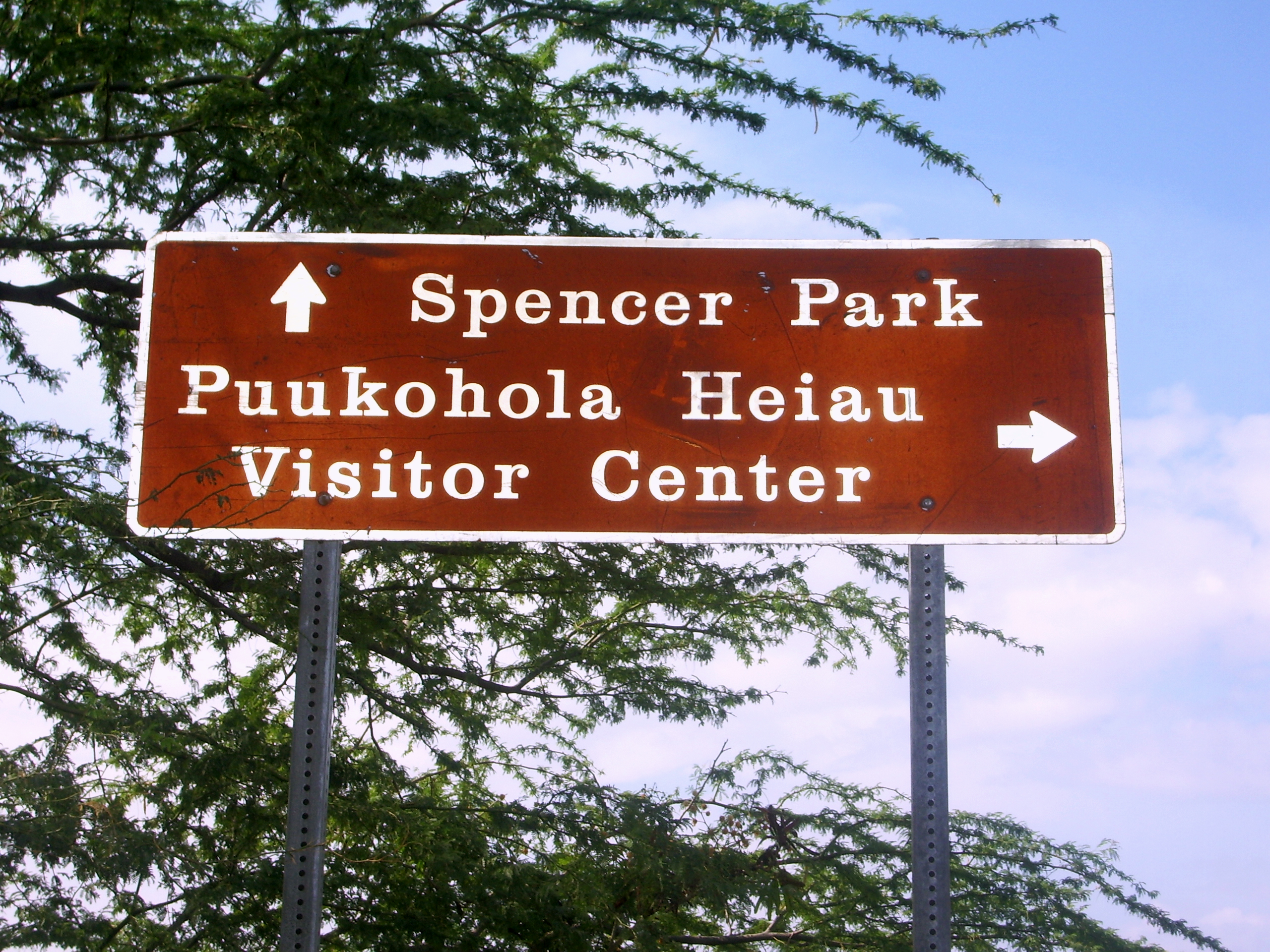
Hawaii Has Very Poor Signage for Towns, Beaches and Attractions; What Signs There Are Are n Hawaiian Words Which May Be Hard For The Visitor To Pronounce And Remember: Photo By Kilgore Trout

Alphabet: The Hawaiian alphabet has five vowels and seven consonants; a total of 12 letters altogether. Several vowels may be used in a row, but consonants are never placed together. Some words have no consonants at all and Hawaiian words always end with a vowel. There are many subtle nuances to the language as well, but for now let's just hit the basics.

Vowels: The vowel sounds in Hawaiian are always pronounced the same and are similar to Spanish or Latin. This chart might visually help as we progress through the sounds using “b” at the beginning and “t” at the end of each vowel sound:

A...pronounced as a soft “u” as in but. (not “aw”)
E...pronounced as a soft “e” as in bet. (not “ay”)
I...pronounced as a hard “e” as in beet.
O...pronounced as a hard “o” as in boat.
U...pronounced as a hard “u” as in boot.

Even at Highway Speeds, The English on This Sign IS Easy To Read, Whereas The Visitor May Have Trouble Decoding The Hawaiian Language Words Quickly Quickly Enough to Turn: Photo By Japhy Ryder
Even at Highway Speeds, The English on This Sign Is Easy To Read, Whereas The Visitor May Have Trouble Decoding The Hawaiian Language Words Quickly Quickly Enough to Turn: Photo By Japhy Ryder

These are the most common vowel sounds. There are some exceptions, such as words with a macron. The macron extends the vowel sound to twice the normal value. (Not all road signs and maps include the macron.)

Ā = Bought...pronounced as “aw” and extends the sound.
Ē = Bet...and extends the sound.
Ī = Beet...and extends the sound.
Ō = Boat...and extends the sound.
Ū = Boot...and extends the sound.

Hokina: The hokina looks like a comma and is added to Hawaiian words to change the meaning or to replace consonants that have been dropped over time. It creates a glottal stop (a slight hesitation with an “uh”, like starting a new word). The hokina will always occur between vowels, especially the same vowel repeated (a'a, i'i, etc). Because of it's significance, in 2004 the hokina was officially added as the 13th letter in the Hawaiian language.

As you explore Hawai'i, you can now begin to pronounce the words correctly. Have fun and aloha.

For more information on traveling to Hawaii in general and visiting the Big Island in particular, please also see www.tourguidehawaii.com and www.lovingthebigisland.wordpress.com.

Copyright 2009 by Frank Burgess.

Friday, June 12, 2009

Frank's Big Island Travel Hints #12: More fun in Hawaii Volcanoes National Park, Big Island, Hawaii

Deeper and Deeper into Hawaii Volcanoes National Park

As you continue driving around and exploring Hawaii Volcanoes National Park you will find many great hiking and bicycling opportunities. Tour Guide has some 50 sights to see in the park and has details such as, parking, food and water and restroom facilities along the way.


One of the best day hikes in the park is the Kilauea Iki Crater Trail. This four mile round trip hike, about three hours at a nominal pace, will descend into the crater itself. From the floor of the crater, you will see fern, Ohia, and tropical rainforest crowding right up to the rim. The floor itself is stark desert, by comparison, as the trail takes you across and then up the other side. Make sure to bring plenty of water and maybe even some snacks for this hike.


To see even more of the parks wonders, we at Tour Guide suggest a drive down the Chain of Craters Road. This drive unlocks dozens more sights, hikes and vistas from high mountain rainforest to the barren lava landscapes and scenic ocean views below. Along this road are a number of overlooks for some fabulous photography. It ends at the sea where waves crash and spew against cliffs with steam clouds in the distance where lava reaches the ocean. Let’s see what this stunning area has to offer.


Lua Manu is a pit crater formed before written records were kept of the eruptive activity in the park. You will notice no cinder around the rim. This indicates no eruption here but a lava lake that formed inside the pit. As it drained, the pit collapsed, the latest of which was in 1974.


There are several more pit craters to see along this route and then you will come to Hilina Pali Road. This nine mile road takes you to some of the most magical views of the National Park. From forest down to the coast, the breathtaking scenery with leave you with the awe and majesty of Mother Nature and Madam Pele. For the hearty campers, Tour Guide will lead you to Kulanaokuaiki Campground. There are restrooms here but no water is available. At the end of Hilina Pali Road is an overlook not to be missed.


Back on Chain of Craters Road, Tour Guide brings you to Pauahi Crater, a large hourglass shaped crater that has held lava from many different flows over the years. Most recently, the 1979 earthquakes opened the south rift of the crater and issued steam and lava fountains. Though this episode only lasted one day, it was precursor to the current flows from Pu’u O’o in 1983 that destroyed hundreds of homes and businesses miles away in the Puna District.


Tour Guide will guide you to Kipuka Kahali’i. A kipuka is a hole or space where the lava surrounded forest or grassland but did not burn it. This one was partially devastated by the 1969 hot ash eruption of Mauna Ulu. The tallest trees survived and some hearty species of plants have returned.

For more information on visiting Hawaii in general and touring the Big Island in particular, please also visit www.tourguidehawaii.com and www.lovingthebigisland.wordpress.com.


Tuesday, May 26, 2009

Hawaii Island Snorkeling Tips, Part IV: Snorkeling Safety

By Donnie MacGowan

Coming to my island for a vacation? There are three things I always recommend the first-time visitor do. First, go on an air tour. Secondly--go to a luau. Finally, I advise people of every age to get in the water and go snorkeling. The "one-one-one, experiencing the world through the fishes' eyes" magic of swimming in those bath-warm lagoons surrounded by clouds of tropical fish is an amazing, restful and restorative pursuit-you will find your mind going back to that experience over and over through the years much more so than many of your other travel experiences. Part I of this series discuses Snorkeling Gear; Part II of this series will discuss Snorkeling Technique and Part III will cover Snorkeling Etiquette; Part IV of the series covers Snorkeling Safety and Part V will cover Big Island Snorkel Spots.

Photo by Donald MacGowan
Bradford MacGowan Snorkeling at Pu'u Honua O Hounaunau: Photo by Donald MacGowan

We've covered snorkeling gear and technique...before we go any farther, let's talk a minute about snorkeling safety.

First and foremost, as with all ocean sports, never turn your back on the ocean. Just as important, never snorkel alone; never get more than 20 feet from your partner. Before getting in the ocean, memorize the color of your partner's mask and snorkel…this is how you will recognize him from a distance in the water. Listen to advice from the lifeguards, obey posted warnings, always pay attention to the currents, surf conditions and surges over rocks.

Plan your points of entry and exit before you get wet; try to enter and exit from sandy areas with little of no surf. You and your partner should agree on a plan about where you are getting in and getting out of the water, what part of the bay you are going to explore and how long you plan to be out. Don't overestimate your abilities, plan conservatively, err on the side of safety. Don't change this plan, once you are in the water, except to make it shorter and more safe.

Don't confront incoming waves head-on, don't try to jump over them and don't turn your back on them; duck under incoming waves before they reach you. Watch the local kids on boogie boards...see how they duck the waves? You do that, too.

Never snorkel on windy days. Offshore winds may take you unexpectedly out to sea or make it hard to swim back in and onshore breezes stack extra water, high on the beach, making nasty rip-currents as it flows back into the ocean. Onshore breezes also bring in jelly fish and man-o-war.

If you are caught in a current, don't panic; don't swim against the current but rather swim diagonally across it toward shore. Keep going, you'll make it.

Poke your head out of the water frequently to check that your partner is within 20 feet of you and to keep yourself oriented relative to your entry and exit places. Stay alert--it's easy to loose track of time, get carried farther than you thought by a current you didn't even notice, wander out of your comfort zone, lazily paddle away from your partner, accidentally stray into a dangerous zone. I cannot stress this enough--it's easy to get overtired; get your partner and swim in BEFORE you feel fatigued, thirsty, sunburned; BEFORE the wind comes up or the surf builds. So stay focused, stay oriented, always know where you are, where your partner is.

Photo by Donnie MacGowan

Lee Ann MacGruder Snorkels the shallows at Ho'okena Beach: Photo by Donnie MacGowan

Sunscreen washing off your body pollutes the water and is a major factor in coral death--wear a t-shirt and baseball cap to avoid sunburn while in the water, waiting until you are out of the ocean and rinsed off to apply sunscreen.

Many things in the ocean sting, most commonly sea urchins--avoid them, do not handle or step on them. White vinegar kills sea urchin stings from embedded spines and, regularly applied, helps to dissolve the spine. Other home remedies for sea urchin, jelly fish and other stings include the application of moistened tobacco, hydrogen peroxide or urine (this latter can be hard to self-administer and will quickly let you know who your real friends are). Like wasp stings, most stings from ocean creatures are not medically dangerous, merely a painful nuisance, but it's best to be prepared with whatever remedy you choose in your beach kit. Some jellyfish stings and all man-o-war stings are potentially life-threatening and need to be treated at the emergency department of the nearest hospital.

This shouldn't even need mentioning, but of course, if you've been drinking--even a little, you should not go snorkeling. Snorkeling is best done between about 9 a.m. and noon, anyway, so sobriety shouldn't even be an issue. Oh, right; you're on vacation--I forgot.

Don't forget to drink lots of water…immersion in salt water is very dehydrating and just swimming around you've worked harder--and sweated more--than you realize. Be kind to your skin and rinse yourself and your gear with fresh water immediately after you get out of the ocean and remember to apply sunscreen and wear your sunglasses. Don't overestimate your skin's tolerance for beach sun; a nasty sunburn is distressingly easy to acquire and will absolutely ruin your vacation. Now might be a good time to go inside and cool off, rest a bit--you are on vacation, you know?

Photo by Donald MacGowan
Bradford MacGowan Photographs a school of Humuhumuele'ele at Kahalu'u Beach: Photo by Donald MacGowan

That's a few of the gear technique and safety tips you should bear in mind...remember to heed whatever advice the lifeguards give you--they are seasoned professionals who intimately know their beach; obey posted rules and be wary of riptides and currents. Most of all, spring for a cheap-o $10 disposable underwater camera, get in the water and enjoy...those fish won't photograph themselves, you know!

A video covering many of these topics is available here.

For more information about visiting and touring Hawaii in general, and exploring the fabulous snorkeling on the Big Island in particular, visit http://www.tourguidehawaii.com and www.lovingthebigisland.wordpress.com - a short video about snorkeling in Hawaii is available here. To see a funny video of my family learning to snorkel in Hawaii, go here. For information about the author, go here.

All media copyright 2009 by Donald B. MacGowan.

Thursday, April 16, 2009

Volcanoes and Hula Dance to the Same Beat

Reprinted from here.


Steam Erupting from Halema'uma'u Crater on Kilauea: Photo by Donnie MacGowan

Unless you've been sitting in a lava cave (the way we sometimes do) you should be well aware that this Sunday is the beginning of the annual Merrie Monarch festival—the world's premier event for watching and learning about the Hawaiian hula.

The hula kahiko, or ancient hula form, is always the crowd favorite on Friday night. The kahiko is one expression of the mo`olelo, or stories, of Hawaiian culture. Of course, a popular theme of hula performed during the Merrie Monarch involves stories of Pele, the Hawaiian deity of the volcano.

The hula of Pele uses rhythmic rising, falling, swaying, and flowing, accompanied by the oli, or chant, and beats of instruments to portray the likeness and action of Pele and the volcano as one inseparable entity. So it may be of little surprise to you that the rhythmic nature of the hula and chants describing the volcano would accurately portray of the bursting forth, and diminishing of such things like lava flows and explosions. But have you ever wondered if the rhythms of the hula have any relation to detailed scientific observations made at the volcano? The answer may be surprising to you; the connections go deeper than you think, and certainly deeper than we're aware of.

Much of the behavior of Kīlauea and Mauna Loa volcanoes are rhythmic in nature. The sounds, earthquakes, and ground swelling of these volcanoes, have all been found to follow rhythmic patterns.

Perhaps the most obvious rhythm of the volcano is the very sound the volcano makes. Anyone who has had the privilege of being near a lava vent can attest to the rhythmic sounds of gas and lava gushing from vents. This is the `uhi `uha sound in the hula chants that results from gases and gas-charged magma rushing through vents, or conduits, in the volcano. Much like a pahu drum, the size of the chamber controls the depth of the sound. These sounds actually extend well beyond the range of human hearing into a realm called the "infrasound". Geologists record and study the depth and breadth of these infrasonic beats to model the internal structure vents and conduits.

The shaking of the volcano also occurs with rhythmic frequency. In the current episode of eruptive activity at Kīlauea, something called episodic tremor has been frequently observed. Episodic tremor is a pattern of seismic activity, or shaking of the volcano, that occurs at semi-regular intervals. Patterns of seismic activity like this have been seen at Mount St. Helens where they were called "drum beat" seismicity. Episodic tremor at Kīlauea can be seen on seismic recorders as triangular-shaped bursts periodically placed—an imprinting reminiscent of a kapa-cloth pattern. A current interpretation is that episodic tremor is caused by the repeated rising and falling of the lava surface underground.

In addition to shaking, the volcano's entire body also sways, or deforms, in rhythmic ways. The ground surface of Kīlauea regularly rises and falls in cycles called deflation-inflation (DI) events. These events are linked to pulses of magma and gas which rise regularly under the summit of Kīlauea in the region of Halema`uma`u. An interesting consequence of magma migration is a coordinated dance of the ground surface at the summit and east rift zone of Kīlauea. As a pulse of magma rises up under Halema`uma`u, the summit of Kīlauea expands, rising upward. As this magma makes its way down the east rift the ground beneath Pu`u `Ō `ō begins to rise too. The dancers complete their turn over the course of a day or so.

The above descriptions only scratch the surface of many deeper rhythmic relationships that exist. So as you watch and hear the hula of Merrie Monarch this year, we encourage you enjoy the mo`olelo `o Pele and hula—both its sheer beauty and, also, its remarkable accuracy in describing the essence of volcanoes.

Activity update

The Waikupanaha and Kupapa`u ocean entries remain active. Surface flows inland from Kupapa`u, which began late last week following a deflation-inflation (DI) event at Kīlauea's summit, remain active along the eastern boundary of the National Park.

At Kīlauea's summit, the vent within Halema`uma`u Crater continues to emit elevated amounts of sulfur dioxide gas, resulting in high concentrations of sulfur dioxide downwind. Though not directly observed, vent noises suggest that lava is still present within the vent about 100 m (110 yds) below the floor of Halema`uma`u crater.

Visit our Web site (http://hvo.wr.usgs.gov) for detailed Kīlauea and Mauna Loa activity updates, recent volcano photos, recent earthquakes, and more; call (808) 967-8862 for a Kīlauea summary; email questions to askHVO@usgs.gov. skip past bottom navigational bar

To see Tour Guide Hawaii video of Kilaeua eruptions go here and here.

For moreinformation on visiting Hawaii in general and touring the Hawaiin volcnoes in particular, plese also visit www.tourguidehawaii.com and www.lovingthebigisland.wordpress.com.

Sunday, April 5, 2009

Day Trip! A Photo Diary of a Scenic Drive through Kona and Ka'u

by Donnie MacGowan

It's springtime on the Big Island which means monsoon season here in Kona.

A Spring Monsoon Cloudburst in Kailua Kona (it dropped 2.6 inches of rain in 72 minutes, then we returned to brilliant blue sky and sun) : Photo by Donnie MacGowan

Remembering that Kona Side of Hawaii is basically arid to semi-arid, "monsoon" simply means that rather than our usual brilliant weather of sapphire skies and tropical sun, we get a few days of grey skies and drizzle and a tropical cloudburst or two--nothing like the folks over on Hilo Side have to contend with. But during the monsoon when we get a couple sunny days, we like to break out of the office, hit the road and see our favorite places.

Kealakekua Bay and Captain Cook Monument from Napo'opo'o: Photo by Donnie MacGowan

This time, we decided to take a ride down the Kona Coast and into Ka'u. Our first stop was at picturesque Napo'opo'o, where the Kealakekua State Historic Monument, Hikiau Heiau and the Captain Cook Monument are.

The Captain James Cook Monument at Ka'awaloa Village in Kealakekua: Photo by Donnie MacGowan

As well as immensely important historically (this is where Cook first met the Hawaiians, as well as the place where he died), dolphin, whales and some of the best snorkeling in the Pacific are here.

Next, we drove along the shoreline, past ancient battlefields, tiny beaches, awesome sea arches and historic churches to the National Historic Monument at Pu'u Honua O Hounaunau, the Place of Refuge.

Sacred Iki nd Hale Keawe at Pu'u Honua O Hounaunau, Big Island: Photo by Donnie MacGowan
Sacred Iki and Hale Keawe at Pu'u Honua O Hounaunau, Big Island: Photo by Donnie MacGowan

This ancient site is enormously important historically and culturally and is very sacred to the native Hawaiians. Adjacent to the Monument is Two Step Beach which, like Kealakekua Bay, hosts unbelievably wonderful snorkeling. In addition to the great Ali'i of Hawaii, James Cook, Mark Twain and Robert Louis Stevenson spent time here.

Two Step Beach at Hounaunau Bay--Some of the Best Snorkeling in the Pacific: Photo by Donnie MacGowan

Driving South through the coffee country of Kona Mauka, we decided to drive down to Ho'okena Beach and do some snorkeling.

Ho'okena Beach In The Morning: Photo by Donnie MacGowan

Recent changes to the beach include more parking, a kayak and snorkel gear rental and snack shop as well as full time caretaker and security…the camping may be a bit more regulated these days, but the beach is much cleaner and safer--it is a joy to visit again after it got so run-down a few years back.

Morning Campers at Ho'okena Beach Park: Photo by Donnie MacGowan

Driving through Kona macadamia nut country across the old lava flows from Mauna Loa, we decided to check out the town of Miloli'i and hike into Honomalino Beach.

An Idyllic Morning at Miloli'i: Photo by Donnie MacGowan

Miloli'i calls itself the "Last Fishing Village in Hawaii" and is a tight-knit enclave of native Hawaiians. The town is beautiful, if obviously impoverished, and the locals, if treated with respect, are friendly and engaging. Be wary…they can also be a bit frisky, so leave no valuables in your car when you hike out to Honomalino Beach, about 20 minutes south along the spectacular coastline.

A Small House on Honomalino Beach: Photo by Donnie MacGowan

From Miloli'i, our wanderlust drew us down to South Point--the southern most point in the United States, and a region of deep mystery, spirituality and fascination. Near the Ka Lae Heiau, one of the most sacred in all Polynesia, we found some rare (perhaps modern) kite petroglyphs in the Queen's Pond.

Kite Petroglyphs at South Point...Are These Modern? : Photo by Donnie MacGowan

Crossing the tip of South Point, we drove to the Kaulana Boat Ramp and hiked into Mahana Beach--South Point's famed Green Sand Beach.

Bathers at Mahana Green Sand Beach at South Point, Hawaii: Photo by Donad B. MacGowan
Bathers at Mahana Green Sand Beach at South Point, Hawaii: Photo by Donald B. MacGowan

It's always a treat to visit and a fascinating experience--beautiful, secluded, mysterious.

Mahana Green Sand Beach in the Afternoon: Photo by Donnie MacGowan

We drove back to the Highway past the Ka Lae Wind Farm, then down through Waiohinu and Na'alehu. Waiohinu is where Mark Twain stayed as he wrote his "Letters From Hawaii", and the monkey pod tree he sat under is still by the roadside.

Coastline of Ka'u from near Na'alehu, Big Island: Photo by Donnie MacGowan

Finally, we wound up at Punalu'u Black Sand Beach to visit the amazing sea turtles and watch the sunset.

Hawaiian Green Sea Turtle Ambles Off into the Punalu'u Sunset: Photo by Donnie MacGowan

Returning to Kailua Kona in the waning light, we arrived back in town just in time for seafood buffet dinner at the King Kamehameha Beach Resort. Could there be a more perfect day?

Kailua Kona in the Evening Light from Kailua Harbour: Photo by Donald MacGowan

For more information on touring Hawaii in general and the Big Island in particular, please visit www.tourguidehawaii.com and www.lovingthebigisland.wordpress.com.

Copyright 2009 Donald B. MacGowan. All photos copyright 2009 Donald B. MacGowan. All rights reserved.

Saturday, March 28, 2009

Rival Kings, Epic Battles and Ghostly Dogs, Kona, Hawaii


Written and produced by Donnie MacGowan; original musical score and videography by Donald B. MacGowan.

Helani Church/'Ohi'a-Mukumuku Heiau

Those vine covered ruins across the street from St. Peter's are the remains of Helani Church, built by the Rev. John D. Paris in 1861 of basalt block and lime mortar. When the local population moved inland about the turn of the century, a new Helani Church was established mauka (uphill) near the Mamalohoa Highway.

The church, however, was erected on a the grounds of the 'Ohi'a-Mukumuku Heiau; a powerful and holy religious temple around which swirls some of the darkest folklore and ghosts stories told around the Hawai'ian Islands. When you hear ghost stories about a white dog and a black dog, they are about the happenings on the grounds of the 'Ohi'a-Mukumuku and Ke'eku Heiaus, during the time when the Ali'i of Hawai'i, Lonoikamakakahiki, was battling for supremacy with the Ali'i of the Maui, Kamalalawalu, in the 16th century.

Beneath the ruins of Helani Church lie the ruins of 'Ohi'a-Mukumuku Heiau, a place of dark legend and lore. Held in Hawai'ian folktales to have been built by the gods, 'Ohi'a-Mukumuku Heiau was re-dedicated to the war god, Kuka'ilimoku, by the Hawai'i Ali'i Lonoikamakakahiki, so that he might vanquish his foe, the Ali'i of the Maui, Kamalalawalu, during their 16th century battles. It is said of these battles that when the Maui attacked the Hawai'i, the numbers of warriors was so vast that just as the first of the Maui war canoes were landing on Hawai'i, the last of their canoes were still leaving Maui.

Lonoikamakakahiki had a particular disagreement with Kamalalawalu when the invading Maui captured his leading general, had his eyes gouged out and ran spears through the eye sockets. Lonoikamakakahiki vowed a bloody revenge.

When Lonoikamakakahiki vanquished the Chief of the Maui, he took Kamalalawalu over to the nearby Ke'eku Heiau and sacrificed him alive to celebrate his great victory. The method of sacrifice was slow and graphic. Kamalalawalu was staked to the ground for several days, then taken to a nearby flat rock and butchered. The body was then towed to sea and fed to the sharks (some versions of the folktale have Kamalalawalu impaled on a pole for several days before being butchered on the flat rock).

Hawai'ian folktales hold that Kamalalawalu brought with him into battle two large, fierce war dogs, a white one (Kapapako) and a black one (Kauakahiok'oka). The dogs are said to have lain down and died on the spot of Kamalalawalu's execution. Although buried beneath the heiau luakini platform, it is said that these dogs can still be seen roaming, and heard howling, in the night searching the underworld for their fallen master. Two stone features found on the makai side of Ke'eku Heiau stone platform represent the two dogs.

Petroglyphs along the rocks, visible at low tide between Kahalu'u Beach Park and Keauhou O'hana Beach Resort, commemorate the sacrifice of Kamalalawalu by Lonoikamakakahiki.

For more information visit www.tourguidehawaii.com and www.lovingthebigisland.wordpress.com.

Tuesday, March 24, 2009

After one year, Kīlauea's summit eruption is still going strong

Reprinted from here.

Halema`uma`u March 24

A plume of volcanic gas and ash rises from a vent on the east side of Halema`uma`u Crater, at the summit of Kīlauea caldera. The Hawaiian Volcano Observatory and Jaggar Museum of Volcanology are in the foreground.

After one year, Kīlauea's summit eruption is still going strong

(To see a recent video of Halema'uma'u eruption, go here)

It seems like only yesterday when the Hawaiian Volcano Observatory (HVO) monitored a several-week build-up in seismic tremor levels and sulfur dioxide emissions in early 2008. While some staff members speculated that a small summit eruption might be on the way, others were convinced, from the lack of earthquake activity and deformation, that Pele was just restless, and that a summit eruption was unlikely.

Then, on March 12, 2008, an area of gas emission formed on the east wall of Halema`uma`u Crater, within Kīlauea's caldera. The extreme temperature of the gases caused the vent to glow at night, attracting tourists and locals alike to the viewpoint at the Jaggar Museum of Volcanology. Hawai`i Volcanoes National Park closed the south part of the caldera to visitors in response to the increased concentrations of hazardous gases—a closure which remains in effect today.

The real surprise occurred at 2:58 a.m. on March 19, 2008, when a small explosion occurred from the site of the gas emission. The explosion—the first at Kīlauea's summit since 1924-threw rocks and boulders over about 40 hectares (100 acres), destroying the Halema`uma`u tourist overlook, blanketing the Halema`uma`u parking lot with rocks and ash, and marking the start of the summit eruption that continues to this day.

Since that event almost one year ago, thousands of tonnes of sulfur dioxide and other volcanic gases have issued from the March 19 explosion crater. The gas has had a tremendous impact on the residents of Hawai`i Island, damaging crops on the south part of the island and worsening existing health problems for people from Hilo to Kona.

Despite the widespread effects of the gas emissions, very little lava has erupted from the vent. A small amount of ash is produced every day, but the bulk of the lava that erupted has been the result of occasional explosions that occurred throughout 2008 (none have occurred in 2009-yet). Near-daily ash collection and mapping of explosive deposits reveal that the total amount of lava and ash erupted is too small to even fill your local supermarket! In fact, the amount of lava and ash produced by the summit eruption is equivalent to what is erupted from Kīlauea's east rift zone in just five hours.

Even though only a small amount has actually erupted, lava has been seen within the vent. Visual observations identified a lava lake about 300 feet below the vent rim in September and October 2008. In February 2009, images from an infrared camera, which is able to see through much of the gas plume, saw a lava lake at a greater depth, about 450 feet below the rim. This lake has recently been replaced by a series of small, spattering vents, still well below the floor of Halema`uma`u Crater.

The current summit eruption has already surpassed the length of all previous summit eruptions at Kīlauea since 1924. In December 2008, HVO scientists thought that the eruption actually might be coming to a close, since activity diminished markedly. Instead of dense, white, roiling, emissions, the plume was wispy, thin, and lazy. Glow disappeared from the vent, and seismic tremor levels dropped considerably.

Of course, Pele was just being her usual, devious self. In January, the return of weak glow and a strong, white plume signaled the renewal of the summit eruption. One year in, there are no signs that the eruption will be ending anytime soon.

The past year has been one of surprises, to say the least. The type of activity currently on display at Kīlauea's summit is unprecedented in the nearly 200 years of recorded eruptions. HVO will continue to closely monitor the eruption to improve our knowledge of how Kīlauea works and to watch for signs of clearing air that might signify the end of this chapter of Kīlauea's history.

Activity update

The Waikupanaha ocean entry remains active, and a small collapse early Wednesday morning (3/11) removed part of the delta there. West of the ocean entry, lava flows were active on the coastal plain and had reached to within 180 m (200 yds) of the ocean near Kupapa`u by mid-morning on Wednesday.

At Kīlauea's summit, the vent within Halema`uma`u Crater continues to emit elevated amounts of sulfur dioxide gas, resulting in high concentrations of sulfur dioxide downwind. Lava remains just out of sight more than 90 m (100 yds) below the vent rim.

Visit our Web site (http://hvo.wr.usgs.gov) for detailed Kīlauea and Mauna Loa activity updates, recent volcano photos, recent earthquakes, and more; call (808) 967-8862 for a Kīlauea summary; email questions to askHVO@usgs.gov. skip past bottom navigational bar

For more information on traveling to Hawai in general and seeing the volcanoes of the Big Island in particular, please visit www.tourguidehawaii.com and www.lovingthebigisland.wordpress.com.


Casino Bonus no Deposit