Showing posts with label turtles. Show all posts

Friday, August 7, 2009

Best Beaches in Hawaii: Part 3, Unusual, Uncrowded and Untamed Beaches of South Hawaii

by Donald B. MacGowan

Sometimes lost in the shuffle between visiting the mile-long sugar-sand beaches of Kohala and the spectacular snorkeling at the Kona-side beaches, the southern beaches of Hawaii Island are by no means second class, poor cousins. Beautiful and alluring in their own right, many are highly unique, offering unusual conditions and rare scenery, all are well worth visiting and none are more than a couple hours drive from Kona or Hilo. Here is a smattering of the best of the Southern Beaches of Hawaii Island. All these beaches are a bit off the beaten track and, with the exception of Punalu'u, aren't on any standard tour of the island. Many of these are remote, none are crowded.

We always advise visitors to be careful with their possessions and leave no valuable in the cars. The locals are friendly and open, so let your smile be your passport and talk story with them; open yourself to an adventure that only begins with getting to know the people of Hawai'i and visiting their beaches.

Mahana Green Sand Beach (see video)

The Beautiful Green Sand Beach at South Point of the Island of Hawaii is Reached by an Easy 2 1/4 Mile Hike: Photo by Donald B. MacGowan
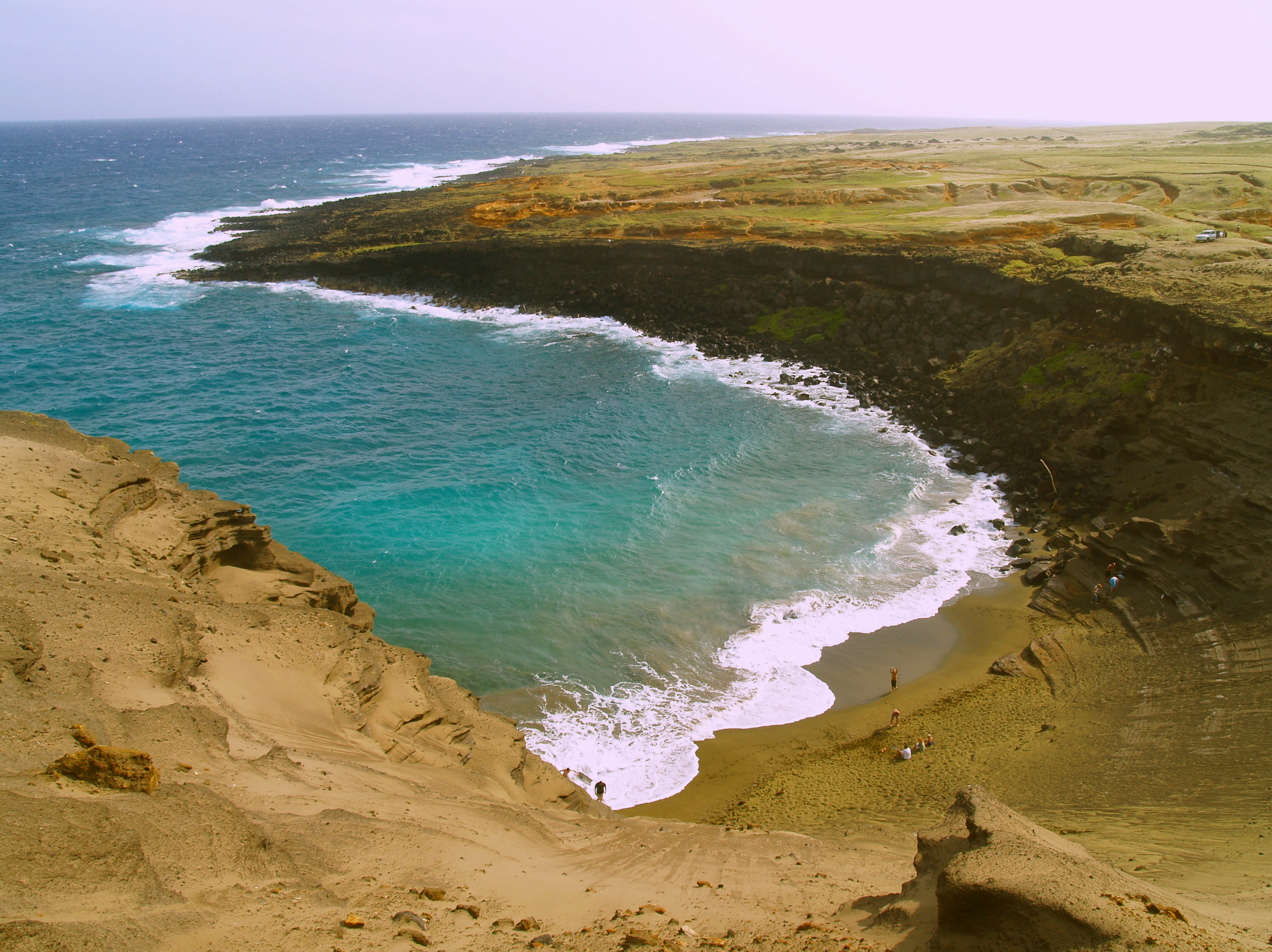

Absolutely unique to the island of Hawai’i, beautiful and strange, are the handful of green sand beaches composed of crystals of the semi-precious mineral olivine (also known as peridot). The green sand beach at South Point is the best known, largest and most accessible of these. The sand grains on this beach are formed from olivine crystals weathering out of the lava and cinders from the cone over an eruptive vent that has been partially breached by the sea. The beach lies in the interior of the cone, and the somewhat protected cove formed by the remnant of the cone makes for a wonderful swimming/snorkeling spot. Be very wary of currents and do not go out far nor in at all if the surf is high or there are strong winds. The bizarre color of the water shrieks for color photographs, particularly underwater photographs taken while snorkeling.

To get here take the South Point Exit from the Hawaii Belt Road between Ocean View and Na'alehu; drive to South Point and, where the road splits, take the Mahana Boat Ramp (left) branch of the road. This road is dirt and broken pavement, but is quite good until the last couple hundred yards above the boat ramp. Park in the obvious flat spot just above the boat ramp and be sure to leave no valuables in your car. The 2 1/4 mile hike is along a terrible dirt road to the Green Sand Beach; the gate at the start of the road may or may be locked...just walk around it. Road conditions along the road to the beach vary dramatically from week to week and the road becomes impassable with even a gentle rain; therefore we do not suggest driving it at all but enjoy the short, pleasant hike. The beach lies in the center of a cinder cone breached by the sea. Once you reach the edge of the cone the obvious trail goes over the side and along the interior wall, angling toward the beach, Alternately, one can hike to the top pf the cone and pick your way down the steep cliff and sand slope (there are a set of stairs at the very top--then it gets tricky); this is very direct, but can be slippery and treacherous. Be wary of rip tides and currents, do not swim beyond the protected reach of the bay. Aren't you glad you read this article before you came here? Now that you are here you understand why I insisted you buy a disposable underwater camera and bring it...look at the color of that water! There are no services or facilities here. At all. None. And a goodly long way to drive to get to any…plan and act accordingly.

Punalu’u Black Sand Beach Park (see video)

Bradford MacGowan Filming at Punalu'u Beach: Photo By Donnie MacGowan
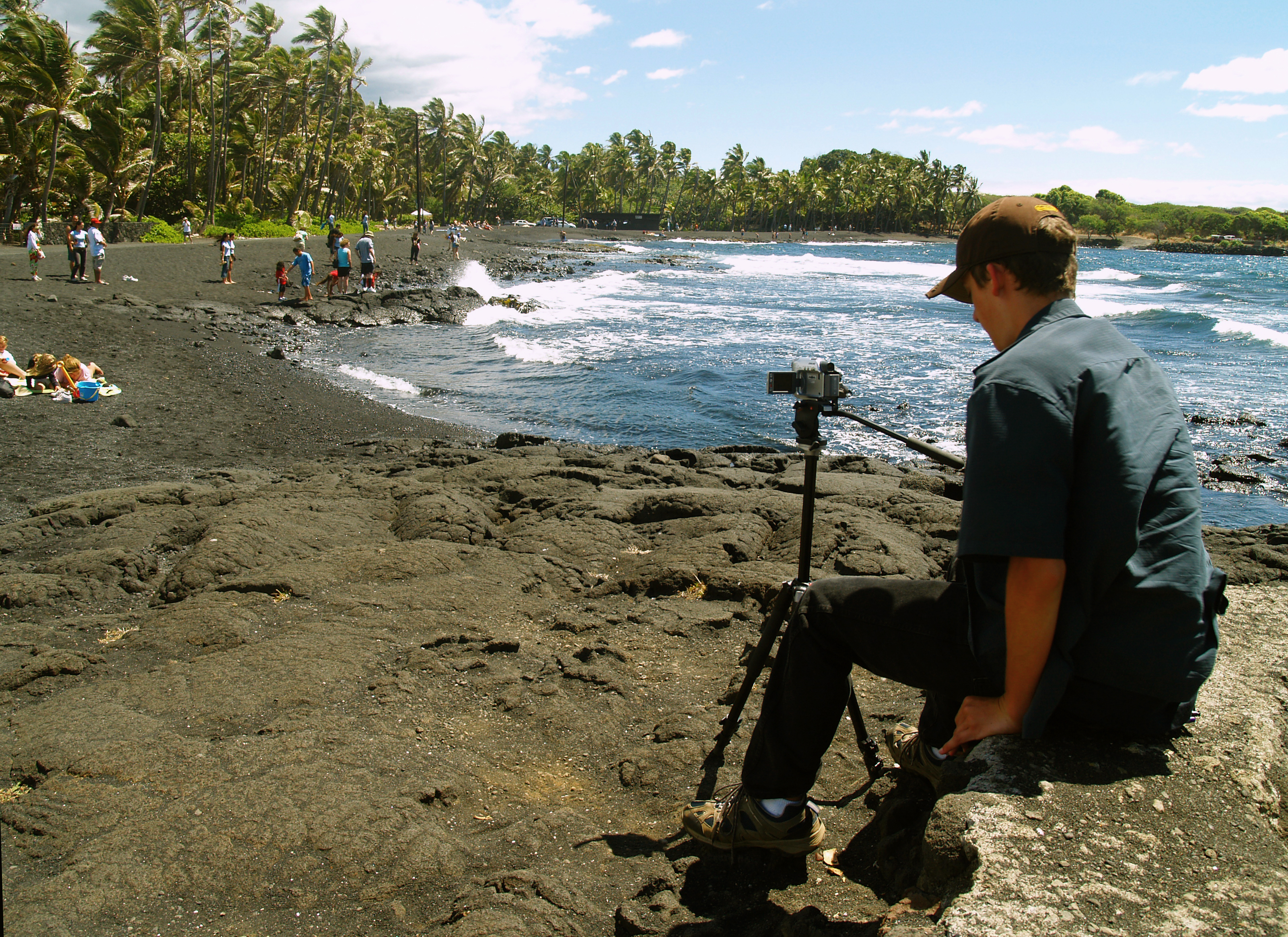

A truly remarkable place of great peace, beauty and spiritual healing, Punalu’u’s black sand-lined coves and beaches are world-renowned. Dozens of endangered Hawai’ian Green Sea Turtles swim the waters of Kuhua Bay, Ninole Cove and Punalu’u Harbor and frequently bask on Kaimu Beach here. The wildness of the ocean and the serenity of the freshwater fishpond and coconut palm-shaded beaches make this an ideal place to spend some soul-recharge time. Snorkeling, picnicking and camping, or just relaxing on the beach, are major destination pass-times here.

Punalu’u means “springs you swim to”; it is the abundance of these fresh water springs just offshore that makes swimming at Punalu’u so cold and this settlement site so important to the ancient Hawai’ians. In pre-contact times, due to the scarcity of fresh water along the Ka’u coast, Hawaiians would swim out into Kuhua Bay with stoppered gourds, dive down on top the springs, unstopper the gourds and, by upending them underwater, fill them with the fresh spring water emanating from the floor of the bay. These springs are one of the very few sources of fresh water on this entire end of the island.

Available services include water, picnic tables, restrooms, electrical outlets, and pavilions, parking; camping is by permit only. During peak tourist time, there is a souvenir stand with some packaged food items and canned drinks for sale. Due to chilly waters, off-shore winds, strong currents and a fearsome rip, swimmers and snorkelers should use caution when swimming at Punalu’u, but it’s hard to resist getting in and swimming with all those turtles.

Kaimu Black Sand Beach

Kaimu Black Sand Beach near the Village of Kalapana: Photo by Donald B. MacGowan
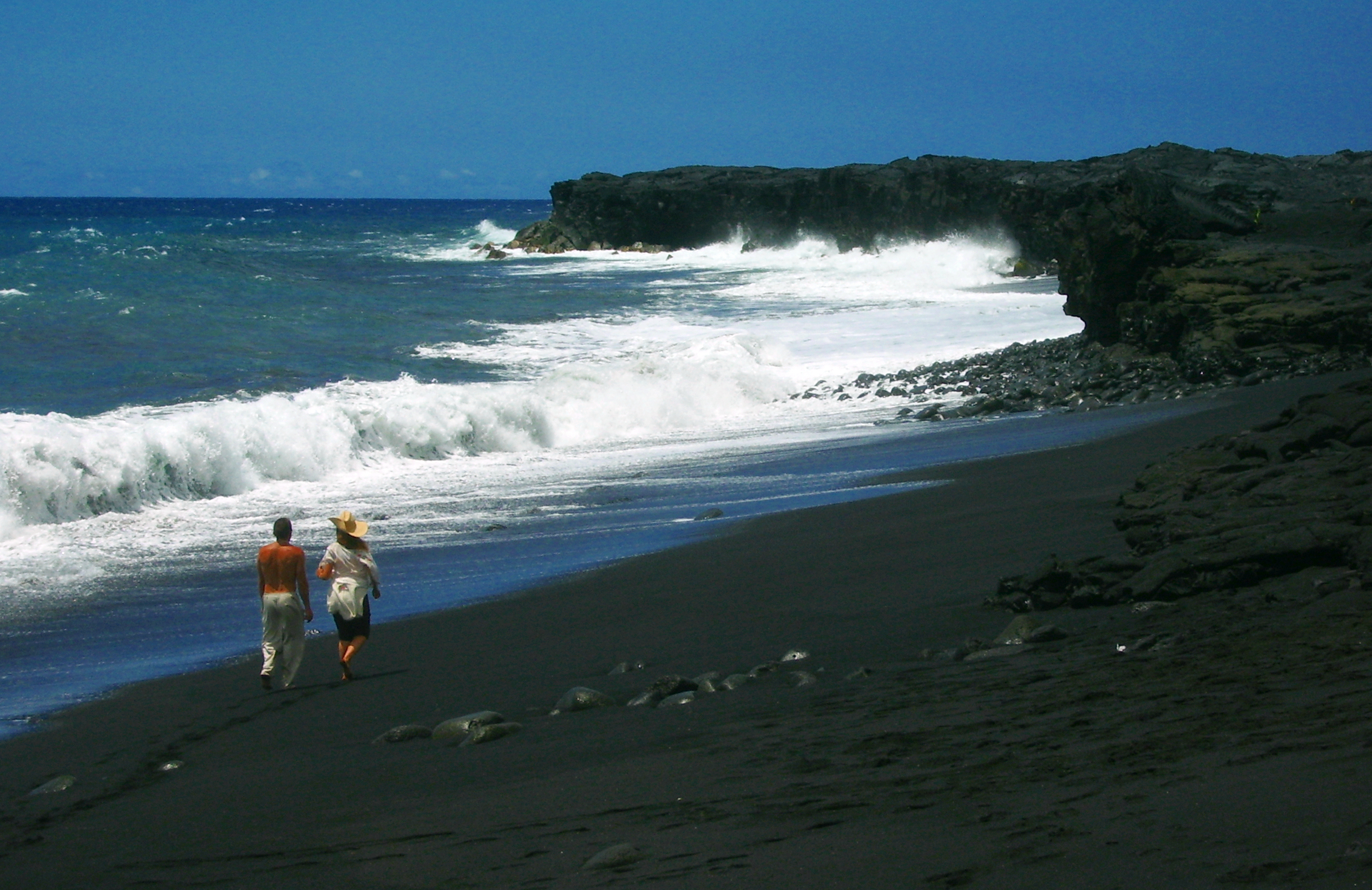

The state’s newest black sand beach, Kaimu Beach, is a barren crescent of sand fronting an unforgiving expanse of lava from the 1990 flows. The old beach and the fishing village of Kalapana that stood along it are long gone, buried under 50-75 feet of lava. The palm trees growing along this trail are the result of one woman’s commitment not to allow her community, her beach, her culture to die under the lava. Planting thousands of palm sprouts, she encouraged her community, school children state wide and hundreds of others to plant the young trees. Today, the realization of her vision of rebirth is in the growing palm groves out on the barren lava plain. The trail to the new black sand beach is marked with these young palms.

Near the parking area along the path are exposed fossils, lava casts of palm trees and other plants…keep a sharp eye out, they are everywhere. Swimming is hazardous at the new beach, so is surfing, the ocean currents being strong and treacherous. But take some time to relax, wade, feel the sand beneath your feet and contemplate the drive of one dying woman to rebuild a world she loved from a devastation few of us can imagine. From the lava hillocks along the trail are nice views of the eruption plume at Pu’u O’o, on the flank of Kilauea as well as the steam clouds where the lave enters the sea at Waikupanaha. This is one of the few places where both can be seen easily and at the same time.

Kehena Beach

Kehena in Puna is a Gorgeous Gem of a Beach; Frequently Clothing Optional, There Is a Sense of Both Community and Welcome Here: Photo by Donnie MacGowan

When the eruption of 1955 created this beautiful black sand beach, the County was swift to capitalize on it and, creating a wonderful beach park, built stone steps down the cliff to the beach. When the beach dropped a full 3 feet during an earthquake in 1975 the stairs were shattered. Like so much else around this island, these stairs were never rebuilt and today terminate about ten feet above the current level of the beach—if you want to get down to the beach, therefore, you must take the dirt path that goes out of the left side of the parking lot.

Once on the beach the first thing that may strike you is that many of the locals who frequent this park have forgotten to put on proper beach attire…or any other attire whatsoever, for that matter. The second thing that will strike you is what a lovely, wonderful spot this is. In the shade of palms and ironwood trees this primeval and idyllic beach is generally sunny even when the rest of Puna is rainy. Swimming here is great, but ocean currents are strong and dangerous not far from shore. The locals are friendly but frisky, so don’t leave valuables in your car.

Pohoiki Beach at Isaac Hale Beach Park

Looking Across Pohoiki Beach to Isaac Hale County Beach Park: Photo by Donald B. MacGowan
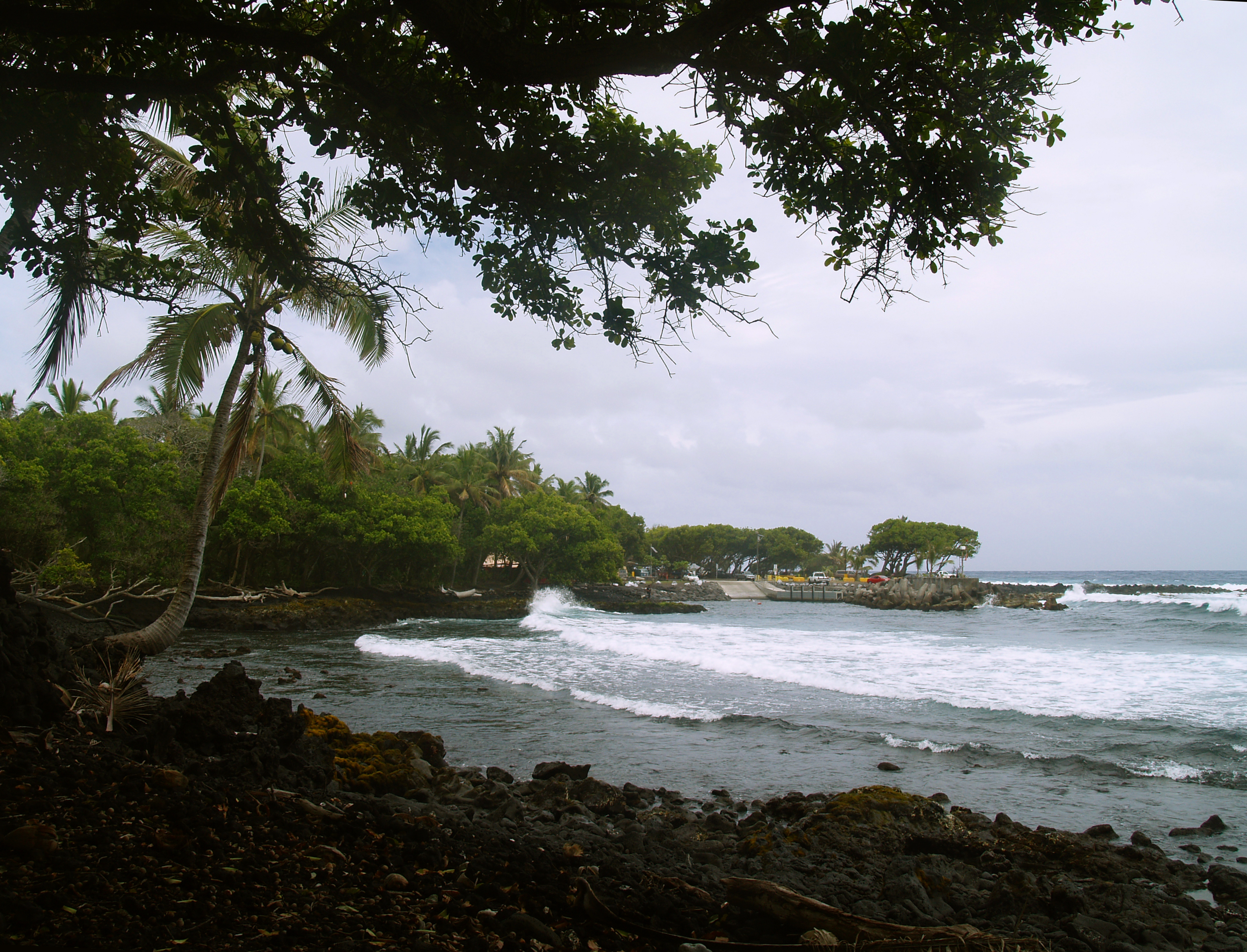

A lovely black sand beach with an expert surf break, Pohoiki Beach is one of the very few real beaches and boat ramps in Puna District; as such this park sees a lot of traffic. It is also the site of the best surfing and some of the wildest snorkeling and scuba diving in Puna. If you do get in the ocean here, go in left of the boat ramp—be alert to bodacious boat traffic (they won’t be alert for you) and for fairly dangerous ocean currents. Understandably, given the crowded nature of this small place, some locals are less than welcoming of visitors. Graciously share this ocean treasure with the residents, but and leave no valuables in your car.

A short path along the shoreline leads from the parking lot, past a house with abundant “No Trespassing” signs, just a few minutes stroll then turns about 20 yards into the jungle to a secluded, perfectly lovely natural hot spring that is wonderful for soaking. Locals usually don’t bother with swimwear here, you shouldn’t feel required to, either.

The facilities at Isaac Hale Park Beach Park have been recently rebuilt, refurbished, upgraded and expanded considerably—this once run-down park is now a quite well-appointed. The facilities include of expanded parking, soccer fields, picnic tables, showers and port-a-potties. Camping is allowed with a Hawaii County permit.

Kapoho Tide Pools

The Kapoho Tide Pools Offer a Unique, Fascinating Snorkeling Experience: Photo by Donnie MacGowan

Stuffed with abundant sea life, this sprawling basin of lava tidal pools is a remarkable treasure for snorkelers of all abilities from the starkly frightened to the seasoned veteran. Moorish idols, yellow tangs, various wrasses and eels, sea urchins and sea cucumbers abound and there are even some nice corals in the deeper pools. The largest pool is called “Wai Opae”, which means “fresh water shrimp”. Keeping to the left of the main channel keeps one away from most of the ocean currents, which can be surprisingly strong, even in small reaches, where ponds empty into the ocean.

An amazing place to spend the day, Kapoho Tide Pools has wonderful snorkeling for people of all levels as well as other general beach activities, including just plain beach exploring, shell collecting, swimming and fishing. No real facilities exist here beyond the parking lot, so come prepared.

Hawaii's Beaches Offer Much More Than Just Sunbathing and Snorkeling--Many Are Associated With Cultural or Historical Sights and Have Intersting Tidepools and Wildlife.  Here, Endangered Green Sea Turtles Leave Enigmatic Tracks In The Sand At Punalu'u Beach: Photo by Donnie MacGowan
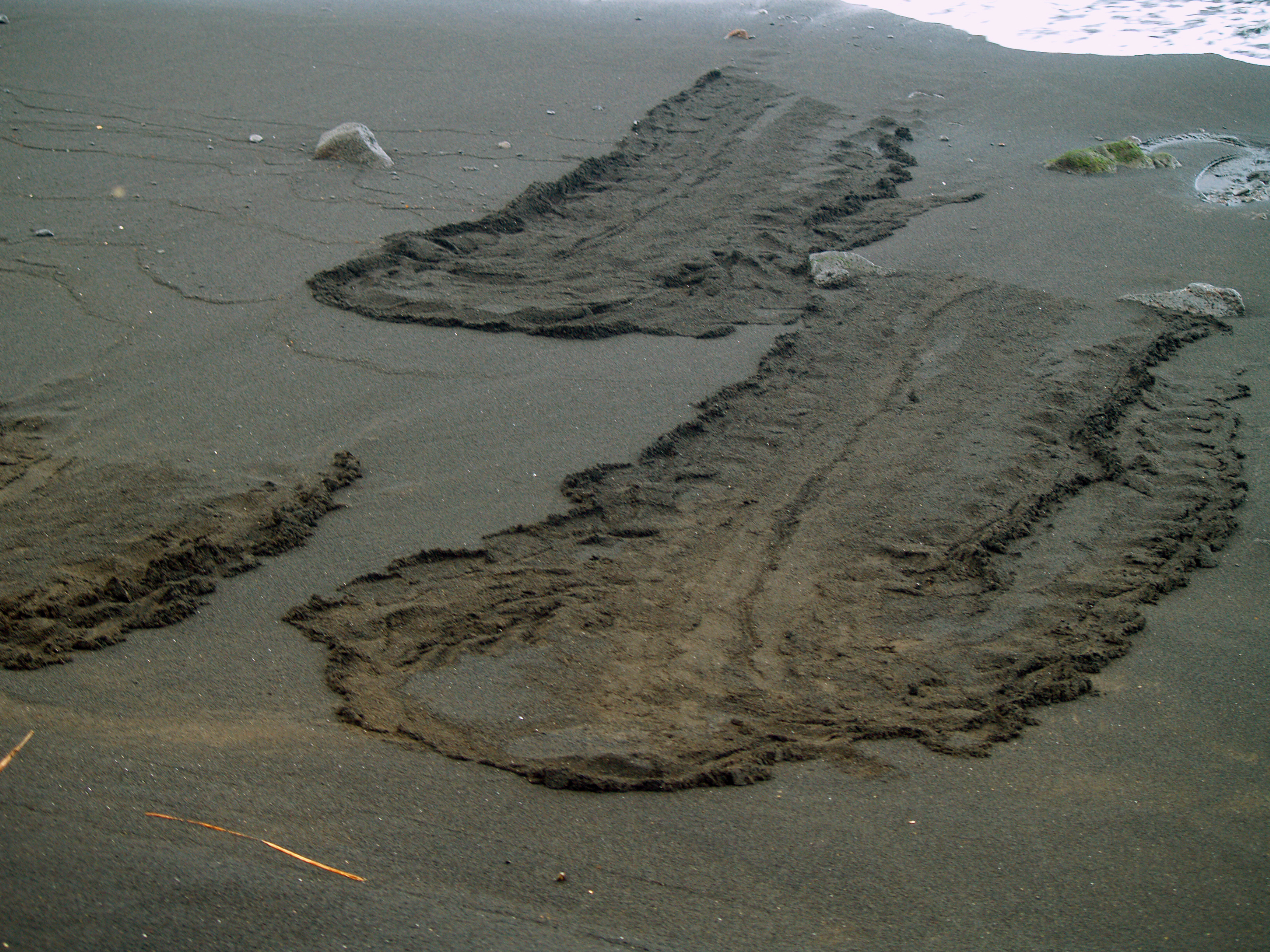
Hawaii's Beaches Offer Much More Than Just Sunbathing and Snorkeling--Many Are Associated With Cultural or Historical Sights and Have Interesting Tidepools and Wildlife. Here, Endangered Green Sea Turtles Leave Enigmatic Tracks In The Sand At Punalu'u Beach: Photo by Donnie MacGowan

For more information about traveling to Hawaii in general and exploring the Big Island in particular, please also www.tourguidehawaii.com and www.lovingthebigisland.wordpress.com. Information about the author can be found here.

All media copyright 2009 by Donald B. MacGowan

Wednesday, May 20, 2009

Hawaii Island Snorkeling Tips, Part III: Reef Etiquette

Coming to my island for a vacation? There are three things I always recommend the first-time visitor do. First, get in the air. Secondly--go to a luau. Finally, I advise people of every age to get in the water and go snorkeling. You will find your mind going back to that experience over and over through the years much more so than many of your other travel experiences. Part I of this series discuses Snorkeling Gear; Part II of this series will discuss Snorkeling Technique and Part III will cover Snorkeling Safety; Part V of the series will cover snorkel spots on the Big Island.

Photo by Donald MacGowan
Gary Burton and his duaghter snorkel at Hounaunau Bay: Photo by Donald MacGowan

Now, let's talk a moment about snorkeling etiquette and protecting the reef and the animals who live there.

Please do not feed the fish, it disrupts their natural feeding habits and you may be injured. Reef fish are territorial and do occasionally "nip" but you should not chase, harass or touch them (this includes octopi). The oils on your fingers will injure their skin and they may carry diseases which they can pass to you on your hands. For photographing reef fish, whether snorkeling or scuba diving, simply find a feeding spot (usually a boulder or dead coral head teeming with algae, and wait calmly and silently nearby. They will slowly begin to check you out and if you can remain still long enough, eventually surround you leading to excellent photos and a very memorable experience.

Snorkeling etiquette calls for protecting not only the reef animals, but also the fragile corals growing on the reef. Corals, actually colonies of very small animals, take hundreds of years to form the structures visible today; they feed, shelter and provide habitats for other reef animals. Coral reefs also protect the lagoons and shoreline from waves and sand erosion. Corals are at the very root of Hawai'ian history and culture; the Hawaiian creation chant places the origin of life in the sea, beginning with a coral polyp.


Simply touching corals to see what they feel like can cause the death of an entire colony. Oils from your skin can disturb the delicate mucous membranes which protect the animals from disease. Please don't walk upon or stand on coral, as this can kill the living coral polyps which, as the builders of the entire reef structure, are the very foundation of the reef ecosystem. Sunscreen washing off your body can kill coral; wear a t-shirt and a swim cap for UV protection and put your sunscreen on AFTER you come out of the water.

Called Honu by Hawaii's natives, the Hawaiian Green Sea turtle is beautiful, serene and seeming wise. Though they have swum the oceans for over 200 million years, peacefully feeding on algae and invertebrates, this highly successful product of amphibian evolution is in grave danger. Loss of habitat, hunting and molestation by humans has conspired to push the Hawaiian Green Sea Turtle to the very verge of extinction.


Photo by Donald MacGowan
Hawaiian Green Sea Turtle at Papakolea Beach: Photo by Donald MacGowan

Protected now by state and federal law, the population of once millions of individuals has been decimated to just a few hundred thousand; although they are making a comeback, Hawaii's honu are still very much endangered.

Do not approach basking turtles closely, never touch or pick them up. Harassing turtles carries a stiff fine and in any case, touching the turtle is a good way to get a raging salmonella infection. If honu are swimming near where you are, do not approach or chase them; always swim to the side of them, never above (as a predatory shark would) nor below them (so they won't feel that their soft belly is at risk).

Anyone who observes their beauty and grace underwater easily understands why the Hawai'ians base their word for "peace", "honua", on their name for the green sea turtle, "honu".

Although harder for the snorkeler to approach, but certainly no less in danger of molestation are the marine mammals: dolphin, seals and whales. In general, it is illegal, dangerous and generally a bad idea to approach marine mammals within 100 yards; 300 yards for females with calves. Dolphins and seals, in particular, may choose to approach you-just remember, this ain't "Flipper"-these are wild animals and they bite. Hard. If approached, remain calm (absolutely entranced, of course, but calm); do not approach any young animals and do not reach out to them as they may interpret this as aggression on your part and possibly bite. Male seals may exhibit dominant behavior and have been known to *ahem* mount swimmers. Avoid these unpleasantries by observing and enjoying these animals from a distance. About whales…uh, wait a minute…if there is anybody out there crazy enough to swim out into the open ocean and harass a 60,000 pound animal with a mouth twice the size of a king-size bed, nothing I say is going to stop them…just use some common sense, OK? Leave them alone—besides…it’s the law.

And now a word about sharks--two words, actually: "Don't Worry". There's good news and bad news about sharks in Hawaii--first the bad news: if you are in water deeper than your knees, you are probably within 200 yards of a shark. The good news? You will never know it. The truth is that you are not likely to see or encounter a shark…period. Tens of millions of people swim Hawaii every year without seeing so much as a dorsal fin break the water. Don't worry--you are not what they eat (so you won’t attract them) and generally, they are more afraid of you than you are of them. To dispel visitor's apprehensions about sharks, the Hawaiian Tourism Bureau used to advertise that tourists were more likely to get hit on the head by a falling coconut than bitten by a shark…but they decided THAT was not a real cheery statistic to crow about, either. In reality, there are only about three shark bites a year in Hawaii—which is amazing considering there are hundreds of thousands of people in the water, all day, every day of the year.

Photograph by Donnie MacGowan
A cloud of raccoon butterfly fish at Kahalu'u Beach: Photograph by Donnie MacGowan

Having said that, bear in mind that all sharks demand respect and there are several things you can do to make yourself generally safer in any shark encounter. Number one safety tip is: avoid them. Sharks are stealth hunters and in any conditions where they are obscured in the water, they will hunt. Therefore--do not go into the water until at least an hour after dawn, be out of the water by about 4 pm; do not enter the water if it is murky; avoid stream mouths. Obey beach closures; obey warnings from the Lifeguards. Little sharks don't get to be big sharks unless they pay strict attention to avoiding whoever is bigger than they are--small sharks generally will glide silently away from you without you ever having known they were there. Big sharks are different. They may approach you.

The most common conventional wisdom you hear is: if you are being stalked or approached, swim purposefully, not panicked, away from the shark at an angle. Do not swim at high speed straight from him, it will trigger his predator-prey response and he’ll chase you. Do not splash excessively; this sounds like a dying fish (i.e., dinner) to sharks. Remember that the larger sharks eat sea turtles…to a shark hunting below you, your outline paddling on a surfboard or boogie board, looks remarkably like a sea turtle. When you approach the water, seeing three or four sea turtles sunning themselves on the beach is normal; seeing twenty or thirty indicates that something very large and hungry is hunting the water nearby. The presence of dolphin nearby is no guarantee there are not also sharks nearby.

There are hundreds of bits of advice for surviving shark attacks from hundreds of shark experts and attack survivors from all over the world—I will not pass these on to you for two reasons. First and foremost, I am a not a shark expert; secondly, I have never needed any of them because I have followed these sensible rules for years and have never, not once, seen a shark while snorkeling. I’m out there 4 or five days a week, year round. You won’t see one either. Relax and enjoy your snorkeling…as I said…don’t worry.

Finally--many people ask "What's the etiquette for, um--er--answering nature's call?" Easy--for wet stuff, just swim a bit away from people and let go, maybe maintaining forward momentum so as not to create a "cloud". No, this isn't why the ocean is salty. For solid stuff, get your partner and both of you swim in and get out, visit the rest room. No exceptions for that.

Part I of this series discuses Snorkeling Gear; Part II of this series will discuss Snorkeling Technique and Part III will cover Snorkeling Etiquette; Part IV of the series covers Snorkeling Safety; Part V will cover Big Island Snorkel Spot and Part VI covers Wilderness Snorkeling.

A short video on this topic is available here.

For more information on traveling to Hawaii in general, and beach activities on the Big Island in particular, visit www.tourguidehawaii.com and www.lovingthebigisland.wordpress.com. For information about the author, go here.

All media copyright 2009 by Donnie MacGowan

Wednesday, November 26, 2008

Your Hawaii Vacation - Let's Talk About Snorkeling Etiquette

Reprinted from here.

Coming to my island for a vacation? There are three things I always recommend the first-time visitor do. First, get in the air-seeing my island from the air is the only way to appreciate its vastness and diversity of landscapes-and it's the best way to see the erupting volcano.

Secondly-go to a luau-for people with limited time, you will not be able to discover much about the magic of the local lifestyle, and although canned and packaged for visitor consumption, a luau is a good place to get an introduction to it.

Finally, I advise people of every age to get in the water and go snorkeling. The "one-on-one, experiencing the world through their eyes" magic of swimming in those bath-warm lagoons surrounded by clouds of tropical fish is an amazing, restful and restorative pursuit-you will find your mind going back to that experience over and over through the years much more so than many of your other travel experiences. There are some thing to bear in mind about snorkeling, however so let's take a moment to talk about reef etiquette and the animals which inhabit the coral reefs.

Please do not feed the fish, it disrupts their natural feeding habits and you may be injured. Reef fish are territorial and do occasionally "nip" but you should not chase, harass or touch them (this includes octopi). The oils on your fingers will injure their skin and they may carry diseases which they can pass to you on your hands. For photographing reef fish, whether snorkeling or scuba diving, simply find a feeding spot (usually a boulder or dead coral head teeming with algae and wait calmly and silently nearby. They will slowly begin to check you out and if you can remain still long enough, eventually surround you leading to excellent photos and a very memorable experience.

Snorkeling etiquette calls for protecting not only the reef animals, but also the fragile corals growing on the reef. Corals, actually colonies of very small animals, take hundreds of years to form the structures visible today; they feed, shelter and provide habitats for other reef animals. Coral reefs also protect the lagoons and shoreline from waves and sand erosion. Corals are at the very root of Hawai'ian history and culture; the Hawaiian creation chant places the origin of life at the sea, beginning with a coral polyp.

Simply touching corals to see what they feel like can cause the death of an entire colony. Oils from your skin can disturb the delicate mucous membranes which protect the animals from disease. Please don't walk upon or stand on coral, as this can kill the living coral polyps which, as the builders of the entire reef structure, are the very foundation of the reef ecosystem. Sunscreen washing off your body can kill coral; wear a t-shirt and a swim cap for UV protection and put your sunscreen on AFTER you come out of the water.

Called Honu by Hawaii's natives, the Hawaiian Green Sea turtle is beautiful, serene and seeming wise. Though they have swum the oceans for over 200 million years, peacefully feeding on algae and invertebrates, this highly successful product of amphibian evolution is in grave danger. Loss of habitat, hunting and molestation by humans has conspired to push the Hawaiian Green Sea Turtle to the very verge of extinction.

Protected now by state and federal law, the population of once millions of individuals has been decimated to just a few hundred thousand; although they are making a comeback, Hawaii's honu are still very much endangered.

Honu may grow up to 45 inches and weigh as much as 400 pounds at maturity, reached at 25 years of age. Hawaiian Green sea turtles can easily be differentiated from the other near shore sea turtle in Hawaii, the much less common Hawksbill turtle, by counting the scales between the eyes. Hawksbills have four scales between the eyes and Hawaiian Green Sea turtles have two.

Lady honu crawl on shore to lay their eggs, generally after migration to the quieter shores of the French Frigate Shoals, 800 miles northwest of Hawaii, or the black sand beaches on the south end of the Big Island of Hawaii.

Do not approach basking turtles closely, never touch or pick them up. Harassing turtles carries a stiff fine and in any case, touching the turtle is a good way to get a raging salmonella infection. If honu are swimming near where you are, do not approach or chase them; always swim to the side of them, never above (as a predatory shark would) nor below them (so they won't feel that their soft belly is at risk).

Anyone who observes their beauty and grace underwater easily understands why the Hawai'ians base their word for "peace", "honua", on their name for the green sea turtle, "honu".

Although harder for the snorkeler to approach, but certainly no less in danger of molestation, are the marine mammals: dolphin, seals and whales. In general, it is illegal, dangerous and generally a bad idea to approach marine mammals within 100 yards; 300 yards for females with calves. Dolphins and seals, in particular, may choose to approach you-just remember, this ain't "Flipper"-these are wild animals and they bite. Hard. If approached, remain calm (absolutely entranced, of course, but calm); do not approach any young animals and do not reach out to them as they may interpret this as aggression on your part and possibly bite. Male seals may exhibit dominant behavior and have been know to *ahem* mount swimmers. Avoid these unpleasantries by observing and enjoying these animals from a distance.

That's a few of the etiquette rules you should bear in mind...remember to heed whatever advice the lifeguards give you--they are seasoned professionals who intimately know their beach; obey posted rules and be wary of riptides and currents. Most of all, spring for a cheap-o $10 disposable underwater camera, get in the water and enjoy...those fish won't photograph themselves, you know!

For more information about visiting and touring Hawaii in general, and exploring the historic and cultural sites on the Big Island in particular, visit http://www.tourguidehawaii.com or http://www.lovingthebigisland.wordpress.com. For more information on Donald B. MacGowan, the author, go here.

Article Source: http://EzineArticles.com/?expert=Donald_MacGowan
 

Casino Bonus no Deposit