Showing posts with label Volcano watch. Show all posts

Wednesday, October 7, 2009

Volcano Watch: Ancient Hawaiians: Plenty of Oars but No Ores

Reprinted form here.

Ancient Hawaiians: Plenty of Oars but No Ores

A September 25, 2009 photo showing Pu`u `Ō `ō fuming in the foreground (note the dense white fume from a vent in the east wall) and Halema`umau fuming in the distance.
A September 25, 2009 U.S.G.S. photo showing Pu`u `Ō `ō fuming in the foreground (note the dense white fume from a vent in the east wall) and Halema`umau fuming in the distance.

Most accounts of Captain Cook's first arrival in Hawai`i describe the Hawaiians' fascination with metal objects. The crew soon found that an iron nail could be traded for any number of goods or services. The fascination with metal stemmed from its novelty. Although Hawaiians had encountered metal before Cook arrived—either from other European ships or from debris washed ashore—it was, at best, exceedingly rare.

Naturally occurring or "native" metals, such as gold, silver, and copper are rare anywhere on earth, and are beyond rare in Hawai`i—they don't exist. Nickel-iron meteorites are also rare everywhere, but Hawai`i has an equal opportunity to receive them. So it's possible that meteoric iron was known to the ancient Hawaiians.

Though native metal is rare, metal combined with other elements is as common as rock itself. For example, about one-third of Hawaiian basalt is iron oxide, aluminum oxide, and calcium oxide, in roughly equal proportions.

To obtain metal in quantity, however, it must be smelted—separated from the other elements with which it is combined. To be suitable for smelting, a rock must contain a much higher proportion of a single metal-bearing mineral than would be found in common rock. Rocks suitable for smelting are called ores.

Many different mineral-concentrating processes are known to produce ore deposits. Placer deposits form when weathering releases mineral grains from rocks and flowing water segregates the minerals according to their densities. Minerals with high densities—most ore minerals—will tend to stay put while less dense minerals are carried away by the current. Placer deposits thus form along streams, rivers or the sea shore. The mineral olivine, heavy but not an ore mineral, was concentrated in this way to form the Green Sand Beach.

Some ores are produced in association with large intrusions of basalt—great blobs of magma that are injected into the earth's crust but that don't reach the surface. Instead they slowly cool deep underground. The slow cooling allows mineral grains to grow and to rise if they are less dense than the magmatic liquid or to sink if they are more dense than the liquid. The dense ore minerals collect in layers on the bottom of the intrusion. Essentially, all of the world's chromium ores and some platinum, nickel, and copper ores formed in this fashion.

Other ores are produced around the roots of volcanoes, where magma gives off heat, chemical-rich solutions, and vapors to surrounding rocks. These products mix with the groundwater-the water found in fractures and cavities in the rock virtually everywhere. The hot mixture is less dense than normal ground water so it migrates upward through fractures. The hot solutions can selectively dissolve low-concentration minerals contained in the country rock. As this witch's brew rises it cools and experiences a pressure reduction. The temperature and pressure reduction reduces the solubility of the various dissolved substances until they eventually crystallize on the fracture surfaces. In this way, metallic minerals that were in low concentrations in the country rock can become highly concentrated in the fractures to form veins. Vein ores yield copper, lead, zinc, gold, silver, tin, and other metals.

Given that ores are commonly associated with igneous processes—that is, with volcanism and magmatic intrusions—you might expect Hawai`i to have some metallic ores. But in fact, ore deposits are unknown in Hawai`i. This may be because they never formed, because they are just not exposed at the surface, or because they have not yet had time to form. Deep erosion is required to bring to the surface ores formed at great depths. So if metallic ore exists within Hawaiian volcanoes, erosion has not been deep enough to bring it to the surface.

The Hawaiians had learned to exploit wood, fiber, stone, and bone to the fullest, so why hadn't they developed the ability to mine, smelt, and work metals? Well, you can't exploit a non-existent resource. "Paradise" didn't come equipped with the raw material to produce metals.

Kīlauea Activity Update

Lava continues to erupt from the TEB vent, on Kīlauea's east rift zone and flow through tubes to the ocean at Waikupanaha. A small lava breakout on the rootless shield complex was active for a few days this week, but has now stagnated. A lava breakout from the tube near the top of the Royal Gardens subdivision has been active throughout the past week. The flows are mostly staying close to the breakout point and are building a broad shield-shaped mound of lava.

Faint glow above the vent at Kīlauea's summit has been visible at night. Volcanic gas emissions remain elevated, resulting in high concentrations of sulfur dioxide downwind.

Two earthquakes beneath Hawai`i Island were reported felt this past week. A magnitude-2.5 earthquake occurred at 5:56 a.m., H.s.t., on Monday, September 21, 2009, and was located 9 km (6 miles) northeast of Waiki`i at a depth of 26 km (16 miles). A magnitude-2.3 earthquake occurred at 7:28 a.m. on the same day and was located in the same area at a depth of 25 km (16 miles).

Visit our Web site (http://hvo.wr.usgs.gov) for detailed Kīlauea and Mauna Loa activity updates, recent volcano photos, recent earthquakes, and more; call (808) 967-8862 for a Kīlauea activity summary; email questions to askHVO@usgs.gov.

For all the information you need about seeing Hawaii's volcanoes, including everything from viewing flowing lava to touring Hawaii Volcanoes National Park or getting to the top of Mauna Kea, please see Tour Guide Hawaii's new iPhone/iPod Touch application here. For more information about traveling to Hawaii in general and visiting the Big Island in particular, please also see www.tourguidehawaii.com and www.tourguidehawaii.blogspot.com.

Sunday, July 5, 2009

Give new life to your old photographs of Hawai`i's volcanoes!

Reprinted from here.

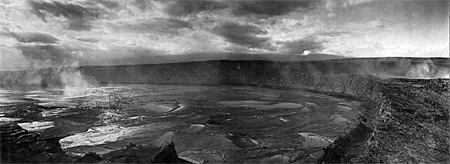
A view of the lava lake within Halema`uma`u Crater on December 27, 1911, with Uwekahuna bluff (where HVO and the Jaggar Museum now stand) and Mauna Loa in the background. The lake level had risen about 120 m (400 ft) since October 1911 and will drop 90 m (300 ft) in January, 1912, the month that HVO was founded by Thomas A. Jaggar's arrival for duty.
The adage "a picture is worth a thousand words" is certainly true, especially when it comes to photographs of Hawaiian eruptions and volcanic landscapes from earlier times.

Long-time readers of "Volcano Watch" might recall our January 20, 2005, article (http://hvo.wr.usgs.gov/volcanowatch/2005/05_01_20.html), which describes an HVO geologist's excitement at finding an 1860s photo of Kilauea's caldera. By comparing the photo to a present-day view of the caldera, he could see the location of volcanic features described in written records (with less than a thousand words) but no longer visible today—a valuable discovery when your job is to decipher a volcano's eruptive history.

Without realizing it, you or a family member may have captured a similarly important historical record of Hawai`i's volcanoes. How? By taking a photo and keeping it.

Your `ohana, like many families, probably has several albums—or shoe boxes—filled with old photographs. Perhaps your great-grandmother took a picture of a long-ago Kilauea summit eruption or your brother snapped a photo of `a`a lava as it flowed down the slopes of Mauna Loa. If you possess photographs that show volcanic landscapes or features, volcanic fume (vog), or any kind of eruptive activity, HVO geologists would like to hear from you and see the photos.

We learn the most from photographs that have some documentation about when and where they were taken. Date and location are essential pieces of information that help us interpret the geologic significance of a photo. If people are recognizable in a photograph, their names should also be included. Any other details you can provide about the image will add to its meaning.

Wide-angle shots are more helpful than close-ups. For example, if a photo is zoomed in on the leading edge of a lava flow and shows nothing else, we cannot determine the size of the flow-or much of anything else—from the image. With wide-angle views, we can see the geographic or geologic context of the eruptive activity or volcanic features shown in the photograph.

If you're interested in sharing your photos with HVO scientists, the first thing you should do is contact us by telephone (808-967-7328) or email us (askHVO@usgs.gov). Geologists are standing by to speak with you. The purpose of this initial conversation is to determine which of your photographs might be beneficial to our research and monitoring efforts on Hawai`i's volcanoes. We will then send you additional information on how we can receive and duplicate photos selected from your collection.

No need to worry about giving up your photographs—you retain ownership of them. We will return your photos to you after duplicating the images selected as most useful. In appreciation of your loaning us the photographs, we will be happy to give you digital copies of the images we scan.

To kick off our effort to expand HVO's photographic collection of Hawai`i's volcanoes, we are asking at this time to see photographs from 1924 and earlier. Those years included frequent lava lake activity in Halema`uma`u Crater and culminated in the explosive eruptions of May 1924.

Pre-1924 photos are of particular interest to us now because they could shed light on Kilauea's current summit eruption. Even if they show no eruptive activity, early photographs of Kilauea's caldera can contribute to a better understanding of the volcano's past and reveal features that are no longer visible. The same is true for early photos of Mauna Loa and Hualalai.

We will initially focus on early historical photographs, but you can contact us about any volcanic images you think might interest us. Although we may not be able to look at photos taken in recent decades right away, we would eventually like to see them. Our ultimate goal is to acquire images from the 1800s through the 20th century.

So, please lend us a hand while taking a trip down memory lane. Look through your family photos and contact HVO if you find images of Hawai`i's volcanoes. Your old photographs could give new life to eruptive events and volcanic landscapes rapidly fading from our visual memories.

Kīlauea Activity Update

Surface flows in the Royal Gardens subdivision remained active as of Thursday, June 18, burning through forested kipuka. Another area of breakouts active higher up on the pali was also reported. The Waikupanaha and Kupapa`u ocean entries remain active and continue to produce prominent plumes as lava spills into the ocean.

At Kīlauea's summit, the vent within Halema`uma`u Crater continues to emit elevated amounts of volcanic gas, resulting in high concentrations of sulfur dioxide downwind. Bright glow from the vent was visible at night through the past week. A collaborative effort last week between HVO and UH-Manoa scientists, using a sophisticated optical remote-sensing technology called LIDAR (Light Detection and Ranging), has measured the lava surface to be about 205 m (675 feet) below the floor of Halema`uma`u Crater.

No earthquakes beneath Hawai`i Island were reported felt this past week.

For more information on traveling to Hawaii in general and exploring the Big Island's volcanoes in particular, please also visit www.tourguidehawaii.com and www.lovingthebigisland.wordpress.com.


Casino Bonus no Deposit