Showing posts with label astronomy. Show all posts

Sunday, February 15, 2009

Hawaii's Sky Tonight!


Reprinted from here.

PLANETS AND THE SUMMER MILKY WAY

The interesting thing about sky-watching is the fact that although the seasonal constellations are predictable, what you may see at any designated time is not. Planetary movement and other recurring events take place on different cycles than the background of stars so we can’t always count on seeing the same combination of sights in the sky at the same times. That keeps me in business.

So what we will see in the sky this July is not unusual, but a fortunate arrangement of celestial constituents that will be easy and convenient to view. Four naked-eye planets dot the evening skies this month, with two staging a nice pairing together and beautiful Venus making its reappearance back into the night. Although it might be challenging to spot Venus low in the western sky after sunset during the first half of the month, by the end of the July it will be climbing higher out of the light and easier to spot.

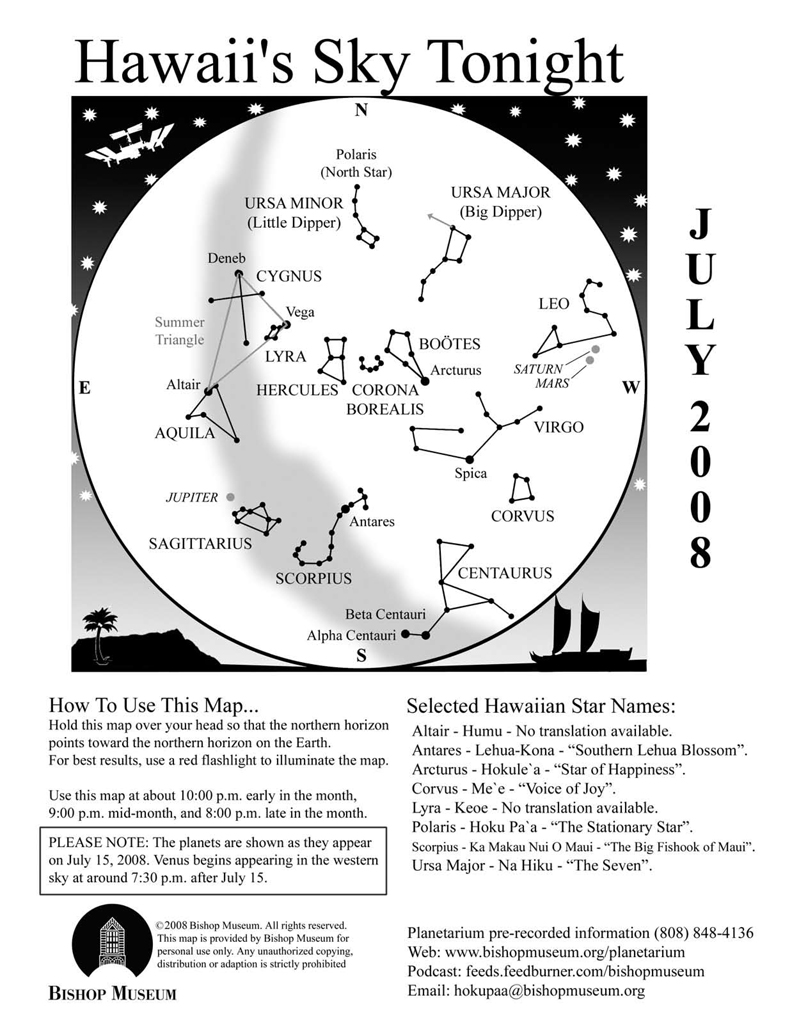
A nice highlight will be the conjunction of Mars and Saturn in the constellation Leo on July 9 and 10. The rust-colored planet and pale yellow Saturn have been slowly creeping closer over the past weeks and will be at their closest on those two dates (although the 10th is technically the closest date, both nights are good for viewing). Included in the lineup is the brightest star in Leo, Regulus, which is on that planet highway called the ecliptic. As a bonus, on July 5 a small crescent Moon joins the group as Mars closes in. That evening going from west to east, you can see the Moon next to the star Regulus, followed by Mars and Saturn. Make sure you start early however, because this gathering will set by 10:00 P.M.

Jupiter is also impressive in the east as the sun sets. The giant planet is at opposition now, meaning that it is on the opposite side of our sky than the sun (think “Sun, Earth, Jupiter” in that order). It appears bigger and brighter in the night sky at this time and is visible in the sky the whole night. Now would be a great time to take out a pair of binoculars and look for the famous features that characterize Jupiter, like the Galilean satellites and the distinct bands of color on the planet. The monster hurricane, the Great Red Spot, is visible with telescopes but not necessarily with average binoculars.

While the planets steal the spotlight this month, don’t forget to pay attention to the summer Milky Way! The hazy band of light extending from north to south is part of the galaxy we reside in and offers many binocular and telescopic sights along the way. The area roughly between Scorpius’ stinger and Sagittarius’ “spout” is particularly wide since that direction is the bulbous center of our galaxy, approximately 26,000 light years away. Rather than individual points of light we see the accumulation of the millions of stars obscured by gas and dust. Right now you can see the Milky Way stretching from the southwest in the direction of the Southern Cross (early in the evening) through the Summer Triangle toward Perseus in the northeast in the early morning hours.

EVENING PROGRAM UPDATE

With so many objects to look for in the skies, it’s difficult to cram everything into one article every month. Consider our planetarium as the next best thing to the real sky, one with a personal “guide” to the stars. An evening program is held on the first Fridays of the month, with sky viewing if the weather is clear. However since it falls on the 4th of July this month, the program has been moved to Friday, July 11. It begins promptly at 8:00 P.M. and reservations are strongly recommended. Call 848-4168.

PHOENIX UPDATE

The Phoenix lander is busily performing its tasks since touchdown on Mars a little over a month ago. What the mission has already done for space exploration was demonstrated by the difficult EDL phase, or Entry, Descent and Landing. Many previous missions were lost in this critical phase, including the predecessor of Phoenix, and since one of the science goals of the mission is to prepare for human exploration, NASA had to prove that landing a craft on Mars has improved dramatically. It appears that goal is well on its way. See http://phoenix.lpl.arizona.edu/ for more information.

The Planets

Earth:

The second of two annual opportunities to experience Lahaina Noon comes this month. Between May and July the sun passes directly overhead for areas within the Tropics. During Lahaina Noon objects that are directly perpendicular to the sun, such as flagpoles or fences, have no shadows since the “shadow” would be cast “under” the object. Times vary by location, so check the website for more information: www.bishopmuseum.org/planetarium

Also, aphelion takes place on July 3, the Earth’s farthest point in its orbit around the sun. Coincidentally the Moon is in a new phase at the same time, so the effect of the tides will be enhanced. Higher tides than normal usually occur during this alignment.

Mercury:

Mercury is in the morning sky now, rising around 4:30 A.M. in early July. By the last week it will be too close to the sunrise to spot as it rounds around the backside of the sun to reappear in the evening sky.

Venus:

For the casual viewer, Venus will be very difficult to spot until mid-month, when it is a little farther from the sun in the western sky at sunset. However the “window” to see it will be short for this month since the planet sets before darkness by 8:00 P.M.

Mars:

Mars is cruising through Leo, meeting up with Saturn along the way and by the end of the month will pass through the constellation on the way to Virgo. The planet is slowly receding from us in its orbit and dimming as it goes, but is still easily visible to the unaided eyes.

Jupiter:

Jupiter reaches opposition on the evening of July 9, rising in the east as the sun sets. If the weather is nice, this is an excellent night to see the four evening planets in the sky. You will need to get somewhere you can see all the way to the western horizon, and starting from that point shortly after sunset (around 7:30 P.M.) look for Venus low in the west, followed by Mars and Saturn close together about halfway up in the western sky and Jupiter rising in the east.

Saturn:

Although Mars and Saturn are set for a rendezvous Saturn’s position changes very little with respect to the starry background. The ringed planet is much farther away than our neighbor Mars, therefore orbiting the sun at a slower rate of speed. Where Mars orbits the sun in almost 687days, Saturn takes 29.5 years!

Sunday, January 11, 2009

Frank's Big Island Travel Hints # 7: Around Hilo


Hilo Side: Akaka Falls to Panaewa Rainforest Zoo

On your way back to the highway from Akaka Falls, stop in Honomu for some local-style shopping and a snack. Handmade curios and ice creams will delight your senses. Once back on Highway 19, turn right toward Hilo, about 10 minutes away.

Hilo is one of the wettest cities in the U.S. averaging around 200 inches per year. This old-style Hawaii town is quaint and bustling. Lots of great shops line the waterfront drive and the largest farmer’s market on the island is situated there as well. Tour Guide will take you right into the heart of town and give you history and attractions, such as the Pacific Tsunami Museum, and the Imiloa Astronomy Center at the University of Hawaii, Hilo Campus. A little farther along the coast are some beautiful beach parks like Richardson and Onekahakaha. Great picnicking, swimming and some good snorkeling can be found here. The Suisan Fish Market is famous for the early morning old-style fish auction. Be sure to take your time in Hilo as the shopping food options are immense.

In Hilo, you will turn north onto Highway. 11 at the intersection near Ken’s Pancake House, a landmark eatery. You will see the airport and Prince Kuhio Plaza on your way out of town. Stop in and visit the mall and shop and eat if you missed it in town. Just a few miles north of the mall is the Panaewa Rainforest Zoo. Tour Guide will tell you how this is the only rainforest zoo in the United States of America. It is also free.

Super Tip: Gasoline in Hilo is typically 6-10 cents per gallon cheaper because it is the main port on the island. It is wise to fill up before heading back to Kona.

This completes this drive day. I suggest returning north through Hilo and back up the Hamakua Coast, through Waimea, and Highway 190 back to Kona.

For further information, visit www.tourguidehawaii.com and here.

Saturday, September 20, 2008

Hawaii's Sky Tonight!


Reprinted for here.

PLANETS AND THE SUMMER MILKY WAY

The interesting thing about sky-watching is the fact that although the seasonal constellations are predictable, what you may see at any designated time is not. Planetary movement and other recurring events take place on different cycles than the background of stars so we can’t always count on seeing the same combination of sights in the sky at the same times. That keeps me in business.

So what we will see in the sky this July is not unusual, but a fortunate arrangement of celestial constituents that will be easy and convenient to view. Four naked-eye planets dot the evening skies this month, with two staging a nice pairing together and beautiful Venus making its reappearance back into the night. Although it might be challenging to spot Venus low in the western sky after sunset during the first half of the month, by the end of the July it will be climbing higher out of the light and easier to spot.

A nice highlight will be the conjunction of Mars and Saturn in the constellation Leo on July 9 and 10. The rust-colored planet and pale yellow Saturn have been slowly creeping closer over the past weeks and will be at their closest on those two dates (although the 10th is technically the closest date, both nights are good for viewing). Included in the lineup is the brightest star in Leo, Regulus, which is on that planet highway called the ecliptic. As a bonus, on July 5 a small crescent Moon joins the group as Mars closes in. That evening going from west to east, you can see the Moon next to the star Regulus, followed by Mars and Saturn. Make sure you start early however, because this gathering will set by 10:00 P.M.

Jupiter is also impressive in the east as the sun sets. The giant planet is at opposition now, meaning that it is on the opposite side of our sky than the sun (think “Sun, Earth, Jupiter” in that order). It appears bigger and brighter in the night sky at this time and is visible in the sky the whole night. Now would be a great time to take out a pair of binoculars and look for the famous features that characterize Jupiter, like the Galilean satellites and the distinct bands of color on the planet. The monster hurricane, the Great Red Spot, is visible with telescopes but not necessarily with average binoculars.

While the planets steal the spotlight this month, don’t forget to pay attention to the summer Milky Way! The hazy band of light extending from north to south is part of the galaxy we reside in and offers many binocular and telescopic sights along the way. The area roughly between Scorpius’ stinger and Sagittarius’ “spout” is particularly wide since that direction is the bulbous center of our galaxy, approximately 26,000 light years away. Rather than individual points of light we see the accumulation of the millions of stars obscured by gas and dust. Right now you can see the Milky Way stretching from the southwest in the direction of the Southern Cross (early in the evening) through the Summer Triangle toward Perseus in the northeast in the early morning hours.

EVENING PROGRAM UPDATE

With so many objects to look for in the skies, it’s difficult to cram everything into one article every month. Consider our planetarium as the next best thing to the real sky, one with a personal “guide” to the stars. An evening program is held on the first Fridays of the month, with sky viewing if the weather is clear. However since it falls on the 4th of July this month, the program has been moved to Friday, July 11. It begins promptly at 8:00 P.M. and reservations are strongly recommended. Call 848-4168.

PHOENIX UPDATE

The Phoenix lander is busily performing its tasks since touchdown on Mars a little over a month ago. What the mission has already done for space exploration was demonstrated by the difficult EDL phase, or Entry, Descent and Landing. Many previous missions were lost in this critical phase, including the predecessor of Phoenix, and since one of the science goals of the mission is to prepare for human exploration, NASA had to prove that landing a craft on Mars has improved dramatically. It appears that goal is well on its way. See http://phoenix.lpl.arizona.edu/ for more information.

The Planets

Earth:

The second of two annual opportunities to experience Lahaina Noon comes this month. Between May and July the sun passes directly overhead for areas within the Tropics. During Lahaina Noon objects that are directly perpendicular to the sun, such as flagpoles or fences, have no shadows since the “shadow” would be cast “under” the object. Times vary by location, so check the website for more information: www.bishopmuseum.org/planetarium

Also, aphelion takes place on July 3, the Earth’s farthest point in its orbit around the sun. Coincidentally the Moon is in a new phase at the same time, so the effect of the tides will be enhanced. Higher tides than normal usually occur during this alignment.

Mercury:

Mercury is in the morning sky now, rising around 4:30 A.M. in early July. By the last week it will be too close to the sunrise to spot as it rounds around the backside of the sun to reappear in the evening sky.

Venus:

For the casual viewer, Venus will be very difficult to spot until mid-month, when it is a little farther from the sun in the western sky at sunset. However the “window” to see it will be short for this month since the planet sets before darkness by 8:00 P.M.

Mars:

Mars is cruising through Leo, meeting up with Saturn along the way and by the end of the month will pass through the constellation on the way to Virgo. The planet is slowly receding from us in its orbit and dimming as it goes, but is still easily visible to the unaided eyes.

Jupiter:

Jupiter reaches opposition on the evening of July 9, rising in the east as the sun sets. If the weather is nice, this is an excellent night to see the four evening planets in the sky. You will need to get somewhere you can see all the way to the western horizon, and starting from that point shortly after sunset (around 7:30 P.M.) look for Venus low in the west, followed by Mars and Saturn close together about halfway up in the western sky and Jupiter rising in the east.

Saturn:
Although Mars and Saturn are set for a rendezvous Saturn’s position changes very little with respect to the starry background. The ringed planet is much farther away than our neighbor Mars, therefore orbiting the sun at a slower rate of speed. Where Mars orbits the sun in almost 687days, Saturn takes 29.5 years!

For more information on touring Hawaii in general and the Big Island in particular, visit tourguidehawaii.com and lovingthebigisland.wordpress.com.

Sunday, July 27, 2008

Hawaii's Sky Tonight!

//www.astroday.net/BishopSky.html

Reprinted from here.
Skywatch Article
July 2008
By Carolyn Kaichi, Bishop Museum


PLANETS AND THE SUMMER MILKY WAY

The interesting thing about sky-watching is the fact that although the seasonal constellations are predictable, what you may see at any designated time is not. Planetary movement and other recurring events take place on different cycles than the background of stars so we can’t always count on seeing the same combination of sights in the sky at the same times. That keeps me in business.

So what we will see in the sky this July is not unusual, but a fortunate arrangement of celestial constituents that will be easy and convenient to view. Four naked-eye planets dot the evening skies this month, with two staging a nice pairing together and beautiful Venus making its reappearance back into the night. Although it might be challenging to spot Venus low in the western sky after sunset during the first half of the month, by the end of the July it will be climbing higher out of the light and easier to spot.

A nice highlight will be the conjunction of Mars and Saturn in the constellation Leo on July 9 and 10. The rust-colored planet and pale yellow Saturn have been slowly creeping closer over the past weeks and will be at their closest on those two dates (although the 10th is technically the closest date, both nights are good for viewing). Included in the lineup is the brightest star in Leo, Regulus, which is on that planet highway called the ecliptic. As a bonus, on July 5 a small crescent Moon joins the group as Mars closes in. That evening going from west to east, you can see the Moon next to the star Regulus, followed by Mars and Saturn. Make sure you start early however, because this gathering will set by 10:00 P.M.

Jupiter is also impressive in the east as the sun sets. The giant planet is at opposition now, meaning that it is on the opposite side of our sky than the sun (think “Sun, Earth, Jupiter” in that order). It appears bigger and brighter in the night sky at this time and is visible in the sky the whole night. Now would be a great time to take out a pair of binoculars and look for the famous features that characterize Jupiter, like the Galilean satellites and the distinct bands of color on the planet. The monster hurricane, the Great Red Spot, is visible with telescopes but not necessarily with average binoculars.

While the planets steal the spotlight this month, don’t forget to pay attention to the summer Milky Way! The hazy band of light extending from north to south is part of the galaxy we reside in and offers many binocular and telescopic sights along the way. The area roughly between Scorpius’ stinger and Sagittarius’ “spout” is particularly wide since that direction is the bulbous center of our galaxy, approximately 26,000 light years away. Rather than individual points of light we see the accumulation of the millions of stars obscured by gas and dust. Right now you can see the Milky Way stretching from the southwest in the direction of the Southern Cross (early in the evening) through the Summer Triangle toward Perseus in the northeast in the early morning hours.

EVENING PROGRAM UPDATE

With so many objects to look for in the skies, it’s difficult to cram everything into one article every month. Consider our planetarium as the next best thing to the real sky, one with a personal “guide” to the stars. An evening program is held on the first Fridays of the month, with sky viewing if the weather is clear. However since it falls on the 4th of July this month, the program has been moved to Friday, July 11. It begins promptly at 8:00 P.M. and reservations are strongly recommended. Call 848-4168.

PHOENIX UPDATE

The Phoenix lander is busily performing its tasks since touchdown on Mars a little over a month ago. What the mission has already done for space exploration was demonstrated by the difficult EDL phase, or Entry, Descent and Landing. Many previous missions were lost in this critical phase, including the predecessor of Phoenix, and since one of the science goals of the mission is to prepare for human exploration, NASA had to prove that landing a craft on Mars has improved dramatically. It appears that goal is well on its way. See http://phoenix.lpl.arizona.edu/ for more information.

The Planets

Earth:

The second of two annual opportunities to experience Lahaina Noon comes this month. Between May and July the sun passes directly overhead for areas within the Tropics. During Lahaina Noon objects that are directly perpendicular to the sun, such as flagpoles or fences, have no shadows since the “shadow” would be cast “under” the object. Times vary by location, so check the website for more information: www.bishopmuseum.org/planetarium

Also, aphelion takes place on July 3, the Earth’s farthest point in its orbit around the sun. Coincidentally the Moon is in a new phase at the same time, so the effect of the tides will be enhanced. Higher tides than normal usually occur during this alignment.

Mercury:

Mercury is in the morning sky now, rising around 4:30 A.M. in early July. By the last week it will be too close to the sunrise to spot as it rounds around the backside of the sun to reappear in the evening sky.

Venus:

For the casual viewer, Venus will be very difficult to spot until mid-month, when it is a little farther from the sun in the western sky at sunset. However the “window” to see it will be short for this month since the planet sets before darkness by 8:00 P.M.

Mars:

Mars is cruising through Leo, meeting up with Saturn along the way and by the end of the month will pass through the constellation on the way to Virgo. The planet is slowly receding from us in its orbit and dimming as it goes, but is still easily visible to the unaided eyes.

Jupiter:

Jupiter reaches opposition on the evening of July 9, rising in the east as the sun sets. If the weather is nice, this is an excellent night to see the four evening planets in the sky. You will need to get somewhere you can see all the way to the western horizon, and starting from that point shortly after sunset (around 7:30 P.M.) look for Venus low in the west, followed by Mars and Saturn close together about halfway up in the western sky and Jupiter rising in the east.

Saturn:
Although Mars and Saturn are set for a rendezvous Saturn’s position changes very little with respect to the starry background. The ringed planet is much farther away than our neighbor Mars, therefore orbiting the sun at a slower rate of speed. Where Mars orbits the sun in almost 687days, Saturn takes 29.5 years!
Questions? Contact Carolyn Kaichi @ hokupaa@bishopmuseum.org or 847-8203.

For more information on visiting Hawaii in general or touring the Big Island in particular, go to www.tourguidehawaii.com or here.

Tuesday, July 22, 2008

Frank's Big Island Travel Hints # 7: Around Hilo


Hilo Side: Akaka Falls to Panaewa Rainforest Zoo

On your way back to the highway from Akaka Falls, stop in Honomu for some local-style shopping and a snack. Handmade curios and ice creams will delight your senses. Once back on Highway 19, turn right toward Hilo, about 10 minutes away.

Hilo is one of the wettest cities in the U.S. averaging around 200 inches per year. This old-style Hawaii town is quaint and bustling. Lots of great shops line the waterfront drive and the largest farmer’s market on the island is situated there as well. Tour Guide will take you right into the heart of town and give you history and attractions, such as the Pacific Tsunami Museum, and the Imiloa Astronomy Center at the University of Hawaii, Hilo Campus. A little farther along the coast are some beautiful beach parks like Richardson and Onekahakaha. Great picnicking, swimming and some good snorkeling can be found here. The Suisan Fish Market is famous for the early morning old-style fish auction. Be sure to take your time in Hilo as the shopping food options are immense.

In Hilo, you will turn north onto Highway. 11 at the intersection near Ken’s Pancake House, a landmark eatery. You will see the airport and Prince Kuhio Plaza on your way out of town. Stop in and visit the mall and shop and eat if you missed it in town. Just a few miles north of the mall is the Panaewa Rainforest Zoo. Tour Guide will tell you how this is the only rainforest zoo in the United States of America. It is also free.

Super Tip: Gasoline in Hilo is typically 6-10 cents per gallon cheaper because it is the main port on the island. It is wise to fill up before heading back to Kona.

This completes this drive day. I suggest returning north through Hilo and back up the Hamakua Coast, through Waimea, and Highway 190 back to Kona.

For further information, visit www.tourguidehawaii.com and here.

Sunday, June 1, 2008

Hawaii's Sky Tonight!

This article reprinted from http://www.astroday.net/bishopsky.html

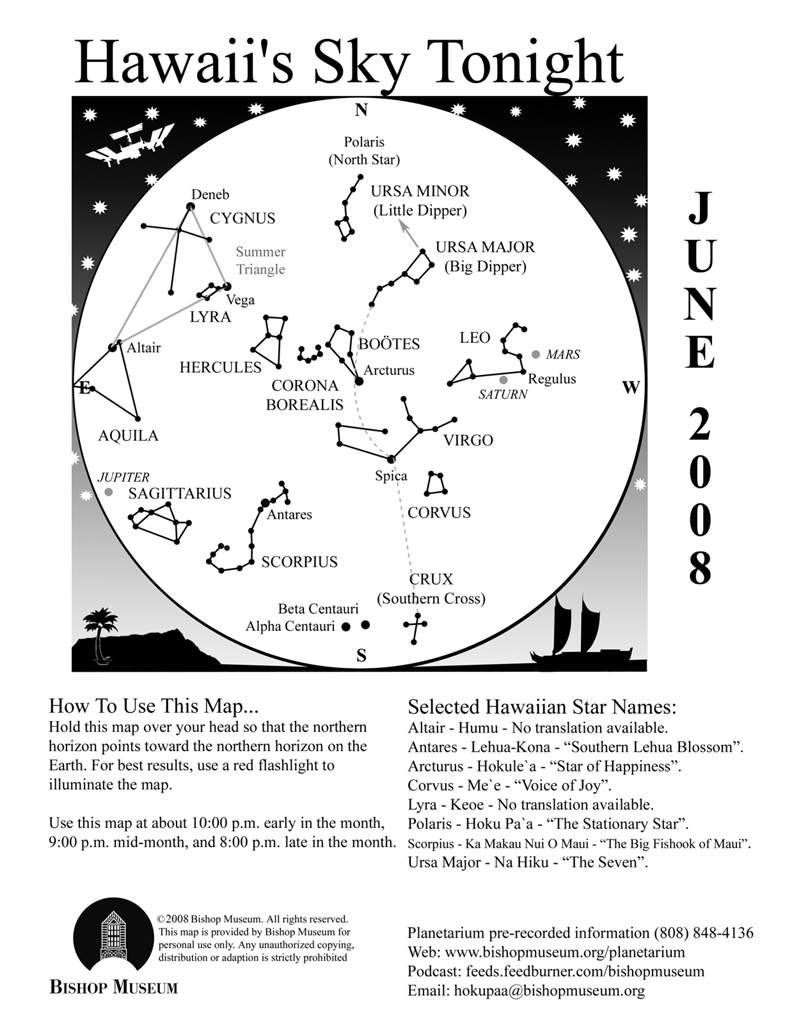
Bishop Museum Sky Map for Hawaii, June 2008

SKY GEOMETRY

The patterns we see in the sky exist only in our imagination. The points of light we group to create the shapes we call constellations are arbitrary and usually don’t have any connection with each other at all except that they happened to line up in someone’s mind at one time. The 88 “official” constellations are recognized by a group of professionals called the International Astronomical Union to help keep order and structure to the science of astronomy. Otherwise, imagine what chaos might reign—how would anyone know how to distinguish one part of the sky from another if names were random? For instance, the constellation Crater the Cup in the southern sky next to Corvus looks remarkably like my Weber grill, but I can’t very well start referring to it as such. As it is, we sometimes “shorten” the constellations anyway. Sagittarius is often referred to as the Teapot, and part of the Big and Little Bears are called the Big and Little Dippers, respectively.

Informal groupings or segments of constellations are called asterisms. They are usually parts of constellations that are more easily recognized, like the Dippers and the Teapot, and at times the references are updated. Some constellations are simply easier to recognize by these nicknames. I have heard the constellation Boötes the Herdsman referred to as a “bowtie” or “ice cream cone”, which most people relate to better.

Sometimes asterisms include groups of stars or constellations, like the Summer Triangle. Known anecdotally as a basic element of celestial navigation, the Summer Triangle is comprised of the three brightest stars in three separate constellations forming a large, distinctly triangular shape in the sky. First to rise in the east is the star Vega in the constellation Lyra the Lyre. Lyra is a small constellation that takes a bit of effort to imagine the harp-shaped instrument from the parallelogram of stars, but it is an area rich in telescopic sights. One is the famous Ring Nebula, M57—a little smoke-ring object that is the remains of a dying star seen at the center of the ring.

Vega is a white star and the fifth brightest star in the sky. Twelve thousand years ago Vega used to be our North Star, but because the Earth slowly “wobbles” (think of a spinning top, except our wobble is 26,000 years long!) the North Pole points toward different stars periodically. Right now, almost halfway through the wobble’s circle, Polaris is our North Star but in another 14,000 years Vega will take that title again.

Almost two hours after Vega rises the second point of the Triangle appears in the east in Cygnus the Swan. Although this constellation can be easily visualized as a bird, it does have an asterism associated with it. Part of the body and wingspan of the Swan is known as the Northern Cross. The star Deneb is the tail feather of the bird and is the brightest star in that constellation. Opposite from Deneb is an interesting star called Alberio. With a low powered telescope or even binoculars what looks like a single star will split into a beautiful sapphire blue and golden pair of stars.

A half hour later, Altair in Aquila the Eagle makes its appearance over the eastern horizon. Altair and Vega represent two figures in Japanese folklore that are celebrated with a national holiday in the country. Altair is the handsome herdsman Hikoboshi (also known as Kengyu) that fell in love with Orihime (Vega), the beautiful fabric-weaver. Their preoccupation with each other began to interfere with their duties, and as a result the gods separated them across a vast river in the sky. You can see that “heavenly river” in the dark sky as the white band of light called the Milky Way.

Fortunately, the story doesn’t end here—the gods heard the unhappy cries of the two lovers and took pity on them. On the seventh day of the seventh month, the two are united for one day as a flock of magpies build a living bridge to bring the two together. Today this occasion is celebrated by a festive holiday called Tanabata in Japan on July 7, although in early times this date was determined by the lunar calendar.

Following the Summer Triangle (and the parallelogram of Lyra) is the big Square of Pegasus. But because it is not included on this month’s map, I will save that “astro-geometry” lesson for another month!

The Planets

Earth:

Summer kicks off, at least astronomically, with the solstice on June 20. At 2:00 P.M. HST the sun crosses from the southern hemisphere into the northern hemisphere, marked by the celestial equator. (The celestial equator is an imaginary line that extends the Earth’s equator into space)

Mercury:

Mercury is passing in front of the sun for most of the month and will reappear in the morning sky during the last week of June. It hangs over the red “bull’s eye” of Taurus in the light of the rising sun.

Venus:

Venus is behind the sun right now, what is referred to as superior conjunction. It will be another month before it will appear back in the evening sky and blaze in the west after the sun sets.

Mars:

Mars quickly moved from Gemini through Cancer last month and will settle in the constellation Leo during June. Saturn has also been a resident of Leo recently and the two planets are heading for a conjunction in July. You can watch the Red Planet edge closer to yellowish Saturn over the month, with Regulus (the brightest star in Leo) in the middle.

The NASA mission to Mars, called Phoenix (see May’s article) will make its descent to Mars on May 25. Unfortunately I cannot update the status of this mission because this article is filed before this date, but I will definitely talk about Phoenix next month.

Jupiter:

The King of Planets rules the night, shining brighter than any other object besides the Moon this month. Jupiter rises by 10:00 P.M. in early June and about two hours earlier by the end of the month. On June 18, the full Moon enters Sagittarius, the same constellation as Jupiter, and the next evening the waning Moon moves just south of the giant planet.

Saturn:
Look for Saturn high in the west at nightfall during the first half of June, then only about halfway up in that direction by the end of the month. The rings of the gas planet is continuing to tip edgewise to our line of sight and well worth watching over the upcoming months. You will need a telescope to really appreciate this sight, however.

Questions? Contact Carolyn Kaichi @ hokupaa@bishopmuseum.org or 847-8203.

For information ad videos about visiting Hawaii in general and touring the Big Island in particular, visit www.tourguidehawaii.com and www.lovingthebigisland.wordpress.com.

Thursday, May 22, 2008

The Sky Over Paradise Tonight

Hawaii's Sky Tonight reprinted from the Bishop Museum, here.

ETA AQUARIDS AND SMALLEST FULL MOON

We spent last month being “grounded” by the myriad of science events in town and I didn’t spend much time on things going on above our atmosphere. In contrast, this month is a bit busier with interesting sky-watching events as well as a number of human-generated activities in our solar system.

Starting with the natural events in our sky, May has the second of the two “really good” meteor showers of the year, with the best-coinciding Moon phase to look for meteors. The Moon is “new”, or dark during the shower, which means there is no moonlight to compete with the streaking lights, however staying away from city lights will make for even better seeing conditions. The Eta Aquarids will peak at 8:00 A.M. on May 5. The radiant of the shower rises in the constellation Aquarius almost directly due east by 2:30 A.M. on May 5, so between then and sunrise is the most ideal viewing time. The Eta Aquarids are leftover bits of Comet Halley making contact with our atmosphere. Often characterized as “dirty snowballs”, comets are essentially loosely packed material that “shed” as they travel through space, especially as they get warmed by the sun. This debris is often pieces no larger than pebbles or dust. Please note that because Aquarius will not rise until the early morning hours, it will not be included on this map. But don’t worry, you do not need a star map nor knowledge of the constellation to look for the Eta Aquarids if you go by the times and direction to look (east).

Speaking of the Moon, this month’s full Moon is the smallest of 2008. Remember that the Moon’s orbit is not perfectly circular but elliptical so there is a closest and farthest point to the Earth every month, called perigee and apogee, respectively. This month’s full Moon coincides with its apogee, therefore making it appear smaller in the sky. The difference visually is less than 10% and most people will probably not notice it, but pictures of the Moon compared at both extremes (perigee and apogee) will definitely show the difference. A good website for this is Astronomy Picture of the Day and search for “apogee” or “perigee”.

SPACE TRAFFIC

There are a lot of exciting missions heading off into space this month—starting closest to the Earth, the space shuttle Discovery is scheduled to launch the last day of May to the International Space Station (ISS). The shuttle carries more components for the Japanese laboratory KIBO and an astronaut from the Japan Aerospace Exploration Agency (JAXA) as a mission specialist. KIBO, which means “hope” in Japanese, will join the recently-added European Space Agency’s Columbus Lab and the existing research modules from the United States and Russia.

Moving further out into the solar system, NASA is anxiously waiting for May 25, when the newest Mars explorer touches down on the Red Planet. The Phoenix Mars Lander has been cruising the 422 million miles to the planet since it launched last August and will join the two Mars rovers, Spirit and Opportunity on the surface in the search for water and signs of habitability. While the rovers explore the equatorial region of Mars, Phoenix will be located at the north polar area. In comparison, if Phoenix were on Earth it would be in Northern Canada within the Arctic Circle. Water is the main ingredient for supporting life as we know it, and scientists are concentrating on this part of Mars because there is evidence of large amounts of water locked in the ice caps at the poles.

Phoenix is named after the mythical bird that bursts into flames as it dies, bringing forth a new bird from its ashes. The Phoenix Mars Lander carries instruments and spacecraft design from two unsuccessful missions, the Mars Polar Lander and the Mars Surveyor 2001 Lander, reviving the technology and making this mission the first to explore the icy polar region of the planet from the surface.

Lastly, a mission that will explore the farthest ends of the universe is also scheduled to launch in mid-May. NASA’s Gamma-Ray Large Area Space Telescope (GLAST) will search deep space for gamma-ray bursts, one of the most elusive and the most powerful forms of radiation in the universe. It is not known what causes these massive explosions of energy and scientists are hoping to determine whether exotic objects such as black holes or neutron stars are involved. GLAST will also study other sources of high-energy, like supernovas and pulsars, to help give more insight to our understanding of the universe.

The Planets

Earth:

Lahaina Noon season begins. Between May and July the sun passes directly overhead for areas within the Tropics. During Lahaina Noon objects that are directly perpendicular to the sun, such as flagpoles or fences, have no shadows since the “shadow” would be cast right “under” the object. Times vary by location, so check the website for more information: www.bishopmuseum.org/planetarium

Mercury:

Mercury is back in the western sky at sunset, low in the horizon during the first week of May and getting to its full height at mid-month. Although small, Mercury is fairly bright but is typically visible mostly during twilight because by the time the sky is fully dark the little planet is too low to the horizon for most people to see. (Unless you have a clear view to the west)

Venus:

Unfortunately the brightest planet is no match for the brightest star in our sky. Venus is very close to the sun right now and will move behind it next month. The casual observer will have a difficult time spotting it the few minutes before the sun rises in the first week of the month.

Mars:

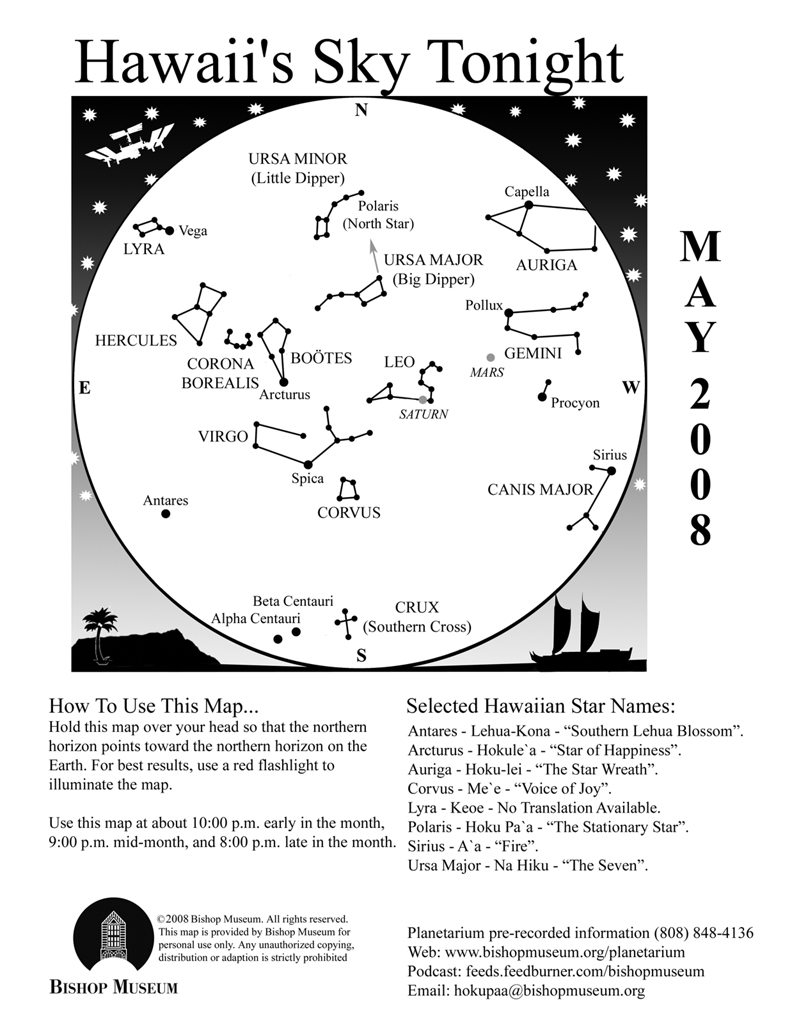
Mars moves from Gemini into Cancer during this month and towards the end of the month (May 21-23) and passes through a nice binocular cluster, M44 or the Beehive Cluster. During the first couple of weeks while the planet is still in Gemini, however, look for the fading planet next to the two brothers’ “heads” at the east of the constellation. It is still as bright as Pollux (the more eastern twin) but continues to fade as it recedes from Earth. On May 9 a crescent Moon joins the group as Mars makes its way eastward. The constellation Cancer contains few bright stars discernable from the city, so it is not included on the map, but follow Mars’ path through the month and see if you can spot the cluster of hundreds of stars with binoculars during its trek through the Beehive!

Jupiter:

Jupiter rises right around midnight the first few days of the month and almost half an hour earlier by just the first week. By the end of the month the giant planet will rise by 10:00 P.M. Jupiter is to the east of the “teapot handle” of Sagittarius, but you won’t have any trouble finding it in the sky because of its brightness.

Saturn:
At the start of May Saturn is almost at zenith at nightfall and next to the “heart” of the constellation Leo. If you are looking at Mars during the month with binoculars, don’t pass up the chance to spot Saturn while you’re at it since they are in the same part of the sky.

Questions? Contact Carolyn Kaichi @ hokupaa@bishopmuseum.org or 847-8203.

For more information on visiting Hawaii and touring the Big Island, visit www.tourguidehawaii.com and www.lovingthebigisland.wordpress.com.

Sunday, May 4, 2008

Tour Guide Hawaii Presents: Hawaii's Sky Tonight

From The Bishop's Museum "Skywatch" webpage.

ETA AQUARIDS AND SMALLEST FULL MOON

We spent last month being “grounded” by the myriad of science events in town and I didn’t spend much time on things going on above our atmosphere. In contrast, this month is a bit busier with interesting sky-watching events as well as a number of human-generated activities in our solar system.

Starting with the natural events in our sky, May has the second of the two “really good” meteor showers of the year, with the best-coinciding Moon phase to look for meteors. The Moon is “new”, or dark during the shower, which means there is no moonlight to compete with the streaking lights, however staying away from city lights will make for even better seeing conditions. The Eta Aquarids will peak at 8:00 A.M. on May 5. The radiant of the shower rises in the constellation Aquarius almost directly due east by 2:30 A.M. on May 5, so between then and sunrise is the most ideal viewing time. The Eta Aquarids are leftover bits of Comet Halley making contact with our atmosphere. Often characterized as “dirty snowballs”, comets are essentially loosely packed material that “shed” as they travel through space, especially as they get warmed by the sun. This debris is often pieces no larger than pebbles or dust. Please note that because Aquarius will not rise until the early morning hours, it will not be included on this map. But don’t worry, you do not need a star map nor knowledge of the constellation to look for the Eta Aquarids if you go by the times and direction to look (east).

Speaking of the Moon, this month’s full Moon is the smallest of 2008. Remember that the Moon’s orbit is not perfectly circular but elliptical so there is a closest and farthest point to the Earth every month, called perigee and apogee, respectively. This month’s full Moon coincides with its apogee, therefore making it appear smaller in the sky. The difference visually is less than 10% and most people will probably not notice it, but pictures of the Moon compared at both extremes (perigee and apogee) will definitely show the difference. A good website for this is Astronomy Picture of the Day and search for “apogee” or “perigee”.

SPACE TRAFFIC

There are a lot of exciting missions heading off into space this month—starting closest to the Earth, the space shuttle Discovery is scheduled to launch the last day of May to the International Space Station (ISS). The shuttle carries more components for the Japanese laboratory KIBO and an astronaut from the Japan Aerospace Exploration Agency (JAXA) as a mission specialist. KIBO, which means “hope” in Japanese, will join the recently-added European Space Agency’s Columbus Lab and the existing research modules from the United States and Russia.

Moving further out into the solar system, NASA is anxiously waiting for May 25, when the newest Mars explorer touches down on the Red Planet. The Phoenix Mars Lander has been cruising the 422 million miles to the planet since it launched last August and will join the two Mars rovers, Spirit and Opportunity on the surface in the search for water and signs of habitability. While the rovers explore the equatorial region of Mars, Phoenix will be located at the north polar area. In comparison, if Phoenix were on Earth it would be in Northern Canada within the Arctic Circle. Water is the main ingredient for supporting life as we know it, and scientists are concentrating on this part of Mars because there is evidence of large amounts of water locked in the ice caps at the poles.

Phoenix is named after the mythical bird that bursts into flames as it dies, bringing forth a new bird from its ashes. The Phoenix Mars Lander carries instruments and spacecraft design from two unsuccessful missions, the Mars Polar Lander and the Mars Surveyor 2001 Lander, reviving the technology and making this mission the first to explore the icy polar region of the planet from the surface.

Lastly, a mission that will explore the farthest ends of the universe is also scheduled to launch in mid-May. NASA’s Gamma-Ray Large Area Space Telescope (GLAST) will search deep space for gamma-ray bursts, one of the most elusive and the most powerful forms of radiation in the universe. It is not known what causes these massive explosions of energy and scientists are hoping to determine whether exotic objects such as black holes or neutron stars are involved. GLAST will also study other sources of high-energy, like supernovas and pulsars, to help give more insight to our understanding of the universe.

The Planets

Earth:

Lahaina Noon season begins. Between May and July the sun passes directly overhead for areas within the Tropics. During Lahaina Noon objects that are directly perpendicular to the sun, such as flagpoles or fences, have no shadows since the “shadow” would be cast right “under” the object. Times vary by location, so check the website for more information: www.bishopmuseum.org/planetarium

Mercury:

Mercury is back in the western sky at sunset, low in the horizon during the first week of May and getting to its full height at mid-month. Although small, Mercury is fairly bright but is typically visible mostly during twilight because by the time the sky is fully dark the little planet is too low to the horizon for most people to see. (Unless you have a clear view to the west)

Venus:

Unfortunately the brightest planet is no match for the brightest star in our sky. Venus is very close to the sun right now and will move behind it next month. The casual observer will have a difficult time spotting it the few minutes before the sun rises in the first week of the month.

Mars:

Mars moves from Gemini into Cancer during this month and towards the end of the month (May 21-23) and passes through a nice binocular cluster, M44 or the Beehive Cluster. During the first couple of weeks while the planet is still in Gemini, however, look for the fading planet next to the two brothers’ “heads” at the east of the constellation. It is still as bright as Pollux (the more eastern twin) but continues to fade as it recedes from Earth. On May 9 a crescent Moon joins the group as Mars makes its way eastward. The constellation Cancer contains few bright stars discernable from the city, so it is not included on the map, but follow Mars’ path through the month and see if you can spot the cluster of hundreds of stars with binoculars during its trek through the Beehive!

Jupiter:

Jupiter rises right around midnight the first few days of the month and almost half an hour earlier by just the first week. By the end of the month the giant planet will rise by 10:00 P.M. Jupiter is to the east of the “teapot handle” of Sagittarius, but you won’t have any trouble finding it in the sky because of its brightness.

Saturn:
At the start of May Saturn is almost at zenith at nightfall and next to the “heart” of the constellation Leo. If you are looking at Mars during the month with binoculars, don’t pass up the chance to spot Saturn while you’re at it since they are in the same part of the sky.

To see video of exploring the lava flow, go here and here; for more information on exploring the Big Island, go here and here; for information on renting GPS-guided tours of the Big Island, go here to see a video demonstration of GPS-guided tours of the Big Island, go here.

skip past bottom navigational bar

Wednesday, April 2, 2008

Hawaii's Sky Tonight


Skywatch Article
April 2008
By Carolyn Kaichi, Bishop Museum

SCIENCE ABOVE AND ABOUT TOWN

There is a major meteor shower this month, the Lyrids, peaking on the evening of Monday, April 21. Unfortunately, an almost-full Moon will shine in the sky all night, making viewing conditions not very ideal for seeing many meteors. The radiant is between Lyra and Hercules but won’t even begin to rise until 9:30 P.M. when the Moon is already well up in the eastern sky. Fortunately, there are many other science related events going on right here in the islands to hopefully satisfy your celestial appetite.

Consider coming to the Bishop Museum Sky Tonight evening program, held every first Friday of the month. This is an hour-long planetarium program concentrating on details of the current month’s sky, with the opportunity to do some telescope viewing if the weather cooperates. Please note that this program has been moved by an hour, now starting at 8:00 P.M., and reservations are required. Call 848-4168 for reservations and information. There is a charge of $4 for non-Bishop Museum members.

The 51st Hawai’i State Science and Engineering Fair is another learning opportunity open to the public on Wednesday, April 2. Amazing and imaginative displays and projects from over 400 students representing 80 schools around the state will be on display at the Neal Blaisdell Center Exhibition Hall from 8:00 A.M. to 7:00 P.M. In addition to these fascinating and sometimes amusing presentations (is your mouth cleaner than your dog’s?), there are several other special exhibits as well. The National Oceanic and Atmospheric Administration (NOAA) is sponsoring a visit by TERRI, a five-foot tall sophisticated robot that sings, tells stories and converses with people. NOAA will also bring an interactive computer exhibit called SciLands—a virtual world in which to explore the Earth in ways most people would never experience. With your virtual personality, you can float on a thundercloud, fly through a hurricane, explore underwater caves and more in the Second Life world. And the Air Force Association will have a full size model of the space shuttle cockpit to walk through. All this is free and open to the public on Wednesday.

On Saturday, April 5, the Bishop Museum hosts the 4th annual Mad About Science Festival from 9:00 A.M. to 5:00 P.M. with the theme, “Healthy Living, Healthy Planet”, focusing on ideas from medicine to Global Warming. The popular behind-the-scenes tours of the museum’s natural sciences collections will be offered and special programs and activities for the entire family will be ongoing throughout the day. In addition, speakers from environmentally-conscious businesses and government agencies in the community will offer talks on keeping our lifestyles, homes and land healthy and safe. NOAA will again make an appearance with TERRI, SciLands demonstrations and hands-on activities for the kids. This is also the last few weeks of the Bishop Museum’s special exhibit, Animal Grossology, which will be open during the Mad About Science Festival.

At the end of the month, on April 27, the University of Hawaii Institute for Astronomy will hold its annual Open House from 11:00 A.M. to 4:00 P.M. Many fascinating astronomy displays, talks and activities will be offered from the Institute and its partners (including the Bishop Museum!). This event is free and open to the public.

Finally, a sneak peak into activities in May—Big Island residents can look forward to AstroDay on Saturday, May 3 at the Prince Kuhio Plaza in Hilo. It’s a day-long celebration of the science, technology and culture in Hawai’i involving participants from all over the state.

MORE ON THE SOUTHERN CROSS

Several readers commented on the fact that one of the featured constellations I wrote about last month, the Southern Cross, was not visible in last month’s map. That is because our map can only show on part of the evening sky and we chose to illustrate the sky only until 10:00 P.M. or so. Unfortunately for last month that just missed the time the Cross rose in the sky. However, since the stars rise around four minutes earlier each night (because of our orbit around the sun) this means that by the end of the month those stars rise roughly two hours earlier. Therefore, the Southern Cross will be on our map this time since it will be up in the south by 10:00 P.M. at the beginning of April!

The Planets

Mercury:

Mercury is traveling behind the sun this month but by the last few days of April emerges low in the western sky at evening twilight. The Pleiades sits near the small planet but that little cluster, along with the other stars associated with the winter sky, are getting progressively lower in the west and more difficult to see as the days get longer.

Venus:

Like Mercury, Venus is also preparing to go behind the sun, although it still has a couple months to go. But it is very close to the sunrise, rising less than an hour before the sun in early April and half an hour in late April. By then it will be too challenging to see until it reappears in the evening sky in late summer.

Mars:

Mars starts off the month on the side of the brother Castor in the constellation of Gemini. As the month progresses, the planet begins to shift eastward toward the other twin Pollux and by the last day of April appears as almost a third “brother” in the constellation. On April 11, a first quarter Moon skims by the Red Planet, making for a nice sight with binoculars or a telescope.

Jupiter:

Jupiter rises in the east by 2:00 A.M. in early April and two hours earlier at the end of the month. It will appear right above a 3rd quarter Moon on April 27, very early in the morning. The giant planet is heading toward opposition in July, so is getting bigger and brighter in our night sky as we approach that date.

Saturn:
Saturn is nicely placed at the “top” of the sky as night falls in the constellation of Leo. The pale golden planet is only a few degrees from the star Regulus, the heart of the lion. Three days after visiting near Mars, the Moon pays a call on the Saturn and Regulus on April 14.

Reprinted from the Bishop Museum Site

Questions? Contact Carolyn Kaichi @ hokupaa@bishopmuseum.org or 847-8203.


Friday, March 14, 2008

Frank's Big Island Travel Hints # 7: Around Hilo


Hilo Side: Akaka Falls to Panaewa Rainforest Zoo

On your way back to the highway, stop in Honomu for some local-style shopping and a snack. Handmade curios and ice creams will delight your senses. Once back on Highway 19, turn right toward Hilo, about 10 minutes away.

Hilo is one of the wettest cities in the U.S. averaging around 200 inches per year. This old-style Hawaii town is quaint and bustling. Lots of great shops line the waterfront drive and the largest farmer’s market on the island is situated there as well. Tour Guide will take you right into the heart of town and give you history and attractions, such as the Pacific Tsunami Museum, and the Imiloa Astronomy Center at the University of Hawaii, Hilo Campus. A little farther along the coast are some beautiful beach parks like Richardson and Onekahakaha. Great picnicking, swimming and some good snorkeling can be found here. The Suisan Fish Market is famous for the early morning old-style fish auction. Be sure to take your time in Hilo as the shopping food options are immense.

In Hilo, you will turn north onto Highway. 11 at the intersection near Ken’s Pancake House, a landmark eatery. You will see the airport and Prince Kuhio Plaza on your way out of town. Stop in and visit the mall and shop and eat if you missed it in town. Just a few miles north of the mall is the Panaewa Rainforest Zoo. Tour Guide will tell you how this is the only rainforest zoo in North America. It is also free.

Super Tip: Gasoline in Hilo is typically 6-10 cents per gallon cheaper because it is the main port on the island. It is wise to fill up before heading back to Kona.

This completes this drive day. I suggest returning north through Hilo and back up the Hamakua Coast, through Waimea, and Highway 190 back to Kona.

For further information, visit www.tourguidehawaii.com.


Casino Bonus no Deposit