Saturday, December 6, 2008

Weekly Volcano Watch!

Reprinted form here.

Halema`uma`u engine shifts gears, but keeps on chugging

Photos, taken by HVO's webcam on November 17th illustrate the new behavior of the summit eruption plume, which this week began oscillating between strong and robust (left), and weak and wispy (right).

For the past month, Kīlauea's summit eruption has been steadily chugging along. Clattering sounds issue from the Halema`uma`u vent as gas pulses forth, forming a thick plume that rolls into white billows high above the caldera. On most days, the plume rises and turns above the summit, gently drifting southward and darkening the Ka`u landscape. In the distance, an endless train of fume wraps around the flanks of Mauna Loa, destined for Kona and other points on the island chain.

Since mid-October, this scene has been relatively steady. But on Monday, November 17th, something changed. The thick white plume that we have become accustomed to seeing suddenly vanished, leaving only transparent trails of fume issuing from the vent. It appeared as though the summit activity had stopped—the chugging engine had seized. But, just as suddenly as it paused, it resumed a few minutes later, and the thick plume returned, puffing high above the caldera. This cycle of robust and wispy plumes occurred several more times on Monday and into the next day.

On Tuesday morning, HVO geologists made their way to the crater's edge and were standing above the vent through four of these plume transitions. Instead of a continuous flow of fume and occasional clatter, they witnessed something far more curious. When the plume became weak and wispy, the faint roar of surf, usually a common sound, was barely audible. Then, suddenly, they heard the loud and intimidating sound of breaking glass, followed by the rushing return of a thick white plume.

During these changes, cameras captured images and instruments recorded temperatures as glow returned to the vent. The glow intensity and associated temperatures were the highest observed since mid-October.

The amount of material ejected onto the crater rim also increased to its highest level since mid-October. This material largely consists of Pele's hair and other glassy fragments suggestive of fresh lava.

So, what is happening at the vent and why has it changed? Our explanations of natural phenomena are always working hypotheses that are refined as more data become available. At this stage, our data suggest that lava may be pistoning (rising and falling) within the vent.

When pistoning occurs, lava rises within the conduit to a level perhaps within 100 meters (300 feet) of the vent rim. As the lava cools, a crust forms on its surface. This crust can impede the flow of gas, causing pressure to build within the lava. When enough pressure is built to break the crust, gas can rush forward. The reduction in gas pressure causes the lava piston to drop down within the vent, and the cycle starts again.

Scientists at HVO have witnessed lava pistoning within vents during other eruptions on Kīlauea. For example, seismic tremor recorded at the summit in recent days is reminiscent of tremor produced at Pu`u O`o several years ago, when lava filled and drained from vents within its crater.

The sound of breaking glass heard within the vent may be caused by shattering of the glassy crust on the lava-piston's surface. The increase in glassy lava fragments deposited on the rim of Halema`uma`u is probably the result of this sequence.

Periods of intense glow observed at night could also be explained by the pistoning. When the crust breaks up and the lava level drops, red-hot molten lava and incandescent vent walls are exposed, increasing the intensity of the glow.

An explanation for changes deep within the volcano causing this pistoning behavior is more ambiguous. Whatever the reasons are for the shift in summit activity, we are sure that the engine is still chugging.

Activity update

Kīlauea Volcano continues to be active. A vent in Halema`uma`u Crater is erupting elevated amounts of sulfur dioxide gas and very small amounts of ash. Resulting high concentrations of sulfur dioxide in downwind air have closed the south part of Kīlauea caldera and produced occasional air quality alerts in more distant areas, such as Pahala and communities adjacent to Hawai`i Volcanoes National Park, during kona wind periods. The have been several small ash-emission events from the vent, lasting only minutes, in the last week. For a few days mid-week, there were several brief periods of decreased plume vigor lasting minutes to hours. During these periods, the plume was the weakest it has been since the vent opened last March.

Pu`u `Ō`ō continues to produce sulfur dioxide at rates higher than the vent in Halema`uma`u Crater. Trade winds tend to pool these emissions along the West Hawai`i coast, while Kona winds blow these emissions into communities to the north, such as Mountain View, Volcano, and Hilo.

Lava continues to erupt from the Thanksgiving Eve Breakout (TEB) vent and flows toward the ocean through a well-established lava tube. Activity at the Waikupanaha ocean entry has fluctuated over the past week, with periods of small littoral explosions and a voluminous plume, followed by periods of no explosions and a wispy plume. Part of these fluctuations may have occurred in response to a deflation-inflation (DI) event at Kilauea's summit on November 16-17. A western branch of the tube, which diverges from the main TEB tube at the top of the pali, continues to supply lava to breakouts on the coastal plain. These breakouts are scattered along the western margin of the TEB flow field and are slowly marching southward toward the National Park boundary.

Be aware that active lava deltas can collapse at any time, potentially generating large explosions. This may be especially true during times of rapidly changing lava supply conditions. Do not venture onto the lava deltas. Even the intervening beaches are susceptible to large waves generated during delta collapse; avoid these beaches. In addition, steam plumes rising from ocean entries are highly acidic and laced with glass particles. Check the Civil Defense Web site (http://www.lavainfo.us) or call 961-8093 for viewing hours.

Mauna Loa is not erupting. Two earthquakes were located beneath the summit this past week. Continuing extension between locations spanning the summit indicates slow inflation of the volcano.

There were no felt earthquakes reported on Hawai`i Island for the past week.

Visit our Web site (http://hvo.wr.usgs.gov) for daily Kīlauea eruption updates, a summary of volcanic events over the past year, and nearly real-time Hawai`i earthquake information. Kīlauea daily update summaries are also available by phone at (808) 967-8862. Questions can be emailed to askHVO@usgs.govskip past bottom navigational bar

For more information on visiting Hawaii in general and touring the Big ISland in particular, go to www.tourguidehawaii.com and www.lovingthebigisland.wordpress.com.

Wednesday, December 3, 2008

What Do I Do On the Big Island? Explore The Incomparable Hamakua Coast!


Photo by Donald MacGowan

The Hamakua Coast, running up the windward side of the Big Island from just north of Hilo to the north tip island at Upolu Point, is one of the most magical, enchanting and memorable parts of the Big Island. To few people take the time to really see the depth and grandeur of the Hamakua District. Once the center of the sugar industry in Hawaii, Honoka'a, and the rest of District comprised of sweeping farm land, torrid jungle canyons and thousand foot lacy waterfalls, sank into pot-plantation era torpor, alowing the decades to simply wash over it. Experiencing a resurgence of energy, population and interest, Hamakua is remaiking itself as a tourist mecca and growing community of entrepreneurs, Eco-friendly industries and boutique agricultural businesses. You owe it to yourself to discover, explore and fall in love with this unique and special part of the Hawaii's Big Island.

Pepe’ekeo Scenic Drive

Located just a few minutes north of Hilo on Highway 19, this “Old Road through Old Hawai'i”, a four-mile-half hour scenic wander, parallels Highway 11 but is removed worlds away from the traffic and hustle along the main road. Rolling along old cane fields, jungle-canopied in places, passing waterfalls and crossing creeks, the Pepe’ekeo Scenic Drive is a special treat for the visitor who may be thinking they waited a century too long to visit Hawai'i. On a sunny day, on a rainy day, it doesn’t matter; this scenic drive is a joy.

A scenic overlook of Onomea Bay, near the head of the trail, reveals the wildly scenic, untamed coastline and canyon mouth, beckons casual hikers to explore Onomea Bay.

Photo By Donald MacGowan

Onomea Bay Trail

Only a few miles north of tame and sedate Hilo Bay, Onomea Bay is subject to the full fury and magic of the open Pacific Ocean. Rugged, jagged, majestic, the wickedly sculpted cliffs along the bay belie the easy 15 minute walk down to the beach. Accessible to most walkers of even marginal condition, the trail leads alongside a botanical garden (be sure not to wander through any their gates unless you are a paying customer) and falls forthrightly down to the canon mouth, past a tiny waterfall at the end of the stream and to the beach. A lovely walk and a wildly inspiration place; if you have an extra forty minutes to spare, this walk is well worth the time.

The fishing here is great but we don’t recommend swimming here due to the currents and rip-tides.


Photo by Donnie MacGowan

Akaka Falls

There is a reason that Akaka Falls rates as the most visited tourist site on the island of Hawai’i. Simply put, the 420 foot, free falling plunge of clear water down a fern festooned cliff is an amazing and beautiful site. Leaving the parking lot, the loop trail immediately splits. Going left through fern, ginger, impatiens and bamboo, one reaches Akaka Falls in 5-8 minutes of ambling. If you turn right, the trail loops up and down some hills, through a wonderful jungle of flowers, ferns, heliconia, palms and bamboo to 100 foot tall Kahuna Falls in about 15 minutes of walking; Akaka Falls is then reached by following the same path another 5 minutes and 5-8 minutes after that you are back at the parking lot.

Almost every town in Hawai’i has a “Wainuenue street”. From the Hawai’ian syllables “wai” meaning “fresh water” and “nue” meaning “colorful” or “dancing”, the word “wainuenue” refers to the rainbow seen in waterfalls. If you are lucky, and approach Akaka Falls on a sunny morning when the sun shines into to grotto, you may be blessed with seeing this lovely Hawai’ian icon, the wainuenue.


When visiting Akaka Falls, be sure to save some time to explore the shops, galleries and cafes of Honomu on the way back to the highway; it’s unlike anywhere you’ve ever been before…guaranteed.

Hakalau Beach Park

Oh, wow! Most definitely the tropical paradise you dreamed about visiting, this thick, lush jungle canyon is a stunning remnant of Old Hawai'i, leading along a rushing stream to a narrow canyon festooned with tropical blossoms, vines and palms to a sandy beach where the surf is nothing short of amazing.

Although locals surf and swim unconcernedly here, the visitor is advised to admire the water, but not go in. Not only are the waves, currents and tides lethally treacherous here, but stream mouths and murky water are prime hunting grounds of Hawai'i’s own tiger, Mano, the shark.


There are no services at Hakalau Beach.


Kolekole Beach Park
The river you saw magnificently leaping with such glorious abandon off the cliff at Akaka Falls ends its journey to the sea by sluicing down through this Koa-tree filled canyon and smashing into the surf at Kolekole Beach Park. Lawns, picnic facilities, a wild beach, a jungle canyon and a water-fall festooned swimming hole round-out the amenities at Kolekole Park.

This is another beach where the visitor is admonished to swim only when the surf is flat and even then with great caution.

Laupahoehoe Train Museum

Back in the day, built around the turn of the century, various train lines nearly circumnavigated the Big Island, carrying raw cane to refineries and sacks of sugar to quaysides dotted here and there around the island. The coming of a large military presence during the Second World War was marked by an era of road building which more or less obviated the need for the trains. Tracks and trestles were cannibalized for wood and metal in the war effort and slowly the Big Island train industry was groaning to an ignoble halt when the tidal wave of 1946 destroyed much of the remaining track; today the carcass of Big Island railroading is all but pillaged into oblivion.

Here at Laupahoehoe, preserved alongside the one-time loading platform, is the Laupahoehoe Train Museum, stuffed full of interesting artifacts and photos and staffed with enthusiastic, well-informed, fun--- and did we mention enthusiastic?—docents. Look for “Old Rusty” outside the museum—a restored engine and caboose.

Laupahoehoe Train Museum and its associated gift shop, featuring many handcrafted gift items made by local artisans, are open daily, from 9 am to 4:30 pm on weekdays, and from 10 am to 2 pm on weekends. Public restrooms are available. Admission is $3.00 per adult and $2.00 for students and seniors.

Kalopa Native Forest State Park and Recreation Area

A small park with numerous hiking trails, Kalopa showcases the upland, tropical forest of the northeastern part of Hawai’i Island. Amenities include picnic tables, tent camping and small, if somewhat ragged, cabins for rent, a wonderful forest ambiance and absolute silence. This a great place to escape the rattle and hum of East Hawai’i.

Honoka’a Town

Built in the era of great plantations and left culturally and economically isolated after the collapse of the sugar industry, until recently Honoka’a and the Hamakua Coast were content to drowse along through the decades. A boom in real estate and a return of vital human energy to the area has made a literal renaissance of the town of Honoka’a. A bustling hub, it boasts numerous wonderful restaurants, gift and boutique shops and the highest density of antique shops on the island. Be sure to stop to explore a little, have a meal or do some shopping in scenic Honoka’a on your way to or from Waipi’o Valley…it’s a fun, happening kind of place. Just remember, it’s a “happening kind of place” in the Hawai’ian sense—which means a little laid back, and always steeped with aloha.

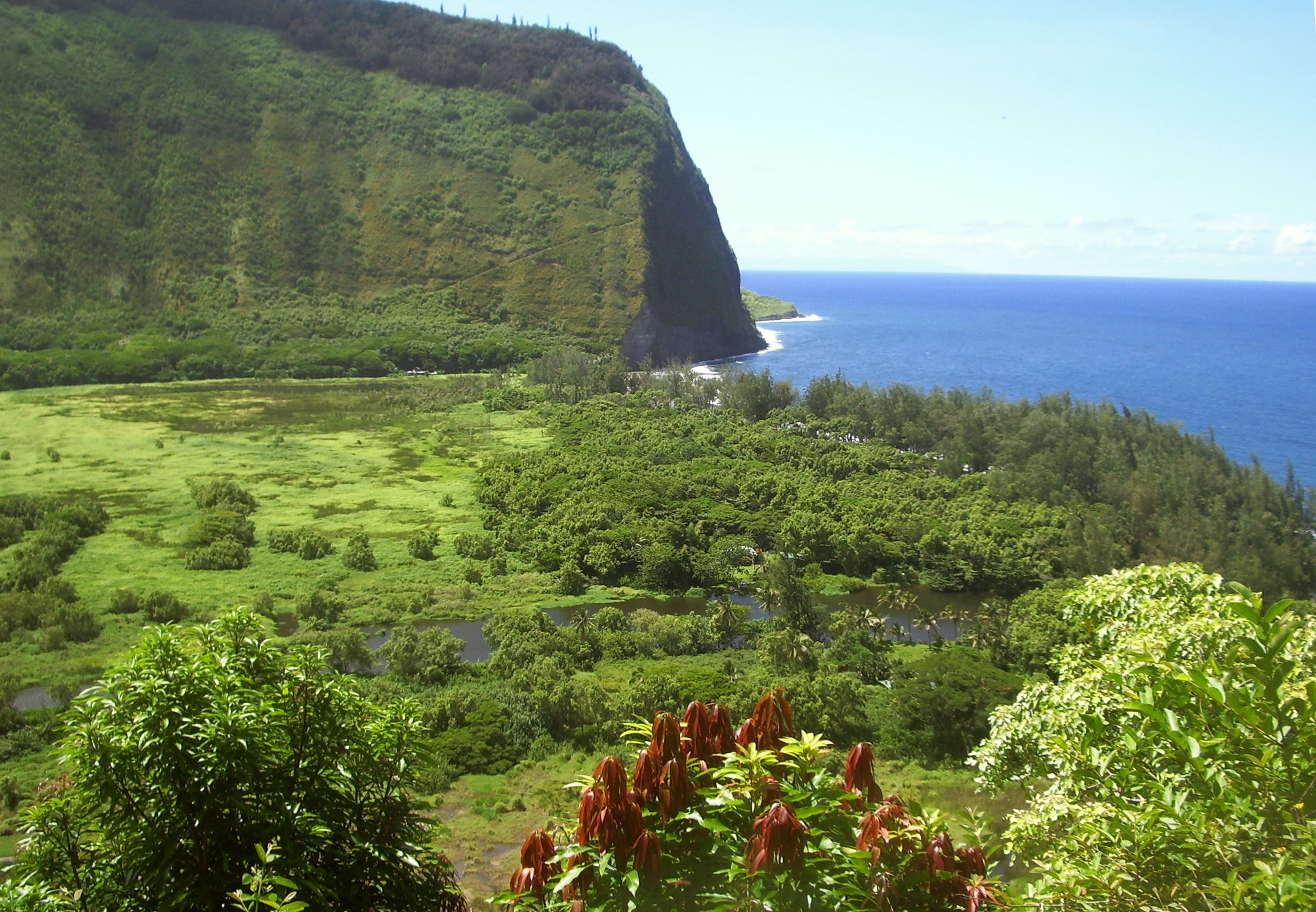
Photo by Dr. Donad B. MacGowan

Waipi’o Valley

Waipi’o Valley is arguably the most magical place on the Big Island. The steep canyon walls and verdant fields of the valley floor, the mile long black sand beach and numerous immense waterfalls that line the valley walls all call out to the visitor for exploration.

Always listed among the most beautiful spots in the State of Hawai’i, this valley is as hauntingly lovely as it is difficult to see in its entirety.


Although the mile-long black sand beach is gorgeous, the forest and jungle canyon floor and walls amazing and the numerous, high-flying waterfalls compelling, it's a long and steep hike down in, and an equally long, but much more arduous, hike out. The road is windy and dangerous to drive...we don't recommend it.

Tours down into the valley in vans, on horse drawn wagons and ATVs can be booked in Honoka’a. Over-flights in fixed wing aircraft and helicopters also offer fine venues from which to see this amazing piece of Hawai’i.


For more information on traveling to Hawaii in general or touring the Big Island in particular, visit http://tourguidehawaii.com or www.lovingthebigisland.wordpress.com.

About the Author: Popular television personality and award-winning independent filmmaker Dr. Donald B. MacGowan originally pursued a career in academics, earning two B.Sc. degrees, a dual M.Sc., and a PhD.; co-authoring over 5.2 million dollars in grants, and publishing more than 200 refereed journal articles, abstracts, etc. Gaining sanity somewhere in that process, he quit the academic rat race and began to live. Donnie is an accomplished, prolific alpinist, having climbed on 5 of the seven continents, putting up more than 150 first ascents on rock, ice and snow, and a dozen first ski descents. He has written, directed and produced short and feature length films on health, travel, mountaineering and life in a touring rock band. Donnie records and tours relentlessly with his Celtic Punk fusion band "Fatal Loins"--although nobody much seems to care for their music. A Hawaii resident since 2000, he quietly and humbly inhabits Kailua Kona, doing environmental good works, surfing the be-jeezis out of the local waves and frenetically producing somewhat bizarre and mildly disturbing programs for local television which have recently been lauded as: "Ignorant", "Arrogant" and "Totally Insane". You may say what you wish about him, Donnie does not care. For somewhere underneath those swaying palm trees, in those warm aloha breezes, he is far too busy praying for good surf to hear you...


Monday, December 1, 2008

Volcano House in Hawaii Volcanoes National Park--A Historical Hostel on the Edge of the World's Most Active Volcano!


The grand tradition of hostelling at the edge of Kilauea Volcano began with construction of the first Volcano House in 1846; as such, Volcano House is Hawaiis oldest continuously operated hotel. Famous Guests include Queen Lilioukalani, Samuel Clemens, Theodore Roosevelt and Elvis Presley. Since Polynesians first arrived in Hawaii, temporary grass shacks had been constructed on the lip of Kilauea Crater to shelter kahuna and alii who went there to give praise and worship to Madame Pele. Chiefess Kapiolani, a converted Christian, had a grass hut constructed on the edge of the crater, then filled with a molten lava lake, in 1826 from which she and her retinue held ceremonies to denounce the goddess.

Benjamin Pitmann Sr. built a grass shack he named Volcano House as the first structure to serve solely for the sheltering of kamaaina and tourists visiting the volcano. In 1866, this structure was replaced with one of ohia poles and pili grass. American novelist and humorist Sam Clemens, who stayed at Volcano House in 1866 proclaimed: The surprise of finding a good hotel at such as outlandish spot startled me, considerably more than the volcano did.

In 1877 the first fully wooden Volcano House was built, which featured 6 rooms and a large parlor with a fireplace; this building is now being used as the Volcano Art Center and was moved to its present location in 1941. Although the hotel has continued to grow and change over the years, the fire in Volcano House fireplace has burned continuously for 125 years. In 1940 most of the hotel was destroyed in a boiler fire and Uncle George Lycurgus built the structure that stands as the current hotel in 1941 of wood and stone.

A tour of the Volcano House and small museum should include the parlor with its koa piano, paintings and welcoming fireplace, the restaurant (the only food available in the Park) and the two gift shops as well as the breath-taking view of Kilauea Crater from the back lanai of the main building.

For more information about traveling the Big Island in general and exploring Hawaii Volcanoes National Park in particular, visit www.tourguidehawaii.com and www.lovingthebigisland.wordpress.com.

Produced by Donald B. MacGowan; videography by Frank Burgess and Donald MacGowan; Narrated by Frank Burgess, Original music written and performed by Donnie MacGowan.

Saturday, November 29, 2008

What Do I Do On The Big Island? Explore Mysterious Puna!


About Puna District

Beautiful, mysterious, untraveled and undiscovered by the herds of tourists, Puna District has so far managed to avoid the overcrowding, loss of local flavor and other problems that come with the extreme popularity being experienced by other parts of this island.

Puna has a somewhat undeserved reputation that, where not actually violent, dangerous and over-run with drug dealers, it is populated entirely by aging hippies, tree huggers, vegetarians, artists, actors and others of somewhat bohemian life philosophies. It is true, like any area where the median income is below poverty level, that there is a certain amount of crime, back-yard marijuana cultivation and other drug use, along with other undesirable activities going on in Puna, but the same could be said of almost anywhere in America. It is also true that the residents of Puna tend to be individualists, socially liberal, embracing of alternative culture; there are most certainly a lot more musicians, artists and poets in Puna than accountants, insurance agents and attorneys. Also true is the fact that many native Hawai’ians living in Puna regard it as the last bastion of THEIR land and may not be as welcoming as you hope. However, the rewards of discovering Puna District’s secrets are very much worth the extra vigilance and preparation to travel there safely, and the people you meet in Puna are certainly friendly and fascinating.

Puna is a magnificent wonderland; from incredible tree-tunneled roads, geothermal fields of steam vents, lovely beach parks, raw lava flows and jungle trails, the land cries out for the visitor to put their fears aside and explore a little bit. Of course, the visitor is reminded to leave no valuables in the car, even when locked, and to be watchful and careful. But bear in mind that tens of thousands of people happily inhabit Puna without ever actually being beset by bandits; Puna is actually a generally safe place for the heads-up, prepared traveler to explore.

As an interesting observation about Puna District, which is itself the same size as the island of Molokai and comprises the rainiest part of the island, is that is has but one lake and no rivers. The volcanic landscape is so young and so porous that the rain, once it hits the ground, percolates immediately through the surface layers of rock to the subterranean aquifer—a lens of freshwater saturating the rock pores and which floats upon the seawater saturating the older rocks, formed hundreds of thousands of years ago in the ocean. This phenomenon represents a huge resource of fresh groundwater for agricultural and municipal use, but until the island ages a great deal and more soil is formed from organic debris and weathering of the rocks, there will be few rivers and lakes.

Remember, very few visitors ever even see Puna District; even most residents never go here…it’s fascinating, beautiful, secluded and very, very much worth spending the time to explore.

Let's take a quick trip through Puna, starting in Pahoa Town and going clockwise through the district, ending up at the Hawaii Belt Road at Kea'au.

Pahoa Town

YEEEEEHAW! Wild, untamed and even a bit unruly, Pahoa Town, with it’s false-front, western-style buildings and raised wooden sidewalks, looks more like it belongs in Wyoming than Hawai'i. But Wild West isn’t the only subculture evident here…tie-dye banners and the general “flower-power” imbuement some businesses and citizens lend Pahoa give it a decidedly “’60’s” feel. It has been said of Pahoa that if it weren’t for counter-cultural influences, it would have no cultural influences at all. This is a bit unfair, but the people of Pahoa are proud of their independent ways and lifestyle. The charm and allure of this way of living is evident when you consider that the region around Pahoa is the fastest growing portion of the island.

Downtown Pahoa is one of the more interesting three or four blocks of real estate in all of Hawai'i. An eclectic mix of truly fine restaurants, food and clothing stores, second hand stores, Real Estate agents, coffee shops and other oddments and interesting boutiques, all arranged around a downtown area of western-style false-front buildings and raised wooden sidewalks.

Saying that the merchandise to be found in the Pahoa Farmer’s Market is “varied and unusual” is a vast understatement and grave disservice to the creative genius of Pahoa merchants. The market is open 9-3 on Sundays, located in the middle of downtown Pahoa and is very much worth the effort to see.

If parking is not available near the Farmer’s Market, a sneaky alternative is to park one block up the hill at the Pahoa Pool and Municipal Park, a very short walk from downtown and the market.

Lava Trees State Monument

Under a fascinating, beautiful, lacy, canopy of monkeypod trees, casts of ohia trees stand as monuments to a fast-moving pahoehoe lava flow that passed through here in 1790. When the lava hit the water-saturated ohia trees, it cooled and began to congeal around them; the rest of the flow passed on, or perhaps drained away down the numerous cracks in this area that formed contemporaneously with the flows. Although the original ohia trees burned away, the quickly cooled lava around them stands here today, hollow, with imprints of the tree bark inside, giving testament to their origin. The crack which likely drained the lava away is still visible, just left of the restrooms.

Lava Trees Park offers trails to hike and a restful, bird-filled jungle to sit and listen to. You can spend between 20 minutes to an hour wandering the trails, here, exploring and discovering. Be careful, however, the area is riddled with hidden cracks in the ground which can make exploring hazardous.

You may wish to avail yourself of the restrooms at Lava Tree State Monument; no matter which direction you have approached the park from, they are the last public facilities for some distance.


Kapoho Village/Disaster of 1960/Puna Geothermal Fields/Virgin Air

A small farming village of perhaps 300 people, Kapoho drowsed into the 20th Century near the modern-day intersections of Highways 132 and 137. On the 13th of January in 1960, a rift eruption half a mile long opened and shot fire fountains 3/10 of a mile into the sky. Burying orchid and papaya farms, the lava advanced on Kapoho, entering the town on the 28th of January and eventually burying as many as 100 homes and businesses.

There is a positive, less destructive side to this awesome volcanic energy. The hot rock, deep within the earth, heats ground water. When tapped by drilling and brought to the surface, the release of pressure on the hot fluids causes them to flash to steam, which is then used to turn electricity-generating turbines. On the Island of Hawai'i, the Puna Geothermal Fields generate very nearly a fifth of all the electricity used in the county at facilities quite near here.

Here, you are very nearly at the easternmost point of Hawai'i Island; breath deeply. Our winds come from the east, and the air you are now breathing is amongst the most pure in the world. Called “virgin air” it is studied by scientists from all over the world. Interestingly, just a few miles to the west, some of the most dangerously toxic atmosphere in the world exists where the current lava flows from Pu’u O’o vent on Kilauea flow into the sea, filling the air with clouds of microscopic glass shards and aerosols of hydrochloric and sulphuric acids.

Kapoho Tide Pools, or Wai Opae

Stuffed with abundant sea life, this sprawling basin of lava tidal pools is a remarkable treasure for snorkelers of all abilities from the starkly frightened to the seasoned veteran. Moorish idols, yellow tangs, various wrasses and eels, sea urchins and sea cucumbers abound and there is even some nice corals in the deeper pools. The largest pool is called “Wai Opae”, which means “fresh water shrimp”.

Keeping to the left of the main channel keeps one away from most of the ocean currents, which can be surprisingly strong, even in small channels, where ponds empty into the ocean.

A wonderful place to spend the day, Kapoho Tide Pools has wonderful snorkeling for people of all levels as well as other general beach activities, including just plain beach exploring, shell collecting, swimming and fishing.

Ahalanui Pond

Also called Pu'ala'a or “Secrets Beach”, this spring and ocean-fed, man made pool is a testament to the vagaries of life on an active volcano. The pool was initially constructed when the springs ran chilly cold. Eruptions in Puna during the ‘50s and 60’s reworked the subterranean waterworks and now the springs run hot and the pool is a comfortably warm 90-95 degrees or so.

Deep enough for swimming, the pool has an open connection to the ocean which flushes water and reef fish into the pool at high tide, keeping the water freshened and the underwater scenery interesting.

With the gentle aloha breezes, swaying palms and surf whooshing against the seawall at the pool, it can be really hard to drag oneself out of the hot pool and continue on exploring…that’s OK, soak awhile longer. You came to Hawai’i for rest, renewal and relaxation anyway, didn’t you? This is a great place to do that.

Picnic tables, pavilions, pit barbecues, showers, lawns and all the pleasantries of a civilized park are available at Ahalanui Pond. Leave no valuables in your car and be vigilant if you stay soaking here, after dark.

Isaac Hale Beach Park

A lovely black sand beach with an expert surf break, Isaac Hale Beach Park is one of the very few real beaches and boat ramps in Puna District; as such this park sees a lot of traffic. It is also the site of the best surfing and some of the wildest snorkeling and scuba diving in Puna.

If you do get in the ocean here, go in left of the boat ramp—be alert to bodacious boat traffic (they won’t be alert for you) and for fairly dangerous ocean currents.

Understandably, given the crowded nature of this small place, some locals are less than welcoming of visitors. Graciously share this ocean treasure with the residents, but and leave no valuables in your car.

A short path along the shoreline leads from the parking lot, past a house with abundant “No Trespassing” signs, just a few minutes stroll then turns about 20 yards into the jungle to a secluded, perfectly lovely natural hot spring that is wonderful for soaking. Locals usually don’t bother with swimwear here, you shouldn’t feel required to, either.

The facilities at Isaac Hale Park are recently rebuilt, refurbished and expanded and comprised of picnic facilities, showers, toilets and a vast new parking lot. Unfortunately, a few fairly nasty port-a-potties remain. Camping is allowed with a County permit.

McKenzie State Recreation Area

Secluded under a canopied ironwood forest and ending at great cliffs against the turbulent open ocean, McKenzie State Recreation Area feels like the End of The World. There’s no beach and no running water, but spectacular shore fishing and a wonderful sense of “aloneness” make this a great place to get away from the bustle of Hilo or the fumes of ubiquitous tour buses. As mentioned earlier, Pun is the home of the unusual and here at McKenzie Park are some very unique and curious picnic tables made from slabs of pahoehoe lava. There are also trails that fan out from this 13 acre Recreation Area into the surrounding forest which beg to be explored.

You may have noticed the huge boulders that line the shore-cliffs along this stretch of Red Road. These mega-ton rocks were hefted out of the sea by violent tsunami waves. Imagine the power of a wave that could lift a boulder of this size from the bottom of the ocean, hurl it a further forty or so feet to the top of the cliff and deposit it many yards inland. Being here will give you a new appreciation, if not absolute horror, at the power of tsunamis.

Camping at McKenzie State Recreation Area is by State Permit, and except for the decrepit state of the facilities, is a genuine pleasure.

Kehena Beach

When the eruption of 1955 created this beautiful black sand beach, the County was swift to capitalize on it and, creating a wonderful beach park, built tone steps down the cliff to the beach. When the beach dropped a full 3 feet during an earthquake in 1975 the stairs were shattered. Like so much else around this island, these stairs were never rebuilt and today terminate about ten feet above the current level of the beach—if you want to get down to the beach, therefore, you must take the dirt path that goes out of the left side of the parking lot.

Once on the beach the first thing that may strike you is that many of the locals who frequent this park have forgotten to put on proper beach attire…or any other attire whatsoever, for that matter. The second thing that will strike you is what a lovely, wonderful spot this is. In the shade of palms and ironwood this wonderful beach is generally sunny even when the rest of Puna is rainy.

Swimming here is great, but ocean currents are strong and dangerous not far from shore. The locals are friendly but frisky, so don’t leave valuables in your car.

Kalapana/Disaster of 1990/End of The Road

In 1990 the goddess Pele determined it was time for some serious housecleaning in Puna. Lava flows from Kilauea’s East Rift swarmed down the mountain and engulfed the villages of Royal Gardens, Kaimu and Kalapana, destroying virtually everything. Immolated and buried were a centuries old fishing village and a world famous black sand beach. The road ends today where the parking lot for Kaimu Black Sand Beach once stood, and is now a thousand yards and more inland.

When the lava came, it wiped out not just homes, gardens, crops and material things, it wiped out a way of life and a landscape cherished by generations. Imagine the loss to a community of having the coconut grove by the beach where, for a thousand years, the Kahunas had blessed the fishing canoes not only wiped away and covered with lava, but the landscape altered so permanently and completely that you’re no longer even sure where it used to be. The spot where generations of fathers taught their sons to fish by casting nets, gone. The groves where mothers sat with their daughters passing on the arts of weaving along with the family stories, gone. The beach where thousands of young lovers had walked the moonlit surf arm in arm for centuries, and perhaps not a few babies had also been made, gone beneath 50 feet and more of lava. Everything gone; a landscape, a way of life, an entire culture.

It was from a vision of strength, a refusal to let her community die, rather than feelings of loss and desolation, that inspired one local resident to replant and reestablish the area. Not just replant her land, but the entire village. She worked steadily, planting hundreds of sprouted coconut and other palms and encouraging others in her community to join in. Even when she discovered she had a terminal disease, she continued her campaign to replant and recover, the community pitching in even more after she passed away. Today there are literally thousands of young trees growing on the no-longer barren lava, and a new geography for new lives and new memories is being born. Her vision of rebirth, now being realized, is a moving testament to the power of love of ones’ community and commitment to ones’ culture. One of the truly most moving stories in the Islands, this place has to be seen to be appreciated.

The trail to the new black sand beach, Kaimu Beach, is marked with these young palms. Near the parking area along the path are lava casts of palm trees and other plants…keep a sharp eye out, they are everywhere. Swimming is hazardous at the new beach, so is surfing, the ocean currents being strong and treacherous. But take some time to relax, wade, feel the sand beneath your feet and contemplate the drive of one dying woman to rebuild a world she loved from a devastation few of us can imagine.

From the lava hillocks along the trail you can get nice views of the eruption plume at Pu’u O’o, up on the flank of Kilauea as well as the steam clouds down a few miles along the coast where the lave enters the sea. This is one of the few places where both can be seen easily and at the same time.

Back at the parking area at the road’s end, look a bit farther to the west and find Uncle Robert’s House, one that was spared the destruction, where a display of photos of the lava flows and the village in pre-disaster times in a miniature museum can be found. along with an interesting nature trail. The stop is worth your time, and be sure to leave a donation in the offering jar.

Kaimu Black Sand Beach

The state’s newest black sand beach, Kaimu Beach, is a lovely if barren crescent of sand at the end of an unforgiving expanse of lava from the 1990 flows. the old beach and the fishing village of Kalapana that stood along it are long gone, buried under 50-75 feet of lava—an unimaginable catastrophe.

The young palm trees you see growing all along this trail are the result of one woman’s commitment not to allow her community, her beach, her culture to die under the lava. Planting thousands of palm sprouts, she encouraged her community, school children state wide and hundreds of others to plant the young trees. Today, the realization of her vision of rebirth is in the growing palm groves out on the barren lava plain.

The trail to the new black sand beach is marked with these young palms. Near the parking area along the path are lava casts of palm trees and other plants…keep a sharp eye out, they are everywhere. Swimming is hazardous at the new beach, so is surfing, the ocean currents being strong and treacherous. But take some time to relax, wade, feel the sand beneath your feet and contemplate the drive of one dying woman to rebuild a world she loved from a devastation few of us can imagine.

From the lava hillocks along the trail you can get nice views of the eruption plume at Pu’u O’o, up on the flank of Kilauea as well as the steam clouds down a few miles along the coast where the lave enters the sea. This is one of the few places where both can be seen easily and at the same time.

Lava Viewing at Waikupanaha

Nowhere else in the world can you see lava flowing from a volcano into the sea; no Big Island visit is complete without seeing this awe-inspiring show. Currently lava is only flowing into the sea outside the Park. Drive south on Highway 130 through Pahoa to the 20 mile marker and take the right branch about two miles to the parking area. Port-a-potties are available here. The road is open from 2 pm. until 10; no cars allowed in after 8. Lava viewing information is available from Hawaii County at 808.961.8093; check conditions before you go. The easy trail, a 20 minute stroll to the viewing area, is well-marked.

The viewing varies as lava flows nearer or farther from the trail. Viewing is best at dusk so bring flashlights for the hike out. Take close-toed walking shoes and a hat, long pants and long-sleeved shirt, at least 2 liters of water and sun block and a rain jacket and camera. Remember food and gas are not available after dark, so fill up BEFORE you park, bring snacks and drinks.

Painted Church

Originally this little Catholic Church stood in the village of Kalapana. Built and painted in 1928 by Father John Velge, who also built and painted the Painted Church in Honaunau, it was picked up and moved to avoid the onslaught of lava when Kalapana was destroyed in 1990. Sitting vacant and abandoned by the roadside for years, it was finally moved here, deconsecrated and is now a Hawai’ian Cultural Center. It is very much worth a stop to look at Fr. Velge’s masterful murals.

Puna Geothermal Field Natural Steam Rooms

Just what is the view at the scenic turnout along Highway 130 between Kalapana and Pahoa near the 15 mile marker? Turns out, there is no view, but something much, much more unusual and interesting. The Puna Geothermal Field here has numerous, and we’re talking hundreds here, small steam vents of varying size and steam output, just a few minutes walk along an obvious trail into the ohia forest from the east side of the road.

Some have been enlarged, or had the vegetation cleared from around them or had benches placed in them by local users; others are in a completely wild state. This is a great place to come for a little natural steam bath and, as seems to be the fashion in Puna, it’s definitely “clothing optional”. Be careful when exploring around here, though…it’s generally safe but it is possible to fall into a few of the holes or turn an ankle and the steam is hot.

This is so awesomely wild, weird and wonderfully different, it’s a “must see”!

Kea’au Town

A small, rural community, Kea’au is growing up to be Hilo’s bedroom suburb. There are some points of interest in the Kea’au area, including a great natural foods store, Hi’iaka’s Healing Herb Garden, some great small restaurants and a shopping center where travelers can fill-up with gas, food and fast food, but most of Kea’au is rural and suburban, of little interest to visitor’s with limited time.

From Kea'au one can catch the Belt Road, either west to Kona or east to Hilo.

For more information on traveling to Hawaii in general or touring the Big Island in particular, visit http://tourguidehawaii.com, www.tourguidehawaii.blogspot.com and www.lovingthebigisland.wordpress.com.

About the Author: Popular television personality and award-winning independent filmmaker Dr. Donald B. MacGowan originally pursued a career in academics, earning two B.Sc. degrees, a dual M.Sc., and a PhD.; co-authoring over 5.2 million dollars in grants, and publishing more than 200 refereed journal articles, abstracts, etc. Gaining sanity somewhere in that process, he quit the academic rat race and began to live. Donnie is an accomplished, prolific alpinist, having climbed on 5 of the seven continents, putting up more than 150 first ascents on rock, ice and snow, and a dozen first ski descents. He has written, directed and produced short and feature length films on health, travel, mountaineering and life in a touring rock band. Donnie records and tours relentlessly with his Celtic Punk fusion band "Fatal Loins"--although nobody much seems to care for their music. A Hawaii resident since 2000, he quietly and humbly inhabits Kailua Kona, doing environmental good works, surfing the be-jeezis out of the local waves and frenetically producing somewhat bizarre and mildly disturbing programs for local television which have recently been lauded as: "Ignorant", "Arrogant" and "Totally Insane". You may say what you wish about him, Donnie does not care. For somewhere underneath those swaying palm trees, in those warm aloha breezes, he is far too busy praying for good surf to hear you...

Wednesday, November 26, 2008

Your Hawaii Vacation - Let's Talk About Snorkeling Etiquette

Reprinted from here.

Coming to my island for a vacation? There are three things I always recommend the first-time visitor do. First, get in the air-seeing my island from the air is the only way to appreciate its vastness and diversity of landscapes-and it's the best way to see the erupting volcano.

Secondly-go to a luau-for people with limited time, you will not be able to discover much about the magic of the local lifestyle, and although canned and packaged for visitor consumption, a luau is a good place to get an introduction to it.

Finally, I advise people of every age to get in the water and go snorkeling. The "one-on-one, experiencing the world through their eyes" magic of swimming in those bath-warm lagoons surrounded by clouds of tropical fish is an amazing, restful and restorative pursuit-you will find your mind going back to that experience over and over through the years much more so than many of your other travel experiences. There are some thing to bear in mind about snorkeling, however so let's take a moment to talk about reef etiquette and the animals which inhabit the coral reefs.

Please do not feed the fish, it disrupts their natural feeding habits and you may be injured. Reef fish are territorial and do occasionally "nip" but you should not chase, harass or touch them (this includes octopi). The oils on your fingers will injure their skin and they may carry diseases which they can pass to you on your hands. For photographing reef fish, whether snorkeling or scuba diving, simply find a feeding spot (usually a boulder or dead coral head teeming with algae and wait calmly and silently nearby. They will slowly begin to check you out and if you can remain still long enough, eventually surround you leading to excellent photos and a very memorable experience.

Snorkeling etiquette calls for protecting not only the reef animals, but also the fragile corals growing on the reef. Corals, actually colonies of very small animals, take hundreds of years to form the structures visible today; they feed, shelter and provide habitats for other reef animals. Coral reefs also protect the lagoons and shoreline from waves and sand erosion. Corals are at the very root of Hawai'ian history and culture; the Hawaiian creation chant places the origin of life at the sea, beginning with a coral polyp.

Simply touching corals to see what they feel like can cause the death of an entire colony. Oils from your skin can disturb the delicate mucous membranes which protect the animals from disease. Please don't walk upon or stand on coral, as this can kill the living coral polyps which, as the builders of the entire reef structure, are the very foundation of the reef ecosystem. Sunscreen washing off your body can kill coral; wear a t-shirt and a swim cap for UV protection and put your sunscreen on AFTER you come out of the water.

Called Honu by Hawaii's natives, the Hawaiian Green Sea turtle is beautiful, serene and seeming wise. Though they have swum the oceans for over 200 million years, peacefully feeding on algae and invertebrates, this highly successful product of amphibian evolution is in grave danger. Loss of habitat, hunting and molestation by humans has conspired to push the Hawaiian Green Sea Turtle to the very verge of extinction.

Protected now by state and federal law, the population of once millions of individuals has been decimated to just a few hundred thousand; although they are making a comeback, Hawaii's honu are still very much endangered.

Honu may grow up to 45 inches and weigh as much as 400 pounds at maturity, reached at 25 years of age. Hawaiian Green sea turtles can easily be differentiated from the other near shore sea turtle in Hawaii, the much less common Hawksbill turtle, by counting the scales between the eyes. Hawksbills have four scales between the eyes and Hawaiian Green Sea turtles have two.

Lady honu crawl on shore to lay their eggs, generally after migration to the quieter shores of the French Frigate Shoals, 800 miles northwest of Hawaii, or the black sand beaches on the south end of the Big Island of Hawaii.

Do not approach basking turtles closely, never touch or pick them up. Harassing turtles carries a stiff fine and in any case, touching the turtle is a good way to get a raging salmonella infection. If honu are swimming near where you are, do not approach or chase them; always swim to the side of them, never above (as a predatory shark would) nor below them (so they won't feel that their soft belly is at risk).

Anyone who observes their beauty and grace underwater easily understands why the Hawai'ians base their word for "peace", "honua", on their name for the green sea turtle, "honu".

Although harder for the snorkeler to approach, but certainly no less in danger of molestation, are the marine mammals: dolphin, seals and whales. In general, it is illegal, dangerous and generally a bad idea to approach marine mammals within 100 yards; 300 yards for females with calves. Dolphins and seals, in particular, may choose to approach you-just remember, this ain't "Flipper"-these are wild animals and they bite. Hard. If approached, remain calm (absolutely entranced, of course, but calm); do not approach any young animals and do not reach out to them as they may interpret this as aggression on your part and possibly bite. Male seals may exhibit dominant behavior and have been know to *ahem* mount swimmers. Avoid these unpleasantries by observing and enjoying these animals from a distance.

That's a few of the etiquette rules you should bear in mind...remember to heed whatever advice the lifeguards give you--they are seasoned professionals who intimately know their beach; obey posted rules and be wary of riptides and currents. Most of all, spring for a cheap-o $10 disposable underwater camera, get in the water and enjoy...those fish won't photograph themselves, you know!

For more information about visiting and touring Hawaii in general, and exploring the historic and cultural sites on the Big Island in particular, visit http://www.tourguidehawaii.com or http://www.lovingthebigisland.wordpress.com. For more information on Donald B. MacGowan, the author, go here.

Article Source: http://EzineArticles.com/?expert=Donald_MacGowan

Monday, November 24, 2008

Steam Vents and Sulfer Banks, Hawaii Volcanoes National Park


Sulfur Banks, on the crater side of the road, is just one of hundreds of gas seep on the flanks of the summit crater spewing hydrogen sulfide, sulfur dioxide, carbon dioxide and steam. Hematite, native sulfur and gypsum minerals precipitate out of the gas flux streaming through the rocks, making colorful splashes on the outcrops. Children and people with heat or respiratory conditions, or anybody with a weak stomach should be wary of venturing down the road to see this. Non-sulfurous steam vents, mostly across the road from the crater and at the aptly named Steaming Bluff, result from rainwater percolating down through the ground being boiled by the hot rock beneath and streaming up vents to the surface. There is a short walk to the Steaming Bluff from the Sulfur Banks parking area which comes to a breathtaking view of the crater and more productive steam vents.

Video written and produced by Donald B. MacGowan; videography by Frank Burgess and Donald MacGowan; Narrated by Frank Burgess, Original music written and performed by Donnie MacGowan. For more information about traveling the Big Island in general and Island Activities in particular, visit www.tourguidehawaii.com and www.lovingthebigisland.wordpress.com.

Friday, November 21, 2008

This Week's Weather in Paradise!

Reprinted from here.
Point Forecast: Kailua Kona HI
19.63N 155.95W (Elev. 1217 ft)
Last Update: 4:38 am HST Nov 21, 2008
Forecast Valid: 6am HST Nov 21, 2008-6pm HST Nov 27, 2008


Forecast at a Glance
Today

Heavy Rain Chance for Measurable Precipitation 30%
Heavy
Rain
Hi 80°F
Tonight

Heavy Rain Chance for Measurable Precipitation 40%
Heavy
Rain
Lo 68°F
Saturday

Heavy Rain Chance for Measurable Precipitation 60%
Heavy
Rain
Hi 79°F
Saturday
Night

Heavy Rain Chance for Measurable Precipitation 50%
Heavy
Rain
Lo 66°F
Sunday

Heavy Rain Chance for Measurable Precipitation 40%
Heavy
Rain
Hi 80°F
Sunday
Night

Heavy Rain Chance for Measurable Precipitation 30%
Heavy
Rain
Lo 66°F
Monday

Heavy Rain Chance for Measurable Precipitation 30%
Heavy
Rain
Hi 81°F
Monday
Night

Isolated Showers Chance for Measurable Precipitation 20%
Isolated
Showers
Lo 66°F
Tuesday

Scattered Showers Chance for Measurable Precipitation 30%
Scattered
Showers
Hi 82°F

Detailed text forecast
Hazardous weather condition(s):

Today: Scattered showers after noon. The rain could be heavy at times. Widespread haze. Cloudy, with a high near 80. West wind between 3 and 5 mph. Chance of precipitation is 30%. New rainfall amounts between a tenth and quarter of an inch possible.

Tonight: Scattered showers. The rain could be heavy at times. Widespread haze. Cloudy, with a low around 68. Calm wind. Chance of precipitation is 40%. New rainfall amounts between a half and three quarters of an inch possible.

Saturday: A chance of showers and thunderstorms, then showers likely and possibly a thunderstorm after noon. Some of the storms could produce heavy rainfall. Widespread haze. Mostly cloudy, with a high near 79. East wind at 5 mph becoming south. Chance of precipitation is 60%. New rainfall amounts between three quarters and one inch possible.

Saturday Night: Scattered showers and thunderstorms. Some of the storms could produce heavy rainfall. Widespread haze. Mostly cloudy, with a low around 66. East wind around 7 mph. Chance of precipitation is 50%. New rainfall amounts between a half and three quarters of an inch possible.

Sunday: Scattered showers. The rain could be heavy at times. Widespread haze. Mostly cloudy, with a high near 80. South wind 6 to 8 mph becoming west. Chance of precipitation is 40%. New rainfall amounts between a half and three quarters of an inch possible.

Sunday Night: Scattered showers. The rain could be heavy at times. Widespread haze. Mostly cloudy, with a low around 66. East wind around 9 mph. Chance of precipitation is 30%. New rainfall amounts between a quarter and half of an inch possible.

Monday: Scattered showers, mainly after noon. The rain could be heavy at times. Widespread haze. Partly cloudy, with a high near 81. West wind around 9 mph. Chance of precipitation is 30%.

Monday Night: Isolated showers. Widespread haze. Partly cloudy, with a low around 66. East wind around 9 mph. Chance of precipitation is 20%.

Tuesday: Scattered showers. Widespread haze. Partly cloudy, with a high near 82. West wind around 9 mph. Chance of precipitation is 30%.

Tuesday Night: Isolated showers. Widespread haze. Partly cloudy, with a low around 66. East wind around 8 mph. Chance of precipitation is 20%.

Wednesday: Scattered showers. Widespread haze. Partly cloudy, with a high near 81. West wind around 8 mph. Chance of precipitation is 30%.

Wednesday Night: Widespread haze. Mostly clear, with a low around 66. East wind around 7 mph.

Thanksgiving Day: Scattered showers. Widespread haze. Mostly cloudy, with a high near 82. South wind around 7 mph. Chance of precipitation is 30%.
 

Casino Bonus no Deposit