Related videos can be seen here, here, here and here.
For more information about visiting Hawaii in general or touring the Big Island in particular, go to www.tourguidehawaii.com and here.
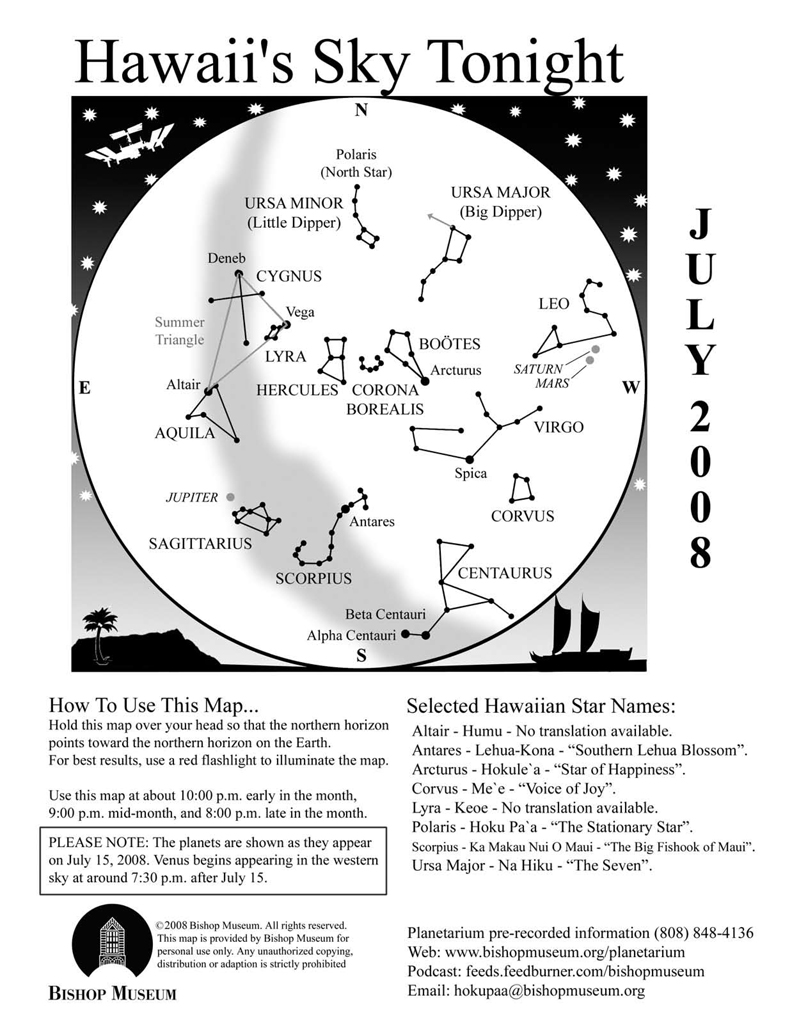
PLANETS AND THE SUMMER MILKY WAY
The interesting thing about sky-watching is the fact that although the seasonal constellations are predictable, what you may see at any designated time is not. Planetary movement and other recurring events take place on different cycles than the background of stars so we can’t always count on seeing the same combination of sights in the sky at the same times. That keeps me in business.
So what we will see in the sky this July is not unusual, but a fortunate arrangement of celestial constituents that will be easy and convenient to view. Four naked-eye planets dot the evening skies this month, with two staging a nice pairing together and beautiful Venus making its reappearance back into the night. Although it might be challenging to spot Venus low in the western sky after sunset during the first half of the month, by the end of the July it will be climbing higher out of the light and easier to spot.
A nice highlight will be the conjunction of Mars and Saturn in the constellation Leo on July 9 and 10. The rust-colored planet and pale yellow Saturn have been slowly creeping closer over the past weeks and will be at their closest on those two dates (although the 10th is technically the closest date, both nights are good for viewing). Included in the lineup is the brightest star in Leo, Regulus, which is on that planet highway called the ecliptic. As a bonus, on July 5 a small crescent Moon joins the group as Mars closes in. That evening going from west to east, you can see the Moon next to the star Regulus, followed by Mars and Saturn. Make sure you start early however, because this gathering will set by 10:00 P.M.
Jupiter is also impressive in the east as the sun sets. The giant planet is at opposition now, meaning that it is on the opposite side of our sky than the sun (think “Sun, Earth, Jupiter” in that order). It appears bigger and brighter in the night sky at this time and is visible in the sky the whole night. Now would be a great time to take out a pair of binoculars and look for the famous features that characterize Jupiter, like the Galilean satellites and the distinct bands of color on the planet. The monster hurricane, the Great Red Spot, is visible with telescopes but not necessarily with average binoculars.
While the planets steal the spotlight this month, don’t forget to pay attention to the summer Milky Way! The hazy band of light extending from north to south is part of the galaxy we reside in and offers many binocular and telescopic sights along the way. The area roughly between Scorpius’ stinger and Sagittarius’ “spout” is particularly wide since that direction is the bulbous center of our galaxy, approximately 26,000 light years away. Rather than individual points of light we see the accumulation of the millions of stars obscured by gas and dust. Right now you can see the Milky Way stretching from the southwest in the direction of the Southern Cross (early in the evening) through the Summer Triangle toward Perseus in the northeast in the early morning hours.
EVENING PROGRAM UPDATE
With so many objects to look for in the skies, it’s difficult to cram everything into one article every month. Consider our planetarium as the next best thing to the real sky, one with a personal “guide” to the stars. An evening program is held on the first Fridays of the month, with sky viewing if the weather is clear. However since it falls on the 4th of July this month, the program has been moved to Friday, July 11. It begins promptly at 8:00 P.M. and reservations are strongly recommended. Call 848-4168.
PHOENIX UPDATE
The Phoenix lander is busily performing its tasks since touchdown on Mars a little over a month ago. What the mission has already done for space exploration was demonstrated by the difficult EDL phase, or Entry, Descent and Landing. Many previous missions were lost in this critical phase, including the predecessor of Phoenix, and since one of the science goals of the mission is to prepare for human exploration, NASA had to prove that landing a craft on Mars has improved dramatically. It appears that goal is well on its way. See http://phoenix.lpl.arizona.edu/ for more information.
The Planets
Earth:
The second of two annual opportunities to experience Lahaina Noon comes this month. Between May and July the sun passes directly overhead for areas within the Tropics. During Lahaina Noon objects that are directly perpendicular to the sun, such as flagpoles or fences, have no shadows since the “shadow” would be cast “under” the object. Times vary by location, so check the website for more information: www.bishopmuseum.org/planetarium
Also, aphelion takes place on July 3, the Earth’s farthest point in its orbit around the sun. Coincidentally the Moon is in a new phase at the same time, so the effect of the tides will be enhanced. Higher tides than normal usually occur during this alignment.
Mercury:
Mercury is in the morning sky now, rising around 4:30 A.M. in early July. By the last week it will be too close to the sunrise to spot as it rounds around the backside of the sun to reappear in the evening sky.
Venus:
For the casual viewer, Venus will be very difficult to spot until mid-month, when it is a little farther from the sun in the western sky at sunset. However the “window” to see it will be short for this month since the planet sets before darkness by 8:00 P.M.
Mars:
Mars is cruising through Leo, meeting up with Saturn along the way and by the end of the month will pass through the constellation on the way to Virgo. The planet is slowly receding from us in its orbit and dimming as it goes, but is still easily visible to the unaided eyes.
Jupiter:
Jupiter reaches opposition on the evening of July 9, rising in the east as the sun sets. If the weather is nice, this is an excellent night to see the four evening planets in the sky. You will need to get somewhere you can see all the way to the western horizon, and starting from that point shortly after sunset (around 7:30 P.M.) look for Venus low in the west, followed by Mars and Saturn close together about halfway up in the western sky and Jupiter rising in the east.
Saturn:
Although Mars and Saturn are set for a rendezvous Saturn’s position changes very little with respect to the starry background. The ringed planet is much farther away than our neighbor Mars, therefore orbiting the sun at a slower rate of speed. Where Mars orbits the sun in almost 687days, Saturn takes 29.5 years!
Questions? Contact Carolyn Kaichi @ hokupaa@bishopmuseum.org or 847-8203.
For more information on visiting Hawaii in general or touring the Big Island in particular, go to www.tourguidehawaii.com or here.
| | |
| A littoral explosion at dusk. Explosions such as this have been common throughout the last several weeks at the Waikupanaha entry. June 29, 2008. | |
On June 24, tiltmeters at Kīlauea's summit and at Pu`u `Ō`ō began showing inflation-the first time sustained inflation has occurred at both sites since July 21, 2007.
In addition to the change in ground deformation, other types of monitoring data indicated a shift in the style of eruptive activity. Throughout early and mid-June, the intensity of the glow from the summit vent had decreased, relative to the strong glow seen in April and May. In late June, however, the summit vent began glowing brighter.
The intensity of the glow, in fact, correlates with bursts of seismic tremor that occur every few minutes, with more glow during the tremor bursts and less between bursts. These tremor bursts also increased in magnitude and frequency in late June. The correlation between tremor and glow led HVO scientists to infer that gas bubbles were bursting through a crusted lava surface beneath the Halema`uma`u vent. Increases in the strength of both the glow and tremor bursts may have indicated rising of the lava surface.
Another late June change in activity was the occurrence of surface lava flows from the east rift zone for the first time in several weeks. Lava broke out of the tube system, both on the east rift zone and above the Royal Gardens subdivision. At the same time, enough lava was being transported through the tube system to result in spectacular littoral explosions at the ocean entry during early July. All of these signs point to a lava tube system that was full to the point of overflowing.
Taken together, this evidence suggests that Kīlauea was engorged with magma, starting in late June. Increased magma in the caldera and east rift areas resulted in inflation of the summit and Pu`u `Ō`ō and, possibly, rising of the lava column in the Hamema`uma`u vent. Magma was also being delivered to the eruption site at a greater rate than normal, resulting in the numerous surface lava flows.
What might be the result of such activity? It is conceivable that more magma within Kīlauea's plumbing system could result in a change in the east rift zone eruption site, much like that which occurred in mid-2007. Lava might even erupt from the Hamema`uma`u vent, forming a lava lake at the summit.
Of course, Pele seems to enjoy keeping us on our toes. On July 1, deformation at Pu`u `Ō`ō stabilized, and the summit began to deflate, suggesting that even more magma was being fed from the summit to the east rift zone eruption site. Lava flow activity on the east rift zone and above Royal Gardens continued to increase. On July 7, a spectacular fountain formed near the TEB (Thanksgiving Eve Breakout) vent, possibly due to partial blocking of the lava tube system. At the summit, however, the intensity of glow from the Halema`uma`u vent has waned, suggesting that, at least for the moment, volcanic activity will focus on the east rift zone.
The weeks since June 24 have been a significant departure from "normal" trends of deformation during the current summit eruption, and also saw the most surface lava flow activity in several months. What caused Kīlauea to suddenly fill with magma and, just as suddenly, begin to drain?
One explanation is that the lava supply to Kīlauea fluctuates on timescales of days to weeks, causing rapid changes in surface deformation and eruptive activity. Although the causes of these fluctuations are not clear, the variations obviously are an important control on the activity we observe at the surface.
HVO will remain vigilant for future changes in the amount of magma coursing through Kīlauea's veins. Such activity should be easy to detect, given the excellent seismic, deformation, gas, and visual monitoring of the volcano, both at the summit and along the east rift zone. We invite you to follow along by checking HVO's Webcams, data plots, and daily activity updates available at http://hvo.wr.usgs.gov.
Kīlauea Volcano continues to be active. A vent in Halema`uma`u Crater is erupting elevated amounts of sulfur dioxide gas and very small amounts of ash. Resulting high concentrations of sulfur dioxide in downwind air have closed the south part of Kīlauea caldera and produced occasional air quality alerts in more distant areas, such as Pahala and communities adjacent to Hawai`i Volcanoes National Park, during kona wind periods.
Pu`u `Ō`ō continues to produce sulfur dioxide at even higher rates than the vent in Halema`uma`u Crater. Trade winds tend to pool these emissions along the West Hawai`i coast. Kona winds blow these emissions into communities to the north, such as Mountain View, Volcano and Hilo. As of this writing (July 10), the gas vent below the east rim of Pu`u `Ō`ō was spattering weakly, with some spatter reaching the crater rim. At least two other vents within the Pu`u `Ō`ō crater were also spattering. The one near the western end of the crater was spattering vigorously and sporadically, feeding a small lava pond on the crater floor.
Lava continues to erupt from fissure D of the July 21, 2007, eruption and is supplying several breakouts along the 2007 Thanksgiving Eve Breakout (TEB) tube system above the pali and near the top of Royal Gardens. Activity was quite vigorous early in the week, feeding multiple breakouts, including a 10-15-m-high lava fountain. By July 10, activity had diminished, with only sparse surface flows observed.
Lava also continues to flow through what remains of Royal Gardens and across the coastal plain to the ocean in a well-established lava tube active now for several months. When the surface activity intensified upslope early in the week, the Waikupanaha ocean entry diminished significantly and appeared nearly inactive. Full vigor had returned by July 10, with small explosions and a large plume.
Be aware that lava deltas could collapse at any time, potentially generating large explosions. This may be especially true during times of rapidly changing lava supply conditions, as have been seen lately. Do not venture onto the lava deltas. Even the intervening beaches are susceptible to large waves generated during delta collapse; avoid these beaches. In addition, steam plumes rising from ocean entries are highly acidic and laced with glass particles. Check Civil Defense Web site (http://www.lavainfo.us) or call 961-8093 for viewing hours.
Mauna Loa is not erupting. Two earthquakes were located beneath the summit this past week. Continuing extension between locations spanning the summit indicates slow inflation of the volcano.
Four earthquakes beneath Hawai`i Island were reported felt within the past week; all occurred on Tuesday, July 8, 2008. A magnitude-2.7 earthquake occurred at 00:06 a.m., H.s.t., and was located 2 km (1 mile) southwest of Kīlauea summit at a depth of 1 km (1 mile). A magnitude-3.2 earthquake occurred at 00:38 a.m. and was located 3 km (2 miles) southwest of Kīlauea summit at a depth of 400 m (0.2 miles). A magnitude-2.8 earthquake occurred at 7:36 a.m. and was located 5 km (3 miles) northwest of Pa`auilo at a depth of 9 km (5 miles). A magnitude-1.8 earthquake occurred at 10:09 p.m. and was located 3 km (2 miles) southeast of Captain Cook at a depth of 8 km (5 miles).
Visit our Web site (http://hvo.wr.usgs.gov) for daily Kīlauea eruption updates, a summary of volcanic events over the past year, and nearly real-time Hawai`i earthquake information. Kīlauea daily update summaries are also available by phone at (808) 967-8862. Questions can be emailed to askHVO@usgs.gov.
For more information on touring Hawaii in general, or visiting the Big Island in particular, go to www.tourguidehawaii.com and here.
Hilo Side: Akaka Falls to Panaewa Rainforest Zoo
On your way back to the highway from Akaka Falls, stop in Honomu for some local-style shopping and a snack. Handmade curios and ice creams will delight your senses. Once back on Highway 19, turn right toward
In
Super Tip: Gasoline in
This completes this drive day. I suggest returning north through
For further information, visit www.tourguidehawaii.com and here.
Can you believe this? It’s absolutely outstanding and amazing! You can actually walk right up to flowing lava here; see a volcano erupt before your eyes and the molten rock pour into the sea. This has to be one of the four or five most exciting, amazing, wonderful, mystical experiences on earth…you must not miss this!

Fire Fountain From
Surface Flow From
Although surface flows and breakouts are frequent and common, there is no guarantee that over any given trip to the
Over the months and years, the lava river issuing from Pu'u O'o winds its way back and forth across the lava plain of about 8 miles breadth, sometimes flowing into the sea within Hawaii Volcanoes National Park, sometime outside the eastern margin of the Park on County of Hawaii land, sometimes ponding behind the low lava hills for weeks at a time without entering the ocean at all. When you check with the rangers about flow conditions, they can tell you the best way to approach these flows.
The Short Hike Into The
If the flows are toward the more western margin and within the
In this case, viewing is from a County of Hawaii-maintained viewing platform. To reach this parking lot and observation point, drive south from
Afternoon Sunlight Makes The Eruption Cloud Glow Long Before The Lava Glow Is Visible At Night (photo by Donald B. MacGowan).
Regardless of where the lava is entering the ocean, this is as far as hikers are allowed to go on this side. Whether you approach the lava flows from the west or the east, bring at least 2 quarts of water, a flashlight for hiking out in the dark, camera, food, first aid kit, sun screen and a rain jacket; wear a sun hat, sturdy hiking shoes, long pants and a long-sleeved shirt--those rocks are sharp! Over the years, we have found a stout hiking stick and an umbrella to be of good use as well. Since photos and video are most spectacular at night, it is wise to bring a camera tripod.
The lava seems to glow with only a dull petulance during the day and may be less than inspiring until nightfall brings it alive and the madly glowing, fiery goddess within is revealed. Thus knowledgeable hikers plan their hike to commence in the afternoon, reaching their destination at dusk, and to hike back in the dark. Check your flashlights before you leave the car. Remember that you are hiking on a highly active volcano, if flowing streams of lava strand you, no rescue is practical or possible; plan, take care and pay strict attention accordingly.
There are other dangers to hiking on the lava plain that might not be obvious to the casual visitor. The steam clouds generated by the lava entering the sea contain fine, glassy particulate material as well as sulfuric and hydrochloric acids in concentration high enough to aggravate the very young and old, expectant mothers and people with respiratory and cardiac conditions. Over the past 20 years, a few adventurous people venturing too close to vents or the sea entries have asphyxiated from toxic gasses. The ocean near the lava entries is superheated and waves lapping on inviting black sand beaches can be scalding hot. Where explosive, the meeting of molten rock and sea can explode large, searing hot rocks hundreds of feet in the air and throw boiling water, splashing everywhere.
Visitor’s To Madam Pele’s Performance Await The Coming Of Darkness And The Best Part Of Her Show (photo by Donald B. MacGowan).
Methane explosions occur with no notice, dozens if not a hundred feet ahead of flows, flinging huge blocks hundreds of feet. Unstable benches that build up into the sea, and upon which the unwary hike and pause to photograph the scenery, are prone to collapse carrying all into the sea. Such collapses can cause local tidal waves which scour the landscape clean of everything as they pass. Thin lava crusts can hide lava tubes, caves, hollows and holes into which hikers occasionally fall and are caught.
A volcano is a naturally highly seismically active area and earthquakes are common (there are over 1200 measurable earthquakes a week on the
Be sure to take extra film or memory cards for your camera and remember to wipe down all cameras, eyeglasses, binoculars, optics and electronics after your visit; the salt and volcano effluent-laden atmosphere is highly corrosive. Batteries may be drained faster than expected due to the high heat near the lava.
Despite the inherent dangers of hiking over liquid rock, steaming and unstable ground along the ever-restless sea, very few hikers are injured here, even fewer are killed. This is only because people enter the goddess’s home with a sense of awe and great caution, and the Rangers are very good about instilling fear and trepidation into the hearts of those who think themselves otherwise immune to the mortal dangers presented here. If you go, remain cautious and vigilant, plan for adversity, think ahead and pay attention. The rewards for this are a moving and amazing experience few ever have, a memory of mystery, awe and wonder to treasure always.
The Coming Of Dusk Makes The Glow Of The Lava Visible (photo by Donald B. MacGowan).
If you are planning on viewing the lava at night, be sure to remember that there will be no open gas stations or restaurants when you depart the Park until you reach either Kona or